

- Call for Sales Enquiries

- +91-9413034047
- +91-294-2413244
- info@pratibharefractory.com

Silica Sand Grading Standards: What Buyers Actually Need to Know Before Signing a PO

Kaolin Powder for Paper Industry: Making Paper Better
April 20, 2026
How Indonesian Importers Buy Talc Powder from India: A Complete 2026 Guide
May 6, 2026Silica Sand Grading Standards: What Buyers Actually Need to Know Before Signing a PO
Two suppliers send you quotes for “99% pure silica sand.” One quotes ₹2,000 a ton. The other quotes ₹15,000. Same product, right?
Not even close.
That gap is exactly why silica sand grading trips up so many procurement teams. Most online guides dump ASTM tables on you and call it a day. This one does the opposite — it walks you through silica sand grading standards the way a seasoned buyer would explain them to a colleague who just inherited the file.
By the end of this guide, you’ll be able to:
- Read any silica sand test report and know if you’re getting what you ordered
- Spot a supplier cutting corners (it’s easier than you’d think)
- Write a silica sand specification sheet that actually protects your operation
Let’s start at the beginning.
What Silica Sand Actually Is
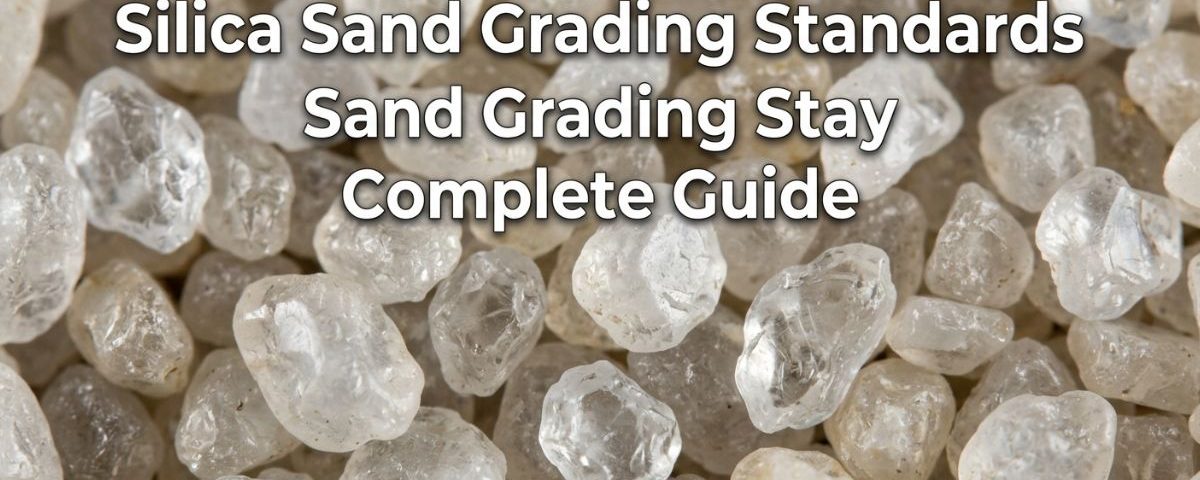
Silica sand goes by several names — industrial sand, quartz sand, white sand. They all describe the same thing: tiny grains of silicon dioxide (SiO₂) in crystalline quartz form. Pure sand, in other words.
Beach sand is a mix of quartz, broken shells, feldspar, and whatever the tide brought in. Industrial silica sand is a different product entirely. It’s been mined, washed, scrubbed, magnetically cleaned, and sieved to hit very specific purity and size targets.
Quick mental model: regular construction sand sits at 60–80% silica. Industrial silica sand starts at 95% and climbs to 99.99%+ for the ultra-pure grades that go into solar panels and semiconductor wafers. That extra purity is what you’re paying for. It’s also what determines whether your glass batch comes out clear or muddied with iron stains.
The “99% Pure” Number Is Doing Most of the Talking
When a supplier says “99.5% silica sand,” they mean 99.5% of the sand by weight is silicon dioxide. Fine. But the remaining 0.5% is where the trouble lives — and that’s the number worth asking about.
Impurities to watch:
- Iron oxide (Fe₂O₃) — public enemy number one for glass makers. Trace amounts produce yellow or green tints.
- Aluminium oxide (Al₂O₃) — affects how the sand behaves at high temperatures.
- Titanium dioxide (TiO₂) — gives glass an unwanted yellow cast.
- Calcium and magnesium oxides — change chemical durability of the finished product.
- Loss on ignition (LOI) — organic matter and moisture that burns off when you heat the sand.
A serious supplier hands you a Certificate of Analysis listing every one of these. If a CoA only shows SiO₂ and nothing else, that’s a red flag. They’re hiding something or they didn’t bother testing.
Natural vs Manufactured Silica Sand
There are two ways to make silica sand:
Natural silica sand is mined from sandstone or river deposits, then washed, scrubbed, and magnetically cleaned. About 95% of industrial buyers use this. It hits 99.0–99.7% purity at a reasonable price and works for foundry, glass, ceramics, and frac sand applications.
Manufactured silica sand is made by crushing pure quartz veins down to size. Purer (99.9%+) but significantly more expensive. Unless you’re making semiconductor wafers or solar-grade glass, you don’t need it. Don’t let a salesperson upsell you.
For most industrial use cases, natural processed silica is the right answer.
Why There Isn’t One Universal Grading Standard
Here’s where buyers get tripped up: there’s no single global rulebook for silica sand grading. Different industries built their own systems based on what mattered to them, and those systems all coexist today.
If you’re buying for a foundry, you’ll hear about AFS numbers. Glass plants obsess over purity percentages and iron limits. Frac sand buyers care about how grains hold up under pressure. They’re all called “silica sand grading standards,” but they measure entirely different things.
The major frameworks you’ll run into:
ASTM Standards (The American Reference)
The American Society for Testing and Materials publishes most of the testing methods used worldwide. The ones that matter for silica sand:
- ASTM C778 — standard sand for cement testing
- ASTM D1140 — measures fines (anything smaller than 75 microns)
- ASTM E11 — defines the wire mesh sieves used to grade particle size
- ASTM C136 — the standard sieve analysis procedure
ASTM mostly tells you how to test, not what the limits should be. You set the limits; ASTM gives you a consistent way to verify.
AFS Standards (The Foundry Reference)
If you’re in the foundry business, the American Foundry Society Grain Fineness Number system is your reference point. AFS GFN gives you a single number — usually between 25 (very coarse) and 180 (very fine) — describing the average particle size of a sand sample.
Most foundries specify sand in the AFS GFN 45–80 range. Steel foundries lean coarser (45–55). Aluminium foundries go finer (65–90). Investment casters need finer still (90–140).
API Standards (For Frac Sand Buyers)
Oil and gas buyers use the toughest specs in the industry. API RP 19C (and its international twin, ISO 13503-2) covers everything: crush resistance, grain shape, acid solubility, turbidity. Real talk — if your supplier can’t produce a current API test report, they aren’t selling you frac sand. They’re selling you regular silica sand and hoping you don’t catch on.
Indian and International Standards
If you’re sourcing or selling in India, the Bureau of Indian Standards publishes references like IS 1542 (sand for plaster) and IS 383 (aggregates). These work for construction-grade material but aren’t designed for high-purity industrial silica sand procurement.
Other standards that come up:
- EN 13139 — European aggregates
- DIN 1164 — German cement sand
- GB/T 32650 — Chinese high-purity quartz sand
- JIS R 5201 — Japanese cement testing sand
The Three Grades of Silica Sand (Pick the Right One)
Most suppliers organise their offerings into three tiers. Names vary, but the actual specs are pretty consistent across the industry.
Grade 1: The Premium Stuff
- SiO₂: 99.8% or higher
- Iron (Fe₂O₃): Below 0.010%
- Used for: Optical glass, solar panels, fibre optics, semiconductors, pharmaceutical glass
This is the high end — multi-stage washed, attrition-scrubbed, magnetically separated, sometimes acid-leached. Honest take: if you don’t need ultra-low iron or sub-ppm metal levels, don’t buy this. You’re throwing money away.
Grade 2: The Workhorse
- SiO₂: 99.3–99.7%
- Iron (Fe₂O₃): 0.015–0.030%
- Used for: Float glass, container glass, frac sand, fibreglass, premium foundry sand
This is what most glass plants and high-spec foundries actually buy. It’s the sweet spot of purity and price for serious industrial use.
Grade 3: The Industrial Standard
- SiO₂: 95.0–99.0%
- Iron (Fe₂O₃): Up to 0.30%
- Used for: General foundry, tile bodies, sandblasting, filtration media, sports turf, masonry
Cheaper, less processed, and perfectly fine when ultra-low iron isn’t required. Don’t pay Grade 1 prices when Grade 3 will do the job — that mistake happens more often than it should.
Quick Comparison Table
| What You Care About | Grade 1 | Grade 2 | Grade 3 |
|---|---|---|---|
| SiO₂ minimum | 99.8% | 99.3–99.7% | 95.0–99.0% |
| Max iron (Fe₂O₃) | 0.010% | 0.030% | 0.30% |
| Max alumina (Al₂O₃) | 0.20% | 0.50% | 2.00% |
| Moisture | ≤ 0.1% | ≤ 0.3% | ≤ 0.5% |
| Mesh range | 70–270 | 30–140 | 16–100 |
| Best for | Optical/electronics | Glass/frac sand | Foundry/construction |
The Six Specs You Should Always Check
A complete silica sand specification covers six dimensions. Skip even one and you’re handing the supplier room to interpret your needs in their favour.
1. Particle Size and Mesh
Particle size shows up two ways: US mesh number (like 30/50) or microns (like 300–600 µm). The relationship is fixed by ASTM E11.
| US Mesh | Microns | Common Use |
|---|---|---|
| 8 | 2,360 | Coarse filtration, sports turf |
| 16 | 1,180 | Filtration, masonry |
| 30 | 600 | Frac sand (20/40), coarse foundry |
| 50 | 300 | Glass batch, foundry sand |
| 70 | 212 | Fine glass, foundry cores |
| 100 | 150 | Precision casting |
| 140 | 106 | Investment casting |
| 200 | 75 | Fine ceramics |
A spec like “30/50 mesh, 90% retained” means at least 90% of the sand passes through a 30 mesh screen and stays on a 50 mesh screen. Anything outside that window is a quality issue.
2. Purity (SiO₂ Percentage)
Measured by X-ray fluorescence (XRF) or wet chemistry. Always ask for a CoA showing SiO₂ to two decimal places. “99% pure” without a number behind the dot is meaningless marketing.
3. Moisture Content
Moisture matters because it changes bulk density and throws off glass batch calculations.
- Oven-dried, bagged: ≤ 0.1%
- Air-dried, bulk: ≤ 0.5%
- Wet-shipped from washing plant: 3.0–6.0%
4. Iron Oxide and Other Impurities
For glass, iron is enemy number one. Typical caps:
- Optical glass: 0.010% max
- Flat and container glass: 0.030% max
- Coloured glass and fibreglass: 0.050% max
- Foundry and construction: 0.30% max
5. Grain Shape
Sphericity and roundness matter for some applications. Frac sand needs both ≥ 0.6 per API RP 19C. Foundry sand actually prefers slightly angular grains for better green strength. Glass plants prefer rounder grains for batch flow.
6. AFS GFN (Foundry Buyers Only)
If you’re buying for a foundry, AFS GFN is the single most important number on your spec sheet. It tells you the average particle size at a glance, and your supplier should hold it within ±2 numbers shipment to shipment.
What Matters in Your Specific Industry
Glass Industry
Glass plants live and die by purity. Standard specs:
- SiO₂: ≥ 99.5%
- Fe₂O₃: ≤ 0.030% (clear glass), ≤ 0.010% (optical)
- Al₂O₃: ≤ 0.5%
- Cr₂O₃: ≤ 0.0002% (chromium turns glass intensely green at trace levels)
- Particle size: 80% within 100–500 µm
Foundry Industry
Foundry sand grading is mostly about AFS GFN, plus a few support specs:
- Acid demand value: ≤ 6 mL HCl/50g
- AFS clay: ≤ 0.5%
- Permeability: 80–250 (depends on application)
- Refractoriness: sintering point ≥ 1,500°C
If foundry sand is your application, work with a trusted silica sand supplier in India who can hold AFS GFN consistently across deliveries.
Oil and Gas (Frac Sand Specifications)
API RP 19C / ISO 13503-2 are the toughest specs in the industry:
- Crush resistance at 4K, 6K, 8K, 10K, 14K psi — fines must stay under 10%
- Sphericity and roundness — both ≥ 0.6
- Acid solubility — ≤ 2.0%
- Turbidity — ≤ 250 FTU
- Common mesh sizes: 20/40, 30/50, 40/70, 100 mesh
Construction and Concrete
For mortar and architectural concrete, IS 383, EN 13139, and ASTM C144 apply:
- SiO₂: ≥ 95%
- Particle size graded across 8 to 200 mesh
- Clay/silt: ≤ 3%
Ceramics and Tiles
- SiO₂: ≥ 98%
- Fe₂O₃: ≤ 0.10% (white body), ≤ 0.50% (red body)
- Particle size: 200–325 mesh for body, 80–120 for glaze frit
Electronics and Semiconductors
A different category entirely:
- SiO₂: ≥ 99.99%
- Total metallic impurities: ≤ 20 ppm
- Each of Fe, Al, Ti, Na, K: ≤ 5 ppm
You won’t get this from natural sand alone — it requires specialised processing, and the vast majority of buyers will never need it.
How to Verify Quality (Don’t Just Take the Supplier’s Word)
A reputable supplier welcomes independent verification. That’s actually how you separate the serious vendors from the rest.
Sieve Analysis
Per ASTM C136, a 100g sample gets shaken through a stack of certified sieves for 15 minutes. The percentage retained on each sieve is reported. From that, you calculate AFS GFN, D50, and D90.
Chemical Testing
XRF is the standard for routine purity testing — fast, accurate to 0.01%. For trace metals at ppm levels, you need ICP-MS.
A real chemical analysis report lists SiO₂, Al₂O₃, Fe₂O₃, TiO₂, CaO, MgO, Na₂O, K₂O, and LOI. The total should sum to 100% ± 0.5%. If it doesn’t, something’s missing — either the lab made an error, or the report isn’t telling you the full story.
Certifications to Demand
Before placing a first order, get:
- Certificate of Analysis for the specific lot, dated within 30 days
- Mill Test Certificate with process flow and source deposit
- ISO 9001:2015 quality management certification
- API certification (if frac sand) — verify the license number on API’s website
- MSDS / SDS per GHS standards
- Independent third-party report — especially for high-value orders
Silica Sand vs Frac Sand: What’s Actually Different?
Quick answer: frac sand is silica sand. It’s silica sand that has passed API RP 19C testing. All frac sand is silica sand, but not all silica sand qualifies as frac sand.
That extra testing (crush, sphericity, turbidity) costs money. Frac sand carries a 30–80% premium over standard silica. Don’t pay for it if your application is glass or foundry — you’re funding tests you don’t need.
Writing a Specification That Protects You
A clear written spec protects both buyer and supplier. Four-step approach:
Step 1: Identify your application. “Foundry” isn’t enough. Specify green sand, no-bake, shell, or investment casting. The application tells you which standard applies.
Step 2: Pick your grade. Match your application to Grade 1, 2, or 3. If you’re not sure, request samples of two adjacent grades and trial them in your process. Don’t guess — trial.
Step 3: Define particle size. State the mesh range and minimum percentage retained. Example: “AFS 50/100, minimum 92% retained between 30 and 140 mesh.”
Step 4: Set purity limits. Minimum SiO₂, maximum Fe₂O₃, Al₂O₃, TiO₂, LOI. Add moisture and any application-specific tests.
A complete spec sheet should include: buyer/supplier names, contract number, material grade, all chemistry limits, particle size distribution, AFS GFN range (if foundry), moisture cap, packaging, delivery terms, and acceptance/rejection criteria.
Sourcing and Ordering: Practical Tips
Finding Good Suppliers
Shortlist suppliers with ISO 9001 plus the application-specific certs that match your industry. Then verify certificate numbers on the issuing body’s online registry. Counterfeit certificates show up in commodity sand markets more often than buyers realise.
Sample First, Order Later. Always.
Always request a 5–10 kg sample with a CoA before placing a bulk order. Send the sample to an independent lab if order value justifies it. If you see meaningful discrepancies between supplier CoA and independent test results, walk away. Don’t argue. Just walk.
Pricing Reality
Silica sand is sold by the metric ton, with significant price breaks at 100 MT, 500 MT, and 1,000+ MT volumes. Bagged premium grades cost more than bulk shipments. For volumes above 5,000 MT/year, annual contracts with quarterly price reviews are standard.
Order Terms
- Incoterms: FOB, CFR, or CIF
- Lead time: 15–30 days standard; 45–60 days for custom gradations
- Packaging: Bulk vessel, 1 MT jumbo bags, or 25/50 kg PP bags
- Payment: 30% advance + 70% against documents, or LC at sight for new buyers
A complete shipment should arrive with: commercial invoice, packing list, lot-specific CoA, certificate of origin, bill of lading, and (for first orders) a third-party inspection report.
Working With Pratibha Refractory
Pratibha Refractory operates an integrated silica sand processing facility with capabilities across all three grades discussed in this guide:
- Foundry-grade silica: AFS GFN 45–110
- Glass-grade silica: Fe₂O₃ < 0.030% for container and flat glass
- High-purity grades: SiO₂ ≥ 99.7% for premium applications
- Custom gradations built to your spec
Every shipment includes a lot-specific CoA backed by our quality management system. Independent third-party verification can be arranged on request.
For new buyers, we provide an evaluation sample with full chemical and physical analysis against shipping costs. Annual contracts include periodic third-party verification and a guaranteed specification window.
Want to talk through your application before buying anything? Our process engineers will help you settle on a spec that delivers performance without overspending on purity you don’t need.
Ready to Move Forward?
- Request a free sample and test report for your specific application
- Get a custom quote based on grade, volume, and delivery
- Talk to a technical specialist about your process
Frequently Asked Questions
What’s the difference between silica sand and quartz sand? The terms get used interchangeably. Both refer to granular SiO₂ in crystalline quartz form. “Quartz sand” is sometimes reserved for higher-purity grades (≥ 99.5% SiO₂), but there’s no formal standards-based distinction.
What grade of silica sand is used for glass manufacturing? Container and float glass typically use Grade 2 silica sand: SiO₂ ≥ 99.5%, Fe₂O₃ ≤ 0.030%, particle size 100–500 µm. Optical glass needs Grade 1 with Fe₂O₃ ≤ 0.010%.
How is AFS Grain Fineness Number calculated? It’s a weighted average of sieve retention values. Each sieve gets a multiplier; you multiply the percent retained by the factor, sum it all up, and divide by total retained percentage. AFS publication 1105 has the full procedure.
Is silica sand the same as frac sand? Frac sand is a sub-class of silica sand that has passed API RP 19C / ISO 13503-2 testing. All frac sand is silica sand, but not all silica sand qualifies as frac sand.
How do I verify silica sand purity? Request an XRF chemical analysis on the specific lot, ideally backed by independent testing. The CoA should show SiO₂ to two decimal places and list every major oxide and LOI summing to ~100%.
Can I buy silica sand wholesale or in bulk? Yes. Most industrial silica sand is sold by the metric ton, with price breaks at 100 MT, 500 MT, and 1,000+ MT volumes. Annual contracts with periodic price reviews are standard for ongoing requirements above 5,000 MT/year.
This guide is published for educational purposes by Pratibha Refractory. Specifications referenced are accurate as of April 2026; standards bodies update specifications periodically, so verify the latest revisions before issuing purchase orders.