

- Call for Sales Enquiries

- +91-9413034047
- +91-294-2413244
- info@pratibharefractory.com

How Indonesian Importers Buy Talc Powder from India: A Complete 2026 Guide

Silica Sand Grading Standards: What Buyers Actually Need to Know Before Signing a PO
April 29, 2026
Soapstone Lumps & Talc Powder for Bangladesh: Land Border vs Sea Routes
May 19, 2026How Indonesian Importers Buy Talc Powder from India: A Complete 2026 Guide
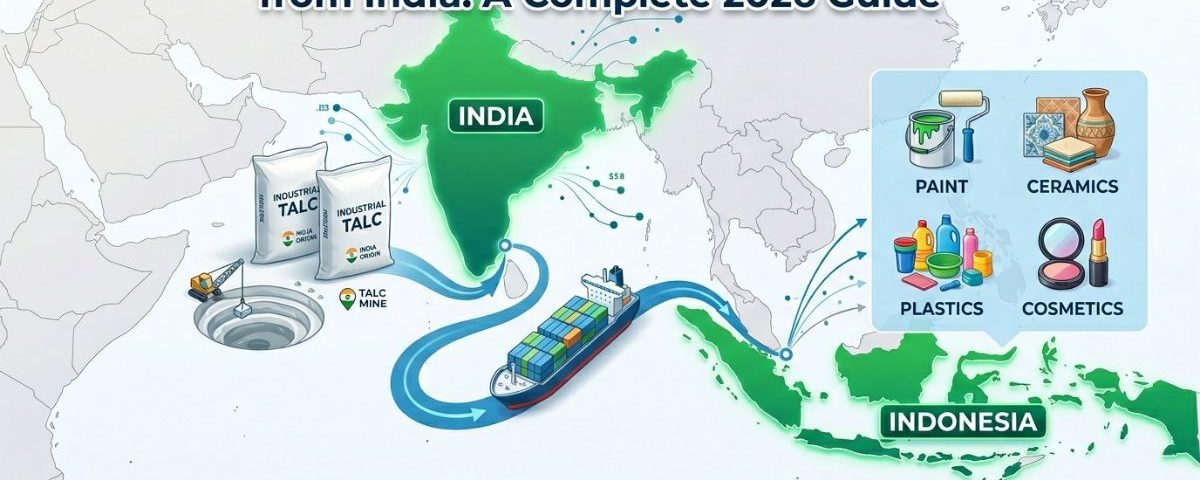
Indonesia’s paint and ceramic industries have been on a tear. Java added nearly 8 million square meters of new tile capacity over the past 18 months, and architectural paint demand keeps climbing alongside the construction boom around Jakarta and Surabaya. Talc powder sits quietly inside both of these industries, doing work that nobody talks about until something goes wrong.
That something usually goes wrong on the first import order from India.
The talc itself is rarely the problem. The problem is that Indonesian buyers walk into Indian sourcing without understanding how the trade actually works. They send vague inquiries, accept the cheapest quote, skip sample testing, and lose 30,000 dollars when their first container arrives with mesh distribution off spec or Fe₂O₃ levels that yellow their light coloured paints.
This guide is for the procurement managers, paint technologists, and factory owners who have decided to source from India and want to do it right the first time. It covers grade selection, supplier verification, shipping, documentation, and the specific mistakes that cost Indonesian importers money. The information here comes from 31 years of running an Indian mineral export business, including regular shipments to Jakarta, Surabaya, and Medan since 2018.
Why Indian Talc Makes Commercial Sense for Indonesian Buyers
The choice between Indian and Chinese talc usually comes down to four things. Price gets discussed first, but it is rarely the deciding factor for serious buyers.
Chinese mining restrictions in Liaoning and Guangxi provinces have pushed costs up steadily since 2022. Indian deposits in Rajasthan and parts of Uttarakhand have stayed stable on supply, which means Indian quotes have been more predictable. The price gap is real, but it varies by grade. Cosmetic grade talc shows the smallest gap; paint and plastic grades show the widest.
The bigger advantage is iron content. Indian talc deposits are naturally low in Fe₂O₃, which matters more than most first-time buyers realize. A talc that looks bright white in the bag can still carry enough iron to yellow a light grey paint or off white ceramic glaze. Indian manufacturers consistently deliver Fe₂O₃ below 0.5 percent for paint grade and below 0.3 percent for cosmetic grade, with COA documentation for each batch.
Then there is the duty question. India and Indonesia are both signatories to the ASEAN India Free Trade Agreement, which means talc imports under HS Code 2526.20 qualify for preferential duty rates. But this benefit is gated behind a single document called Form AI, issued by APEDA in India. Without it, you pay the full MFN rate. We will come back to this because missing Form AI is the most expensive mistake first time importers make.
Finally, shipping. Mundra Port to Tanjung Priok runs 12 to 14 days on direct CMA CGM and Maersk services, which is faster than most Shanghai or Qingdao routings to Jakarta. Less transshipment also means less risk of containers getting stuck in Singapore or Port Klang.
The four Indonesian industries buying Indian talc
Talc is not one product. The grade your factory needs depends entirely on what you are making, and getting this match wrong is the most common reason first orders fail at quality control.
Paint manufacturers dominate Indonesian talc imports, particularly companies serving the marine, architectural, and decorative segments. The standard requirement here is 500 to 800 mesh, brightness above 92 percent, and Fe₂O₃ below 0.5 percent. Marine paint and light coloured architectural paint manufacturers tighten this further to Fe₂O₃ below 0.4 percent because even subtle iron contamination shows up as yellowing on white walls and ship hulls.
Ceramic tile factories are the second largest segment, concentrated in the Java cluster around Jakarta and the Surabaya belt. Tile bodies and glazes typically use 200 to 400 mesh talc with brightness 88 plus and consistent LOI values. The expansion of Indonesian tile capacity over the past two years, partly driven by Chinese export restrictions and anti dumping cases in third party markets, has pushed talc demand from this sector noticeably.
Plastic compounders run on finer talc, usually 1500 to 2500 mesh. The plate like crystal structure of fine talc improves stiffness and dimensional stability in injection moulded parts, which is why Indonesian automotive component suppliers and packaging producers use it heavily. PP and PE compounding factories in the Jakarta and Surabaya industrial estates are the main buyers here.
Cosmetic OEMs working on local Indonesian brands and export contracts need cosmetic grade talc at 2500 mesh and finer. The specification bar is highest here: brightness 95 plus, Fe₂O₃ below 0.3 percent, US FDA approval, asbestos free certification, and BPOM compliance documentation. The BPOM registration process is the real gatekeeper for this segment, so confirm your supplier provides complete documentation before you commit to an order.
Specifying talc properly
Most quality disputes start with vague specifications. “High quality talc” or “premium grade” tells your supplier nothing. The table below covers the practical specifications Indonesian buyers should send with every inquiry.
| Grade | Mesh | Brightness | Fe₂O₃ Max | Application |
|---|---|---|---|---|
| Paint | 500 to 800 | 92 plus | 0.5 percent | Decorative, marine, architectural |
| Ceramic | 200 to 400 | 88 plus | 0.6 percent | Tile bodies, glazes, sanitaryware |
| Plastic Filler | 1500 to 2500 | 90 plus | 0.4 percent | PP and PE compounding |
| Cosmetic | 2500 plus | 95 plus | 0.3 percent | Personal care, FDA grade |
| Pharmaceutical | 2500 plus | 96 plus | 0.2 percent | USP and EP grade |
Beyond these core parameters, mention LOI tolerance, oil absorption requirements, and any application detail that affects performance. A paint manufacturer producing marine coatings needs to know more than a tile factory. The more specific your inquiry, the faster you get to a useful quote.
Free download: Talc Grade Selection Guide for Indonesian Buyers. One page reference matching paint, ceramic, plastic, and cosmetic applications with the right specifications.
Supplier verification, done properly
This section is the most important part of the guide. Skip it and you risk your money. Most importers who get burned skip verification because the supplier price quote looks too good to walk away from. That is exactly the supplier you should walk away from.
Start with documents. Ask for the supplier’s IEC code, GST number, APEDA membership, and FIEO membership. These are government issued credentials, and you can cross check them on official websites within ten minutes. Genuine manufacturers send these without hesitation. If a supplier sends screenshots without numbers, makes excuses, or offers to “share details after the order is confirmed,” walk away. You have already learned what you needed to know.
The next step is documentation specific to the product. Request the technical data sheet for the grade you want, a Certificate of Analysis from a recent shipment, and the Material Safety Data Sheet. A real manufacturer has these ready. Traders pretending to be manufacturers send generic templates that look professional but contain no batch-specific data. Look for COAs that name a batch number, production date, and tested values for that specific batch.
Sample testing is non-negotiable. Order a 500-gram sample of the exact grade you intend to import. Most established Indian manufacturers ship samples free, charging only the courier cost of 35 to 65 USD via DHL or FedEx. Test it at a certified Indonesian lab against the same specifications listed in the TDS. If the sample matches within tolerance, you have validated the supplier technically. If it does not, you have saved yourself from a far more expensive lesson.
Then there is the factory question. Ask for a video factory tour. Genuine Indian manufacturers will walk you through their grinding mill, packaging line, and quality control lab on a video call without much fuss. If a supplier refuses or keeps postponing, treat it as a near-certain sign that they are a trader without their own production. The same applies if the photos they send do not match the address listed in their GST and IEC documents.
Finally, ask for two trade references from Southeast Asia. Genuine suppliers share these with permission from their existing buyers. A five minute phone call to a Vietnamese or Thai customer reveals more than fifty email exchanges. Ask about quality consistency, on time delivery, and how the supplier handled disputes. The way a supplier handles a problem matters more than the way they quote a price.
Shipping, in actual numbers
Most Indian talc shipments to Indonesia move through one of three routes. Mundra to Tanjung Priok is the workhorse, taking 12 to 14 days on direct services. This is the route most established Indian suppliers use because Mundra has the container handling capacity and direct connections that Indonesian destination ports need.
Mundra to Tanjung Perak takes 14 to 16 days, usually with one transshipment in Singapore or Port Klang for most carriers. Direct services exist but require booking. East Java buyers prefer this route to save on inland delivery costs.
JNPT to Belawan handles Sumatra-bound shipments in 13 to 15 days, with fewer direct services and more transshipment risk. Buyers in Medan should book at least two weeks in advance.
For all routes, the standard load is 18 metric tons in one 20-foot FCL container. Production and loading at the Indian end take 3 to 5 days after order confirmation. Indonesian customs clearance and inland delivery from the port to your warehouse takes another 5 to 7 days.
So your realistic order to warehouse timeline is 25 to 30 days. Build this into your inventory planning, especially if you are running tight production schedules or working against firm delivery commitments to your downstream customers.
CFR Jakarta versus FOB Mundra
This is one of the questions first-time Indonesian importers ask most often, and the answer is more nuanced than a simple recommendation.
Under FOB Mundra, your Indian supplier delivers the talc to Mundra Port and loads it onto your nominated vessel. From that moment, you handle ocean freight, insurance, and customs. The risk transfers to you the moment the cargo crosses the ship’s rail.
Under CFR Jakarta, the supplier handles everything up to delivery at Tanjung Priok. They book the freight, pay shipping, and provide all documentation. Risk transfers to you at the destination port.
The cost comparison depends on volume and your existing relationships. For an 18 MT FCL of paint-grade talc, ocean freight from Mundra to Tanjung Priok currently sits between 1,200 and 1,800 USD, depending on season and carrier. If you have an Indian side freight forwarder who can negotiate below this range, FOB saves you money. If you do not, CFR is simpler and the supplier’s freight rate is usually competitive.
The honest recommendation is this. First time importers and mid-sized buyers should use CFR. The coordination is simpler, the supplier handles documentation, and the freight cost is predictable. Larger buyers running monthly shipments should move to FOB once they have an established freight forwarder relationship in India, because the cumulative savings add up.
Get a CFR Jakarta quote in 24 hours. Send your specifications, quantity, and destination port. We will send a detailed quote with duty calculation under ASEAN India FTA.
Documentation that actually matters
Missing or incorrect documentation is the second biggest reason for delays at Tanjung Priok and Tanjung Perak. Before your supplier sends the original Bill of Lading, confirm you have all of these.
The Commercial Invoice should carry the full HS code 2526.20, unit price, total quantity, and Incoterm. The Packing List shows number of bags, weight per bag, gross and net weight, and container number. The Bill of Lading itself comes as one original and three copies; the original is what you need at the Indonesian port for cargo release.
The Certificate of Origin from APEDA confirms the goods are of Indian origin. Form AI is the document that unlocks ASEAN India FTA preferential duty, and missing it costs you the duty benefit. The Certificate of Analysis from the manufacturer should show actual specifications for your shipment batch, not generic numbers from a template.
The Material Safety Data Sheet is required for customs clearance and for warehouse storage compliance. For cosmetic grade talc, BPOM compliance certification is mandatory before the product can enter Indonesian cosmetic manufacturing. A Phytosanitary Certificate is sometimes requested when wooden pallets are used, and an Insurance Certificate is required for CIF or CIP shipments.
The two documents that cause the most trouble for Indonesian importers are Form AI and HS code classification. Errors in either trigger customs queries that delay clearance by 7 to 14 days, sometimes more. A good Indian supplier checks documents twice before dispatching the original BL through DHL or FedEx.
Five mistakes that cost Indonesian importers money
After three decades of exporting industrial minerals, the patterns are predictable. These five mistakes account for almost every quality dispute and shipment delay we see.
Choosing supplier on price alone. The cheapest quote is almost always the worst quality. A 5 percent saving on talc cost is meaningless if your paint factory rejects the shipment because of inconsistent mesh distribution. The cost of one rejected container, including demurrage, return shipping, and production downtime, wipes out a year of price savings.
Skipping sample testing. Some buyers order directly from the TDS without testing a sample. The TDS shows what the supplier can produce in ideal batches; your shipment may vary. Always test at an Indonesian certified lab against the same parameters the TDS lists. This single step prevents most quality disputes.
Not specifying Fe₂O₃ tolerance. First time buyers ask for “white talc” without specifying maximum Fe₂O₃, and receive talc that meets visual whiteness but fails in light coloured paint applications. Iron content tolerance must be in your inquiry, especially for paint and cosmetic grades.
Missing Form AI. This is the single most expensive mistake. Without Form AI, your shipment does not qualify for ASEAN India FTA preferential duty, and you pay the full MFN rate. The financial impact compounds across multiple shipments. Confirm Form AI will be provided before order finalization, every time.
Trusting traders pretending to be manufacturers. Indian B2B portals are full of traders who present themselves as manufacturers. They source from real factories at higher prices, add their margin, and sell to Indonesian buyers. The result is higher cost, no factory accountability, and quality variations between shipments. Verify factory ownership through video tour, GST address verification, and trade references before placing your order.
Request a free 500g sample. We send free samples of any talc grade to verified Indonesian businesses. You pay only the courier charge of 35 to 65 USD. Sample comes with full TDS and COA.
Frequently Asked Questions
What is the best talc powder supplier for Indonesian importers?
There is no single best supplier. The right choice depends on your industry, required mesh size, and order volume. A reliable Indian talc supplier should hold ISO 9001 certification, US FDA approval if you handle cosmetic or pharma grade, and REACH compliance if you re export to European markets. They should be a direct manufacturer with verifiable IEC code, GST number, and APEDA membership. Pratibha Refractory Minerals has been exporting industrial minerals since 1993, with regular talc shipments to Jakarta, Surabaya, and Medan.
How long does a shipment of talc powder take from India to Jakarta?
From Mundra Port to Tanjung Priok, transit time is 12 to 14 days on direct services. Add 3 to 5 days for production and loading at the Indian end, plus 5 to 7 days for Indonesian customs clearance and inland delivery. Total time from order confirmation to warehouse delivery is 25 to 30 days. Surabaya via Tanjung Perak takes 14 to 16 days; Medan via Belawan takes 13 to 15 days from JNPT.
What is the MOQ for talc powder import to Indonesia?
Most Indian manufacturers set MOQ at 18 metric tons, which fills one 20 foot FCL container. For first-time buyers wanting to verify quality before scaling, some suppliers offer trial orders of 5 MT through LCL, though the per-ton cost is 25 to 35 percent higher. Established buyers in the paint and ceramic industries typically order 36 MT or 54 MT per shipment to optimize freight cost. Below 5 MT monthly, working through a local Indonesian distributor is more economical.
Which talc grade is used in Indonesian paint manufacturing?
Indonesian paint manufacturers use 500 to 800 mesh talc with brightness above 92 percent and Fe₂O₃ below 0.5 percent. Coarser talc at 300 to 500 mesh is used in primers and undercoats; finer talc at 800 mesh and above goes into topcoats and emulsion paints where surface smoothness matters. Marine and light coloured architectural paints require Fe₂O₃ below 0.4 percent to prevent yellowing. Look for whiteness above 95 percent and oil absorption between 28 to 32 g per 100g.
How to verify an Indian talc supplier before placing the first order?
Ask for IEC code, GST number, APEDA and FIEO memberships, and cross-check on government websites. Request the technical data sheet, COA from a recent shipment, and MSDS. Get a 500-gram free sample and test at a certified Indonesian lab against TDS specifications. Ask for two trade references from Southeast Asian buyers and call them directly. Finally, do a video factory tour where the supplier walks through their grinding mill, packaging line, and QC lab. Genuine manufacturers welcome this; traders avoid it.
Apa HS code untuk talc powder import ke Indonesia?
Talc powder import ke Indonesia menggunakan HS Code 2526.20. Pastikan kode ini tercantum dengan benar di Commercial Invoice dari supplier India Anda. Kesalahan klasifikasi HS Code adalah salah satu penyebab utama keterlambatan customs clearance di Tanjung Priok dan Tanjung Perak. Selain HS Code, pastikan juga Form AI tersedia untuk mendapatkan tarif bea masuk preferensial.
What is the duty on talc powder imported from India to Indonesia?
Indonesia and India are members of the ASEAN-India Free Trade Agreement, which allows preferential duty on talc imports under HS Code 2526.20. To claim the AIFTA preferential rate, you must have a Form AI issued by APEDA. Without Form AI, you pay the full MFN duty. Indonesian importers also pay VAT (PPN) at 11 percent on CIF value plus duty, plus Income Tax PPh 22 (typically 2.5 percent for established importers with an API license). Confirm current rates with a Bea Cukai-approved customs broker.
Can Indonesian buyers get free talc samples from Indian suppliers?
Yes, most established Indian talc manufacturers provide free 500-gram samples to verified business buyers. The buyer pays only the courier charge of 35 to 65 USD via DHL or FedEx. Delivery to Jakarta, Surabaya, or Medan takes 5 to 7 days. Suppliers usually ask for company name, business address, intended application, and required specifications before sending. Reliable manufacturers send TDS, COA, and MSDS along with the sample.
Conclusion
Sourcing talc from India is straightforward once you know what to look for. Match the right grade to your industry, specify Fe₂O₃ tolerance and mesh distribution clearly, verify your supplier through documents and a factory video tour, and confirm Form AI before every order. These five steps prevent most of the problems Indonesian importers face on their first shipments.
The Indian talc industry is mature, with reliable manufacturers shipping to Indonesia for over two decades. The challenge is separating direct manufacturers from traders, and matching the right specifications to your application. Once you have done this once, the second and third orders become routine.
Pratibha Refractory Minerals has been manufacturing and exporting industrial minerals since 1993, with regular talc shipments to Indonesian paint, ceramic, plastic, and cosmetic industries. Our facility in Udaipur holds ISO 9001:2015, US FDA, REACH, Halal, and Kosher certifications. We provide complete documentation including Form AI, COA, and MSDS for every shipment, and we send free 500 gram samples to verified Indonesian buyers.
If you are evaluating Indian talc suppliers for your next order, send your specifications and we will respond within 24 hours with a CFR Jakarta quote, complete TDS, and sample dispatch confirmation.
About the Author
Mohit Lakhani is the Director of Pratibha Refractory Minerals, a 31-year-old industrial mineral manufacturer based in Udaipur, Rajasthan. Pratibha has been supplying talc, dolomite, quartz, and kaolin to buyers across Indonesia, Vietnam, Bangladesh, Turkey, and other markets since 1993. Connect on LinkedIn for technical inquiries or supplier verification calls.