

- Call for Sales Enquiries

- +91-9413034047
- +91-294-2413244
- info@pratibharefractory.com

Best Talc Powder Supplier for the Plastic Industry

Quartz Powder Manufacturer UAE: A Sourcing Guide for Buyers
September 8, 2026Best Talc Powder Supplier for the Plastic Industry
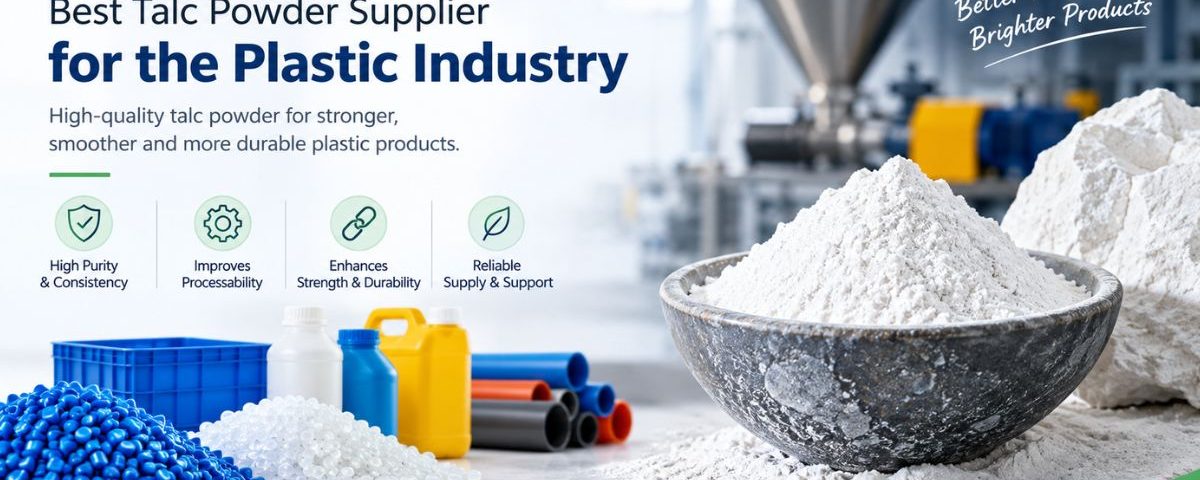
A talc powder supplier is suitable for the plastic industry when it can consistently deliver the particle size, purity, whiteness, moisture control, and dispersion behaviour a specific polymer application needs and back that consistency with reliable batch-to-batch supply. For plastic manufacturers, “best” is not a fixed label; it depends on how well a supplier’s material matches the polymer, the processing method, and the end-product requirements, and how reliably that match holds up across repeat orders.
This matters because talc is one of the most widely used mineral fillers in plastics, and small variations in particle size or moisture can change how a batch processes on the line. Buyers who evaluate suppliers against clear technical and supply criteria – rather than marketing claims – are better positioned to avoid processing surprises and maintain product quality across production runs.
This guide walks through what talc powder is, why it is used in plastics, how to evaluate particle size and quality parameters, what to ask a supplier before ordering, and how Pratibha Refractory Minerals fits into that sourcing picture as an Indian industrial minerals supplier.
What Is Talc Powder and Why Is It Used in Plastics?
Talc is a naturally occurring hydrated magnesium silicate mineral, mined and processed into fine powder for use as a functional filler across plastics, paints, rubber, paper, and other industrial applications. In its powdered form – sometimes referred to as soapstone powder depending on the source rock – talc is valued for its platy (flat, layered) particle structure, softness, and chemical inertness.
In plastics specifically, talc is used as a mineral filler that is blended into a polymer matrix, typically polypropylene, to modify the material’s mechanical and processing characteristics. Because talc particles are platy rather than spherical, they tend to align during processing, which can influence properties like stiffness and dimensional stability differently than round-particle fillers such as calcium carbonate.
The degree to which talc changes a given plastic’s behaviour depends on the grade selected, the particle size and distribution, the loading level (how much talc is used relative to the polymer), and how well the talc is dispersed during compounding.
Why Do Plastic Manufacturers Add Talc Powder?
Plastic manufacturers add talc powder to modify how a polymer performs and processes, not simply to reduce cost. Common reasons include:
- Stiffness – talc reinforcement can increase the flexural modulus of a polymer, which is useful where a part needs to hold its shape under load.
- Dimensional stability – talc can help reduce warpage and improve dimensional consistency in moulded parts, particularly relevant for parts with tight tolerances.
- Heat resistance – talc-filled compounds can show improved heat deflection temperature compared to unfilled polymer, depending on the grade and loading.
- Processing behaviour – talc can affect melt flow, cycle time, and mould filling, so processors often adjust machine settings when introducing or changing a talc grade.
- Shrinkage control – talc loading is commonly used to manage shrinkage in injection-moulded parts, which supports dimensional consistency between cavities and shots.
- Surface characteristics – particle size and dispersion quality influence surface finish, especially in appearance-critical parts.
- Cost optimisation where technically appropriate – talc can be a cost-effective filler, but this should follow from a technical fit assessment, not replace one.
Every one of these effects depends on the specific polymer, the formulation, the talc grade, the loading level, and the processing method used. A talc grade that improves stiffness in one PP formulation will not automatically deliver the same result in a different polymer system or process – which is why supplier and buyer typically need to discuss the target application directly rather than rely on generic claims.
Which Plastics Use Talc Powder?
Talc is used across a range of polymer systems and end products, most commonly:
- Polypropylene (PP) – by far the most common talc application in plastics, spanning automotive, appliance, and packaging-grade compounds.
- Engineering plastics – talc is used in select engineering polymer systems where technically appropriate, though loading and grade selection differ from PP applications.
- Automotive plastic components – bumpers, interior trim, and under-the-bonnet parts often use talc-filled PP for stiffness and heat resistance.
- Household appliances – talc-filled compounds are used in appliance housings and components where dimensional stability matters.
- Packaging-related applications – certain rigid packaging formats use talc for stiffness and processing benefits.
- Injection-moulded components – talc is widely used in injection moulding across industries for shrinkage control and stiffness.
- Consumer plastic products – general consumer goods that need a balance of stiffness, cost, and processability.
Not every talc grade works across all of these applications equally. A grade suited to automotive-grade PP compounding may not be the right choice for a different polymer system or processing route, which is why application-specific evaluation matters more than a single “best for plastics” label.
What Type of Talc Powder Is Suitable for Plastic Manufacturing?
Selecting the right talc powder for a plastics application generally comes down to evaluating the material against the following characteristics:
- Particle size – finer particle sizes generally disperse more easily and can support better surface finish, while coarser grades may suit different cost or reinforcement targets.
- Particle-size distribution – a controlled, consistent distribution supports predictable processing and mechanical properties batch to batch.
- Purity – mineral purity affects consistency of performance and reduces the risk of unwanted formulation interactions.
- Whiteness – relevant mainly for appearance-sensitive or light-coloured plastic products.
- Moisture – excess moisture can cause processing issues such as splay or inconsistent melt behaviour, so moisture control matters at the point of supply.
- Dispersion – how readily the talc breaks down and distributes through the polymer melt during compounding.
- Mineral composition – the presence of associated minerals in the talc can influence performance and should be understood for the intended application.
- Surface characteristics – particle shape and surface texture affect how the talc interacts with the polymer matrix.
- Application-specific requirements – ultimately, the “right” talc is the one matched to the specific polymer, process, and end-use requirement, established through technical discussion and, where appropriate, trial testing.
Because these parameters interact, buyers are generally better served requesting a specification sheet and sample for their own process trial rather than relying on a single headline number.
How to Choose a Talc Powder Supplier for the Plastic Industry
A practical evaluation checklist for procurement and technical teams:
- Product consistency – does the supplier maintain consistent quality across repeat production runs, not just in a single sample?
- Technical specifications – can the supplier provide clear documentation on particle size, purity, and other relevant parameters?
- Particle-size control – does the supplier demonstrate control over particle size and distribution for the grades relevant to your application?
- Quality testing – what quality checks does the supplier apply before dispatch, and can these be discussed or verified?
- Application suitability – is the supplier able to discuss which grade suits your specific polymer and process, rather than offering a single generic product?
- Sample availability – can you obtain a sample for internal trial before committing to bulk quantities?
- Production capacity – can the supplier support your required order volumes and repeat orders reliably?
- Packaging – does the supplier offer packaging suited to your handling, storage, and shipping requirements?
- Lead time – are quoted lead times realistic and consistently met?
- Export capability – for international buyers, does the supplier have experience with export documentation and logistics?
- Documentation – can the supplier provide the paperwork (specification sheets, packing lists, certificates of origin, etc.) your procurement process requires?
- Communication and technical support – is the supplier responsive and able to support technical questions during evaluation and after order placement?
Talc Powder for PP: What Should Buyers Consider?
Polypropylene is the most common polymer paired with talc, but that does not make grade selection automatic. Buyers sourcing talc powder for PP applications typically need to consider:
- Talc particle size – finer particles generally support better dispersion and surface finish in PP compounds, while coarser particles may be used where cost or specific reinforcement targets are the priority.
- Dispersion – how well the talc disperses in the PP melt during compounding directly affects the consistency of the final part’s mechanical properties.
- Loading level – the percentage of talc used relative to the PP resin, which is determined by the formulator based on the target property profile.
- Stiffness – the level of stiffness improvement depends on grade, particle size, and loading, not on talc alone.
- Impact performance – increasing talc loading for stiffness can trade off against impact resistance, so formulators typically balance these properties together.
- Processing conditions – talc-filled PP may process differently from unfilled PP, and processors often adjust settings when introducing a new grade.
- Dimensional stability – a key reason talc is used in PP, particularly for parts with tight tolerance requirements.
This is an area where formulation expertise sits with the compounder or moulder, while the supplier’s role is to provide a consistent, well-documented raw material that supports the formulator’s targets. Buyers should discuss their specific PP grade and application with the supplier rather than assume one talc grade fits every PP use case.
Talc Powder Particle Size for Plastics
Particle size and particle-size distribution are among the most important factors in talc’s performance as a plastics filler, because they directly influence dispersion, surface finish, and mechanical property outcomes. Finer, more consistently distributed particles generally disperse more evenly through the polymer melt, which supports smoother surfaces and more predictable mechanical behaviour.
There is no single “correct” micron specification for talc in plastics – the appropriate particle size depends on:
- The polymer being used
- The end product and its performance requirements
- The processing method (injection moulding, extrusion, etc.)
- The required mechanical properties (stiffness, impact resistance, and so on)
- Surface finish expectations
- Dispersion requirements specific to the compounding process
Because of this variability, buyers should request the specific particle-size data relevant to their application directly from the supplier and, where possible, validate it against their own process through sample trials rather than relying on general industry figures.
Talc Powder Quality Parameters Buyers Should Check
| Parameter | Why It Matters in Plastics |
| Particle size | Dispersion and formulation behaviour |
| Particle-size distribution | Batch consistency and processing |
| Purity | Performance and formulation consistency |
| Moisture | Processing and product quality |
| Whiteness | Appearance-sensitive applications |
| Mineral composition | Application suitability |
| Bulk density | Handling and formulation considerations |
| Batch consistency | Repeatable production |
Exact acceptance limits for each of these parameters should be agreed between buyer and supplier based on the specific application, polymer system, and processing method – there is no universal threshold that applies across every plastic product.
How Talc Powder Can Affect Plastic Performance
Talc’s influence on a finished plastic part spans several interrelated properties:
- Stiffness – talc reinforcement typically increases flexural modulus, subject to grade and loading.
- Dimensional stability – talc can help parts hold their shape and tolerances more consistently through the moulding cycle.
- Shrinkage – talc loading is commonly used to manage and reduce shrinkage variation in moulded parts.
- Heat resistance – talc-filled compounds can show improved heat deflection behaviour, depending on formulation.
- Surface finish – influenced heavily by particle size and dispersion quality.
- Processing – talc can change melt flow characteristics and cycle times, requiring process adjustment.
- Weight – talc loading changes part density, which formulators account for in design.
- Impact properties – often trades off against stiffness gains and needs to be balanced at the formulation stage.
An important caveat for buyers: higher talc loading does not automatically mean better performance. Beyond a certain point, increased loading can reduce impact resistance, change processing behaviour unfavourably, or fail to deliver proportional stiffness gains. Loading level is a formulation decision that should be optimised for the specific application, not maximised for its own sake.
Talc Powder Supplier vs Manufacturer: What Should Plastic Buyers Look For?
These terms are often used loosely in B2B sourcing, but they describe different positions in the supply chain:
- Manufacturer – processes raw talc/soapstone into finished powder grades, typically with direct control over grinding, particle-size control, and quality consistency at the source.
- Supplier – may manufacture directly or source from manufacturers and resell, sometimes blending material from multiple sources.
- Distributor – typically holds inventory and resells finished product without direct control over production, often serving smaller order quantities or specific regions.
For plastics buyers, the practical difference lies in:
- Source control – closer proximity to production generally means more consistency and more ability to influence specification.
- Production capability – relevant to whether the business can scale to your volume requirements.
- Quality consistency – manufacturers with direct process control can often maintain tighter batch-to-batch consistency.
- Supply capacity – important for buyers with recurring or growing volume needs.
- Technical documentation – manufacturers are often better positioned to provide detailed, verifiable specification data.
- Export experience – relevant for international buyers navigating documentation, packaging, and logistics requirements.
Asking a prospective supplier directly where they sit in this chain – and how they source and control their material – is a reasonable and common part of B2B due diligence.
Why Consider an Indian Talc Powder Supplier?
India has a long-established industrial minerals sector, including talc and soapstone processing, supported by domestic mineral resources and decades of export experience to international markets. For plastics buyers evaluating sourcing options, factors worth considering when looking at Indian suppliers include:
- Manufacturing ecosystem – India has an established base of mineral processing units serving plastics, paints, rubber, and other industrial sectors.
- Industrial mineral availability – access to talc, soapstone, and related industrial minerals through domestic mining regions.
- Export experience – many Indian mineral suppliers have decades of experience serving international B2B buyers, including documentation and logistics familiarity.
- Bulk supply – Indian suppliers commonly serve bulk industrial order volumes suited to manufacturing-scale requirements.
- B2B sourcing – established trade relationships and processes for industrial buyers, including sample requests, technical discussion, and repeat ordering.
- Customised specifications where available – some suppliers can work with buyers on application-specific requirements rather than offering only standard grades.
This is not a claim that Indian sourcing is universally cheapest or best – sourcing decisions depend on a buyer’s specific technical, logistical, and commercial requirements, and should be evaluated case by case.
Pratibha Refractory Minerals for Talc Powder Requirements
Pratibha Refractory Minerals is an established Indian supplier of industrial minerals, based in Rajasthan, in operation since 1987. The company has been exporting since 1995, with approximately 80% of its business export-oriented, and produces at a capacity of approximately 2,000 tonnes per month across its industrial mineral range.
Talc and soapstone powder – supplied in both powder and lump form – are part of Pratibha’s product range for B2B industrial buyers, alongside other industrial minerals including dolomite, kaolin/china clay, quartz/silica sand, and mica.
For plastics manufacturers evaluating talc powder sourcing, Pratibha’s combination of long-standing operational history, established export experience, and industrial-scale production capacity positions it as a supplier worth including in a sourcing evaluation. As with any supplier relationship, buyers are encouraged to discuss their specific polymer application, required particle size and other specifications, target loading, packaging preferences, and order volumes directly, and to request samples for internal trial before committing to bulk quantities.
Contact Pratibha Refractory Minerals to discuss your talc powder requirements, specifications, application, quantity, and supply requirements.
Supplier Evaluation Factors at a Glance
| Supplier Evaluation Factor | Why Plastic Manufacturers Should Check It |
| Particle size | Affects dispersion and application performance |
| Consistency | Helps maintain repeatable production |
| Purity | Supports formulation consistency |
| Moisture | Important for processing |
| Whiteness | Relevant for appearance-sensitive products |
| Technical documentation | Helps quality and procurement teams |
| Production capacity | Important for bulk requirements |
| Export capability | Relevant for international buyers |
| Packaging | Supports safe handling and storage |
| Technical support | Helps match material to application |
Need Talc Powder for Plastic Manufacturing?
Share your required application, polymer, particle-size requirement, quantity, packaging preference, and destination with Pratibha Refractory Minerals to discuss suitable talc powder options for your production needs.
Frequently Asked Questions
What is talc powder used for in plastics?
Talc powder is used in plastics primarily as a mineral filler that can improve stiffness, dimensional stability, and other application-specific properties when properly selected and dispersed. It is most commonly used in polypropylene compounds across automotive, appliance, and packaging applications, with the exact effect depending on grade, loading, and formulation.
Why is talc added to polypropylene?
Talc is added to polypropylene mainly to increase stiffness, improve dimensional stability, and help manage shrinkage during moulding. The degree of improvement depends on the talc grade, particle size, and loading level used in the formulation, and is typically balanced against processing and impact-property requirements.
What type of talc powder is used in plastic manufacturing?
Plastic manufacturing generally uses micronized or fine-ground talc powder with controlled particle-size distribution, selected to match the specific polymer and application. There is no single universal grade – the appropriate type depends on the target properties, polymer system, and processing method.
How does talc improve polypropylene?
Talc can improve polypropylene’s flexural modulus (stiffness), dimensional stability, and heat deflection behaviour when incorporated at an appropriate loading level and dispersed effectively. These improvements are application-dependent and should be validated through formulation trials.
What particle size of talc is suitable for plastics?
There is no single particle size suitable for all plastics applications; the appropriate size depends on the polymer, processing method, required mechanical properties, and surface-finish expectations. Buyers should request particle-size data specific to their application and, where possible, trial the material in their own process.
Does talc increase plastic stiffness?
Talc reinforcement typically increases a plastic’s flexural modulus, or stiffness, when used at an appropriate loading and grade. The extent of the increase depends on the polymer system, talc grade, particle size, and loading level used.
Does talc reduce plastic shrinkage?
Talc loading is commonly used to help manage and reduce shrinkage variation in injection-moulded plastic parts. The degree of shrinkage control depends on the specific formulation, loading level, and processing conditions.
Can talc powder be used in injection moulding?
Yes, talc powder is widely used as a filler in injection-moulded plastic parts, particularly in polypropylene, where it supports stiffness, dimensional stability, and shrinkage control. Grade and loading are selected based on the specific part requirements.
How do I choose a talc powder supplier?
Choosing a talc powder supplier involves evaluating product consistency, technical documentation, particle-size control, sample availability, production capacity, packaging, lead time, and communication quality. Requesting a sample for internal process trial before committing to bulk quantities is a standard part of this evaluation.
What quality parameters should I check before buying talc powder?
Buyers should check particle size, particle-size distribution, purity, moisture content, whiteness (where relevant), mineral composition, bulk density, and batch-to-batch consistency. Acceptance limits for each should be agreed with the supplier based on the specific application.
What is micronized talc powder?
Micronized talc powder refers to talc that has been ground to a fine, controlled particle size, typically to support better dispersion and surface finish in applications like plastics. The exact micron range used varies by application and should be confirmed with the supplier for your specific use case.
Is talc powder suitable for automotive plastics?
Talc powder is widely used in automotive plastic components, particularly in talc-filled polypropylene compounds used for interior trim, bumpers, and under-the-bonnet parts, where stiffness and heat resistance are important. Grade selection should match the specific automotive specification and testing requirements.
What information should I provide when requesting a talc powder quotation?
When requesting a quotation, buyers should share the target polymer/application, required particle size or grade (if known), loading level under consideration, order quantity, packaging preference, and delivery destination. Sharing this information helps the supplier recommend a suitable grade and provide an accurate quote.
What should I ask a talc powder manufacturer before placing a bulk order?
Before placing a bulk order, buyers should ask about batch-to-batch consistency, available quality documentation, sample availability for trial, production capacity relative to their order volume, typical lead times, and export/packaging capability for their destination.
What is the difference between talc and soapstone powder?
Soapstone is the massive rock form from which talc powder is commonly processed, and the terms are often used interchangeably in industrial mineral supply, including for plastics-grade talc. Buyers should confirm the specific processing and grade details with the supplier rather than relying on terminology alone.