

- Call for Sales Enquiries

- +91-9413034047
- +91-294-2413244
- info@pratibharefractory.com

China Clay Price from India 2026: What Drives Kaolin Costs for Importers

Cost of Soapstone Vs Quartz: Which Mineral Is More Cost-Effective?
June 17, 2026
Sourcing Dolomite Powder from India in 2026-27
July 13, 2026China Clay Price from India 2026: What Drives Kaolin Costs for Importers
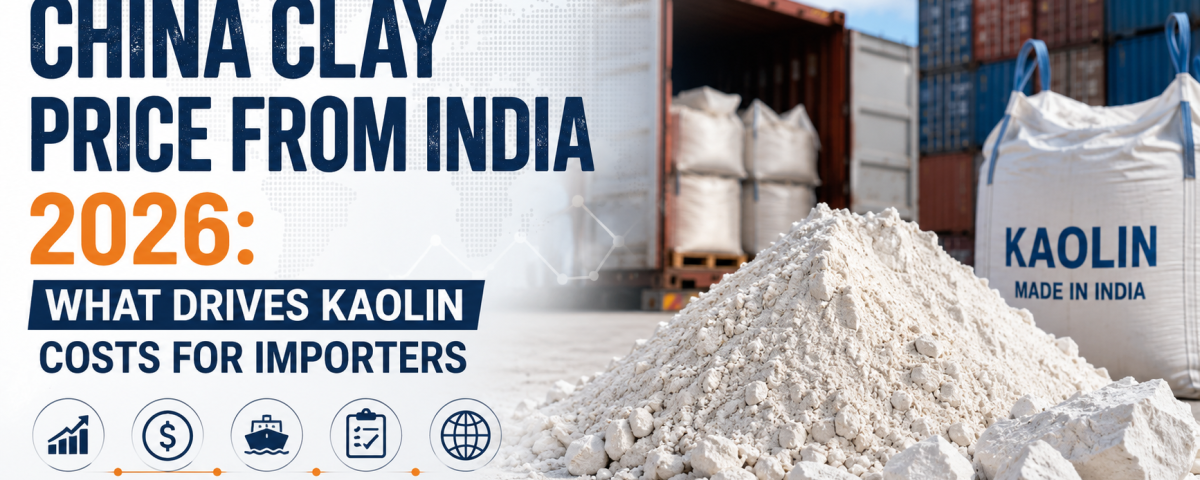
If you import China clay, you’ve felt it: two suppliers quote the same grade, and the numbers are worlds apart. One looks cheap at the factory gate and lands expensive at your port. The other quotes higher and arrives lower. The mineral barely moved – everything around it did.
For international buyers sourcing kaolin from India in 2026, the real story isn’t the clay price. It’s grade, ocean freight, fuel, Incoterms and processing capacity. Understand those, and you stop comparing meaningless factory prices and start comparing true landed cost. This feature hands you the same lens our export desk in Udaipur uses every day.
| Why we don’t publish fixed prices China clay pricing is always quotation-based for exports. Your final number depends on grade, brightness, volume, your port, chosen Incoterm (FOB vs CIF), container rates and currency on the day. Anyone quoting a single “world price” is guessing. Below we explain the factors that move your quote – so you can read any offer accurately and request a precise price for your lane. |
What’s inside
01 Why India for China clay
02 China clay in plain terms
03 The grades – and why they price so differently
04 FOB vs CIF: the number that actually matters
05 The nine forces moving your kaolin cost in 2026
06 Calcined kaolin: the premium export tier
07 Import essentials: HS codes, MOQ, documents
08 Smart procurement for importers
09 The 6 import mistakes that quietly cost you
10 2026 export outlook
11 Importer’s checklist
12 FAQ (20 questions)
1. Why buyers source China clay from India
India is one of the world’s reliable origins for China clay and processed kaolin, and for many importers it hits a sweet spot the bigger origins miss.
Buyers come to India for a specific mix of reasons:
- Consistent processed grades – washed and calcined kaolin built to a written spec, lot after lot.
- Competitive landed cost – often strong once freight and duty are compared honestly against China, Brazil or US origins.
- Flexible volumes – container-level orders, not just bulk vessel quantities, which suits mid-sized importers.
- Export documentation maturity – COA, MSDS, certificate of origin and standard trade paperwork handled as routine.
- Multiple gateway ports – Mundra, Nhava Sheva and others give routing flexibility to most world regions.
| Buyer’s read: Don’t compare India to another origin on factory price alone. Compare delivered-to-your-port cost, grade consistency and documentation reliability. That’s where Indian processed kaolin usually competes hardest. |
2. China clay in plain terms
China clay is the commercial name for kaolin, a soft white clay made mostly of the mineral kaolinite. It forms as granite and feldspar-rich rock weathers over millions of years. The name comes from the Kao-ling hills of China, where Europe first sourced it for porcelain.
It’s valuable because it’s white, chemically stable, fine-grained and fires beautifully. That’s why it ends up in tiles, sanitaryware, paper, paint, rubber, fibreglass and refractories worldwide. For a deeper primer see What is China Clay? and the full breakdown of Kaolin Uses.
3. The grades – and why they price so differently
Importers who ask only “what’s your kaolin price?” get useless answers. Kaolin is a family of products, and each grade sits at a very different price level.
| Grade / form | Typical export use | Relative price level | ||
| Run-of-mine (raw lump) | Cement, coarse ceramics, filler | Lowest | ||
| Washed / levigated clay | Tiles, sanitaryware, tableware | Moderate | ||
| Coating-grade kaolin | Paper, paint, rubber | Higher | ||
| Calcined kaolin | Refractories, fibreglass, premium coatings | Premium (2–4x washed) | ||
| Micronised / surface-treated | Specialty polymers, cosmetics | Highest | ||
| Expert tip Two shipments labelled ‘China clay’ can differ in price several times over. Price against a spec sheet – ISO brightness, +325 mesh residue, moisture, iron and titania – never against the name. This matters even more across borders, where you can’t inspect before shipping. | ||||
Grades are often bought together with adjacent minerals – see Ball Clay, Feldspar, Silica Sand and Refractory Raw Materials.
4. FOB vs CIF: the number that actually matters
For an importer, the factory price is almost irrelevant. What matters is which Incoterm the quote uses and what it includes.
| Term | What it covers | Best for |
| Ex-Works | Goods at the plant only; you arrange everything | Buyers with strong India-side logistics |
| FOB (port of loading) | Goods loaded on vessel at Indian port | Buyers who control their own ocean freight |
| CIF (your port) | Cost + insurance + ocean freight to your port | Buyers who want a single landed number |
| CFR / DAP | Variations on freight & delivery responsibility | Case-by-case |
A low Ex-Works price can land far more expensive than a higher CIF quote once ocean freight, insurance and handling are added. Always compare like-for-like Incoterms. Ask every supplier to quote the same term to the same port, then compare.
| The single most useful question “Can you quote CIF [my port] for this exact spec and volume?” That one line turns five confusing factory prices into five comparable landed numbers. |
5. The nine forces moving your kaolin cost in 2026
Almost every price move in 2026 traces back to one of these nine levers. Watch them instead of the clay.
1. Ocean freight & containers
For a heavy, lower-value mineral, sea freight can be a major share of landed cost. Container availability, blank sailings and route disruptions in 2026 move your delivered price more than the clay ever does.
2. Fuel & energy
Mining, drying and especially calcination run on fuel and power. When energy climbs, processed and calcined grades move first – often before raw-clay quotes react at all.
3. Grade & specification
Brightness, particle size, moisture and iron/titania content set the base price tier. A small spec upgrade can shift your quote significantly, so specify only what your application truly needs.
4. Currency & exchange rate
You pay in your currency; the supplier prices partly in rupees and dollars. Exchange-rate swings alone can move your landed cost quarter to quarter, independent of any real price change.
5. Global ceramic & paper demand
Ceramics, paper and paint demand worldwide pulls on kaolin supply. Strong overseas construction and packaging cycles tighten availability and firm up processed grades.
6. Mining regulations at origin
Environmental clearances and lease rules in producing belts can restrict raw-clay supply quickly. Regulatory friction in 2026 is a genuine upside risk for raw grades and a reason to keep a reliable, compliant supplier.
7. Processing & beneficiation capacity
Washing and calcination capacity is the real bottleneck for clean export grades. Limited capacity keeps processed kaolin firm even when raw clay is cheap at the pit.
8. Port & handling costs
Loading, bagging, container stuffing and port charges all sit inside your FOB number. Congestion or handling-cost changes at the loading port feed straight into your quote.
9. Import duties & compliance at destination
Your own country’s tariff, HS classification and any anti-dumping or quality rules change your final landed cost. Two identical shipments to two countries can cost very differently at the door.
| The takeaway When a quote jumps, ask which lever moved. For importers it’s almost always freight, energy, grade or currency – not the mineral. That single question reframes every negotiation. |
6. Calcined kaolin: the premium export tier
Calcined kaolin is raw kaolin fired to ~650–1,000°C to drive off water, producing a whiter, harder, more opaque and electrically resistive product. It typically carries a 2–4x premium over washed clay and serves refractories, fibreglass, high-end paints, and wire and cable.
Because calcination is energy-hungry, this grade tracks fuel and power more tightly than any other. For importers, that means watch the energy line, not the clay line, when budgeting calcined-grade orders. See Calcined Kaolin for the full picture.
| Market insight In 2026, calcined kaolin from any origin moves first and fastest when global gas and power costs climb – often before raw-clay quotes react. Lock calcined-grade contracts early when energy is soft. |
7. Import essentials: HS codes, MOQ & documents
Before you request a quote, get these basics right – they prevent the most common cross-border delays.
HS classification
Kaolin and kaolinic clays generally fall under HS heading 2507. Confirm the exact sub-code and any duty with your own customs broker, since classification and tariff vary by destination country.
Minimum order & packing
Most export orders move at container level – roughly 25–27 metric tonnes per 20-ft container depending on packing. Typical packing is 25/50 kg bags, jumbo (FIBC) bags, or bulk. Confirm packing before pricing, as it affects both cost and handling.
Standard documentation
- Commercial invoice & packing list
- Certificate of Analysis (COA) per lot
- Material Safety Data Sheet (MSDS)
- Certificate of Origin
- Bill of Lading
- Any destination-specific certificates (quality, phytosanitary where required)
| Expert tip Ask for a COA per lot, not a one-time spec sheet. Consistency shipment-to-shipment is worth more than a slightly lower headline price – especially when you can’t inspect goods before they sail. |
8. Smart procurement for importers
Good importing is a system, not a haggle. Here’s the sequence our export desk recommends:
- Buy to spec, not to name. Fix ISO brightness, +325 residue, moisture and iron/titania limits in writing before discussing price.
- Compare like-for-like Incoterms. Get every supplier to quote the same term (ideally CIF) to the same port.
- Order a sample and trial it. Run a lab check and a plant trial before committing to container volume; kaolin behaves differently in your body than on paper.
- Confirm packing and MOQ early. Bag type and container fill affect both price and handling at your end.
- Agree payment terms clearly. LC or TT, advance percentage and balance terms should be settled up front.
- Contract for stability. For steady demand, a quarterly or annual rate contract shields you from freight and energy spikes.
- Track freight, energy and currency. These forecast your next quote better than the clay price itself.
- Qualify a second, compliant supplier. Never single-source across a border; keep an audited backup warm.
9. The 6 import mistakes that quietly cost you
Mistake 1: Comparing Ex-Works to CIF
You’re comparing apples to shipping containers. Always normalise every quote to the same Incoterm and port before deciding.
Mistake 2: Buying on name, not spec
‘Good quality China clay’ is not a specification. Without ISO brightness, residue and moisture in writing, you can’t verify what arrives.
Mistake 3: Ignoring moisture
You pay kaolin rates for water and higher shipping weight. Fix a maximum moisture percentage and a penalty clause.
Mistake 4: Skipping the sample trial
Lab-clean clay can still misbehave in your specific application. Trial before you commit a container.
Mistake 5: No COA per lot
One good batch proves nothing about the next. Insist on lot-level certificates so consistency is contractual.
Mistake 6: Single sourcing across a border
One lease dispute, clearance delay or port disruption and your line stops. Keep a qualified backup supplier.
2026 export outlook
Our desk’s honest read for the year ahead, stated plainly:
- Processed & calcined grades: firm to rising. Energy and ocean freight keep pressure on clean export grades upward.
- Raw clay: range-bound but policy-sensitive. Mining-regulation friction at origin is the main upside risk.
- Freight & currency: the quiet deciders. For most importers, logistics and exchange rates – not the mineral – will explain 2026’s landed-cost story.
- Documentation & reliability: the differentiator. Buyers increasingly pay a small premium for suppliers who ship on time with clean paperwork.
Bottom line: expect a firm, freight-and-energy-led market, with the best landed prices going to importers who contract early, buy to spec and compare true CIF cost.
Importer’s checklist
- ☐ Written spec: ISO brightness, +325 mesh residue, moisture %, iron & titania limits
- ☐ Certificate of Analysis (COA) per lot agreed
- ☐ Same Incoterm (ideally CIF, your port) quoted by every supplier
- ☐ HS code and destination duty confirmed with your broker
- ☐ Packing type and MOQ per container confirmed
- ☐ Sample lab test + plant trial completed
- ☐ Moisture penalty clause agreed
- ☐ Payment terms (LC/TT, advance %) settled in writing
- ☐ Rate contract or quarterly pricing for steady demand
- ☐ Qualified backup supplier identified
Frequently asked questions
What is the China clay price from India in 2026?
China clay from India is always priced by quotation, not a fixed rate. Your number depends on grade, brightness, moisture, order volume, your port and the Incoterm (FOB or CIF). Raw grades sit lowest, washed grades higher, and calcined kaolin at a clear premium. Request a CIF quote for your exact spec and port to get a real figure.
Is China clay the same as kaolin?
Yes. China clay and kaolin are the same mineral, made mostly of kaolinite. ‘China clay’ is the traditional commercial name and ‘kaolin’ the technical term. Export documents, spec sheets and customs paperwork may use either word interchangeably, so treat them as identical when comparing offers across suppliers and origins.
Why don’t suppliers publish a fixed China clay price?
Because export pricing is genuinely lane-specific. Grade, volume, your port, Incoterm, ocean freight, packing and currency all change the number. A single ‘world price’ would mislead you. Serious suppliers quote against your exact specification and destination, which is why requesting a CIF quote for your spec is the only way to compare accurately.
What drives kaolin costs the most for importers in 2026?
Ocean freight, energy, grade and currency drive most of the variation – not the clay itself. Container availability and fuel move landed cost heavily, energy drives calcined grades, and exchange rates shift your final number. Global ceramic and paper demand plus origin mining rules then tilt prices up or down.
How much does calcined kaolin cost to import?
Calcined kaolin carries a clear premium, typically 2–4x washed clay, because calcination is energy-intensive and delivers superior brightness, opacity and hardness. Exact landed cost depends on grade, volume, freight and your port. For calcined orders, watch global energy prices closely, as they move this grade before raw-clay quotes react.
What is the difference between FOB and CIF for China clay?
FOB means the price covers goods loaded onto the vessel at the Indian port; you arrange and pay ocean freight and insurance. CIF means the supplier’s price includes cost, insurance and freight to your port. CIF gives you a single landed number, while FOB suits buyers who control their own shipping. Always compare quotes on the same term.
Why should I buy China clay from India rather than China or Brazil?
India offers consistent processed grades, competitive landed cost, container-level flexibility and mature export documentation. For many mid-sized importers it competes strongly once freight and duty are compared honestly. The right choice depends on your port, grade and volume, so compare delivered-to-port cost and reliability rather than factory price alone.
What HS code is used for China clay / kaolin?
Kaolin and kaolinic clays generally fall under HS heading 2507. The exact sub-code and applicable duty vary by destination country, so confirm classification with your own customs broker before importing. Correct classification avoids clearance delays and ensures you budget the right duty into your landed cost.
What is the minimum order quantity for importing kaolin?
Most export orders move at container level – roughly 25–27 metric tonnes per 20-ft container, depending on packing. Some suppliers accept part-container or consolidated shipments. Packing options include 25/50 kg bags, jumbo FIBC bags or bulk. Confirm MOQ and packing before pricing, as both affect cost and handling.
What documents do I need to import China clay from India?
Standard export documents include a commercial invoice, packing list, Certificate of Analysis per lot, MSDS, Certificate of Origin and Bill of Lading. Your destination may require additional quality or phytosanitary certificates. A reliable supplier handles this paperwork as routine, which is itself a strong signal of export experience.
How does ocean freight affect my landed kaolin cost?
For a heavy, lower-value mineral, sea freight can be a large share of landed cost. Container availability, blank sailings and route disruptions in 2026 can move your delivered price more than the clay itself. This is why FOB and CIF quotes differ so much, and why you should always compare on the same Incoterm.
How does currency affect China clay import prices?
You pay in your currency while the supplier prices partly in rupees and dollars, so exchange-rate swings alone can move your landed cost from quarter to quarter, independent of any real price change. When your currency strengthens against the dollar, imports get cheaper; when it weakens, budget for a higher effective price.
What specifications should I request when importing kaolin?
Request ISO brightness, residue on +325 mesh, moisture percentage, and iron (Fe2O3) and titania (TiO2) limits, plus particle-size data. Insist on a Certificate of Analysis per lot, not a one-time spec sheet. Specifying precisely, and only what your application needs, prevents overpaying for brightness or fineness you won’t use.
How does moisture affect imported China clay cost?
High moisture means you pay kaolin rates for water and higher shipping weight, then spend energy drying it. Moisture inflates both freight and processing cost. Always fix a maximum moisture percentage in your contract and negotiate a penalty clause, so wet clay doesn’t quietly raise your effective landed cost.
Should I sign a rate contract or buy spot?
For steady demand, a quarterly or annual rate contract shields you from freight and energy spikes, smooths budgeting and secures supply. Spot buying can win on a lucky day but leaves you exposed to container shortages and sudden energy-driven jumps. Match your buying method to your demand pattern and cash-flow needs.
Will China clay export prices rise in 2026?
Processed and calcined grades look firm to rising, driven by energy and ocean freight, while raw clay is more range-bound but sensitive to origin mining regulation. Freight and currency are the quiet deciders for most importers. Overall, expect a firm, freight-and-energy-led market, best navigated by contracting early and buying to spec.
How do I compare quotes from different kaolin suppliers?
Normalise everything: same specification, same Incoterm, same port, same packing. Only then are the numbers comparable. Add destination duty and handling to reach true landed cost. Weigh consistency, COA reliability and documentation quality alongside price – a marginally cheaper supplier that ships inconsistent lots often costs more in the end.
What is the difference between China clay and ball clay?
Both are kaolinitic clays, but ball clay is finer, more plastic and usually darker before firing, prized for workability in ceramic bodies. China clay (kaolin) is whiter and less plastic, valued for brightness. They’re often blended in ceramic recipes, and each is priced and imported on its own grade and properties.
How do origin mining regulations affect supply and price?
Environmental clearances, lease renewals and district mining rules can restrict raw-clay supply quickly in a producing belt. Regulatory friction is a genuine upside price risk for raw grades in 2026. Importers exposed to a single origin should keep a compliant backup supplier qualified in case a lease or clearance stalls.
How do I choose a reliable China clay exporter in India?
Choose established producers who provide written specs, a Certificate of Analysis per lot, clean export documentation and consistent grades. Rajasthan-based suppliers, including PRM in Udaipur, serve international ceramic and refractory buyers. Prioritise grade consistency, documentation reliability and true landed (CIF) cost over the lowest factory quote, and always trial a sample first.
The bottom line
China clay pricing looks confusing only until you stop watching the clay. For importers in 2026, the story is written in grade, ocean freight, energy, currency and Incoterms. Buyers who compare true CIF cost, buy to spec, trial before volume and contract early won’t just survive the swings – they’ll import better than their competitors, shipment after shipment.
That’s the whole game: stop reacting to the factory price, and start reading the forces behind your landed cost.
About Pratibha Refractory Minerals – An Udaipur-based producer and exporter of industrial and refractory minerals, supplying ceramic, refractory and industrial buyers across international markets. This feature reflects our own export-desk experience and is intended as sourcing education, not a formal price quotation. For a precise CIF quote to your port, contact our export team with your grade and volume.