

- Call for Sales Enquiries

- +91-9413034047
- +91-294-2413244
- info@pratibharefractory.com

Talc Powder in PVC: Benefits, Uses & How to Choose the Right Grade

Best Talc Powder Supplier for the Plastic Industry
September 19, 2026Talc Powder in PVC: Benefits, Uses & How to Choose the Right Grade
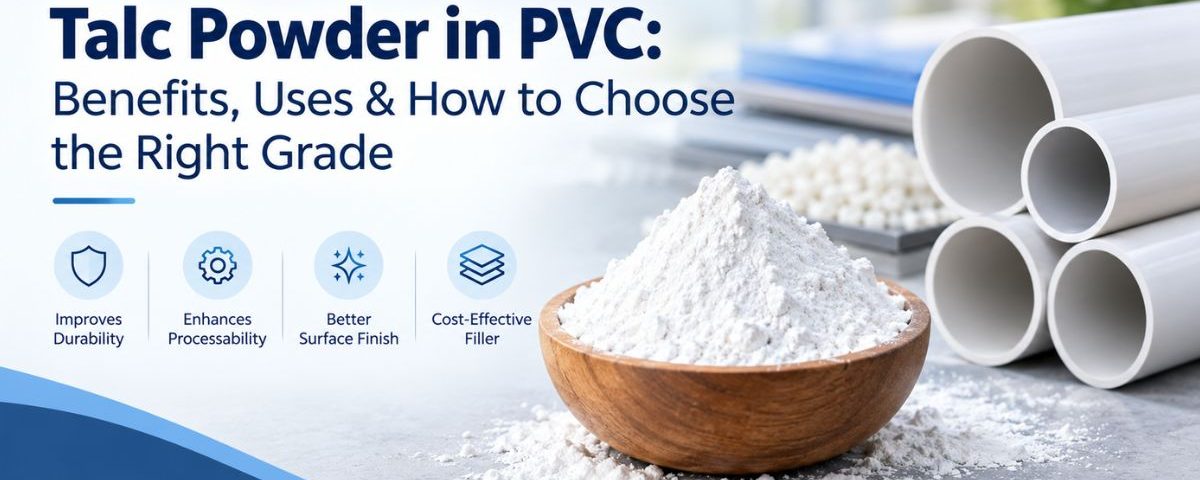
PVC on its own is rarely processed as a pure polymer. Most rigid and flexible PVC products are compounded with stabilisers, lubricants, modifiers and mineral fillers, which help manufacturers control product properties and formulation cost.
Talc powder is one of the mineral fillers used in plastics. When selected and tested properly, talc powder in PVC can influence stiffness, dimensional behaviour, surface finish and processing. The right talc grade depends on the PVC application, the required properties, particle size, purity and the processing method. A wrong choice can cause processing problems or inconsistent output.
This guide explains where talc fits in PVC, how it affects properties, and what buyers should check before ordering in bulk.
What Is Talc Powder and Why Is It Used in PVC?
Talc is a naturally occurring hydrated magnesium silicate mineral. It has a plate-like (lamellar) structure and is one of the softest industrial minerals. In India, talc is also traded as soapstone and is supplied as lumps or ground powder in different particle sizes.
Several characteristics make industrial talc powder relevant to plastics:
- Plate-like particles. Platy particles can influence stiffness and dimensional behaviour in a polymer matrix.
- Softness. Talc is far less abrasive than many hard mineral fillers, which is a consideration for processing equipment wear.
- Chemical inertness. Talc is generally stable and does not react readily in most polymer systems.
- Light colour. Good-quality grades are used where colour and finish matter.
In PVC formulations, talc powder as a filler in PVC is typically used to partly replace more expensive formulation components, to modify mechanical behaviour, or to adjust surface and processing characteristics. Its effect depends on the grade, loading level and the rest of the formulation, which is why trials matter.
Benefits of Talc Powder in PVC
The benefits below are not guaranteed outcomes. Results depend on the PVC type (rigid or flexible), formulation, filler loading, particle size and processing conditions.
Stiffness and rigidity. Because of its platy structure, talc can help increase the stiffness of PVC compounds. This is relevant for rigid products where shape retention matters.
Dimensional stability. Talc may help reduce shrinkage or distortion in some products, which supports tighter dimensional control in extruded and moulded items.
Surface characteristics. A well-selected, finely controlled grade can contribute to a smoother and more uniform surface. A poorly selected one can do the opposite, so particle-size control is important.
Processing behaviour. Depending on the formulation, talc can influence melt behaviour and output. It can also affect lubricant demand, so processors should confirm their lubricant system when adding or increasing talc.
Cost optimisation. A mineral filler for PVC can reduce the amount of costlier ingredients needed per unit of product. The saving is only real if the product still meets its performance and quality requirements.
Thermal and mechanical considerations. Talc may contribute to heat-related behaviour such as stiffness retention at elevated temperature. However, high filler loading can also reduce impact strength or elongation, so balance is essential.
Applications of Talc Powder in PVC
Not every PVC product uses talc, and loading levels vary widely. These are the areas where mineral filler use is technically relevant.
PVC Pipes and Fittings
Mineral fillers are commonly used in PVC pipe compounds. Talc powder for PVC pipes may be considered where stiffness and cost control are priorities. Pipe makers must still meet applicable standards for pressure rating, impact resistance and dimensions, so filler type and loading should be validated through testing.
PVC Profiles
In window and door profiles, conduits and similar extruded sections, talc can support rigidity and dimensional control. Surface finish and impact performance are the critical checks here, so particle size and top-size control matter.
PVC Sheets
Rigid PVC sheets can use mineral fillers to modify stiffness and cost. Surface appearance and uniformity are important, which makes consistent particle-size distribution a priority.
PVC Flooring
In vinyl flooring, mineral fillers are widely used in the compound or backing layers. Talc may be one of several filler options, depending on the construction and performance targets of the flooring.
Cables and Other PVC Products
Some cable compounds and other PVC items use mineral fillers for cost and property adjustment. Electrical and flexibility requirements are stricter here, so any talc use needs careful testing against the product specification.
How Talc Powder Affects PVC Properties
| Property | Role of Talc | Why It Matters |
|---|---|---|
| Rigidity | Platy particles can raise stiffness of the compound | Helps products hold shape under load, especially pipes and profiles |
| Dimensional stability | May reduce shrinkage or warpage in some formulations | Supports consistent size and fit in extruded and moulded parts |
| Surface characteristics | Fine, well-graded particles can help surface uniformity | Affects appearance, finish and sometimes printability or coating |
| Processing | Can influence melt flow, output and lubricant demand | Poor dispersion or wrong loading can cause processing issues |
| Thermal behaviour | May help maintain stiffness at higher temperatures | Relevant where products face heat in service or storage |
| Filler loading | Higher loading changes the balance of properties | Excess filler can reduce impact strength and elongation |
The key point: talc is not a “fill it up” additive. Each increase in loading shifts several properties at once, so the right level is found through formulation trials, not assumption.
How to Choose the Right Talc Powder Grade for PVC
For industrial buyers, grade selection is where most of the value or risk sits. Check the following factors.
- Particle size / mesh. This influences dispersion, surface finish and mechanical behaviour. Different products need different ranges.
- Particle-size distribution. Two powders with the same mesh can behave differently if one has a wider distribution or oversize particles. Ask for distribution data, not just a mesh figure.
- Purity. Impurities or associated minerals can affect colour, abrasiveness and consistency. Higher purity is generally preferred for demanding applications.
- Whiteness. Important for light-coloured or visible products such as profiles, sheets and flooring.
- Moisture content. Excess moisture can cause processing issues such as voids or surface defects and can affect handling. Request moisture limits.
- Chemical composition. Typical oxide analysis (such as magnesium and silica content) helps confirm grade identity and batch consistency.
- Surface characteristics. Particle shape and surface behaviour affect how well talc disperses and bonds in the PVC matrix.
- Compatibility with the PVC formulation. Talc interacts with stabilisers, lubricants and other fillers. Confirm it works in your actual recipe.
- Batch-to-batch consistency. A good grade that varies between lots creates quality problems on the line. Consistency is often more valuable than a marginally better specification.
- Packaging and bulk supply capability. Check bag size, packing quality, moisture protection and whether the supplier can maintain regular volumes.
What Mesh Size of Talc Powder Is Suitable for PVC?
There is no single correct answer. The suitable talc powder mesh size for PVC depends on the product, the processing method and the formulation.
Points to keep in mind:
- Finer is not automatically better. Very fine powders can be harder to disperse, may raise bulk-handling issues and can affect lubricant demand. Coarser material may be acceptable in some products but can hurt surface finish or impact performance in others.
- Match the grade to the process. Extrusion of pipes, profile extrusion, sheet production and calendering can each tolerate different particle sizes.
- Consider filler loading and finish. A higher loading or a high-quality visible surface usually calls for tighter particle-size control.
- Check top-size control. Oversize particles, even in small amounts, can create surface defects or weak points.
Before ordering bulk quantities, discuss your product, process and target properties with the supplier, then run trial batches on your own line.
Talc Powder for Different PVC Applications
| Application | Key Requirement | Talc Consideration |
|---|---|---|
| PVC pipes | Dimensional accuracy, impact resistance, compliance with standards | Controlled particle size, consistent batches and trial validation of loading |
| PVC profiles | Surface finish, rigidity, colour | Whiteness, fine and consistent distribution, impact check |
| PVC sheets | Uniform surface, stiffness | Tight particle-size distribution and good dispersion |
| PVC flooring | Cost balance, stability, wear performance | Filler combination and grade suited to the flooring construction |
| Cables and other PVC products | Electrical, flexibility and safety requirements | Purity and moisture control; thorough testing against product specification |
Always treat this as a starting point for discussion. Final specifications should come from your own testing.
Common Mistakes When Buying Talc Powder for PVC
- Choosing only on price. A cheaper powder that causes rejects or line stoppages costs more in the end.
- Ignoring particle size. Mesh alone is not enough. Distribution and top size matter.
- Not checking purity and chemical composition. Variation here can show up as colour or processing changes.
- Skipping the technical data sheet and COA. Buy against a written specification, and ask for a Certificate of Analysis with shipments.
- Accepting inconsistent material. Lot-to-lot variation is a common hidden problem.
- Not testing in the actual formulation. A grade that works in one compound may not work in another.
- Overlooking packaging and supply continuity. Damaged bags, moisture pickup or delayed deliveries disrupt production.
How to Evaluate a Talc Powder Supplier in India
A reliable talc powder supplier in India should be able to answer the following clearly:
- Product specifications: Can they share defined grades with particle size, purity and moisture details?
- Quality consistency: How do they maintain uniformity across batches?
- Testing documentation: Do they provide COA and technical data on request?
- Production capacity: Can they handle your monthly requirement?
- Bulk supply capability: Can they deliver repeat orders without interruption?
- Packaging options: Are suitable bag sizes and moisture-protective packing available?
- Technical support: Will they discuss your application and recommend grades?
- Delivery reliability: What is their record on dispatch timelines?
- Export capability: Useful if your business serves overseas buyers, since export experience usually reflects stronger documentation and packing discipline.
- Application-specific grades: Can they supply different grades for different needs rather than one standard product?
Suppliers who can answer these questions openly are usually easier to work with over the long term. A talc powder manufacturer in India with experience in both domestic and export supply is often better placed to meet these expectations.
Why Choose Pratibha Refractory Minerals for Talc Powder?
Pratibha Refractory Minerals is an India-based B2B mineral supplier and manufacturer, founded in 1987 in Rajasthan. The company has been exporting since 1995, and approximately 80% of its business is export-oriented. Supply volume is approximately 2,000 tonnes per month.
Its product range covers talc/soapstone powder and lumps, dolomite, china clay, quartz/silica sand and mica, which makes it a practical single-source option for manufacturers who buy more than one industrial mineral.
For PVC and plastics buyers, the company’s approach is built around:
- Consistent industrial mineral supply for regular production needs
- Bulk requirements, with a focus on B2B orders rather than retail quantities
- Application-focused sourcing, where the discussion starts from your product and process
- Reliable B2B supply for both domestic and export requirements
If you are evaluating talc powder for PVC, share your application, target specifications and monthly volume so the right grade can be discussed.
FAQs About Talc Powder in PVC
What is talc powder used for in PVC?
It is used as a mineral filler to influence stiffness, dimensional behaviour, surface characteristics and formulation cost. The effect depends on grade, loading and formulation.
Is talc powder used as a filler in PVC?
Yes. Talc is one of the mineral fillers considered for PVC and other plastics, alongside materials such as calcium carbonate. Choice depends on the product and performance targets.
What type of talc powder is suitable for PVC?
A grade with controlled particle size and distribution, good purity, suitable whiteness, low moisture and consistent quality from batch to batch. The exact grade depends on the PVC product.
What mesh size of talc powder is used in PVC?
There is no single mesh size. It varies with the product, process and filler loading. Discuss your requirement with the supplier and confirm through trials.
How does talc affect PVC properties?
Depending on formulation, it can influence rigidity, dimensional stability, surface finish, processing behaviour and heat-related performance. Higher loadings may reduce impact strength or elongation.
Can talc powder be used in PVC pipes?
Mineral fillers are used in PVC pipe compounds, and talc can be considered. Manufacturers must validate the grade and loading against the applicable pipe standards and their own test requirements.
How should manufacturers select a talc powder supplier?
Look for clear specifications, COA availability, consistent quality, bulk supply ability, suitable packaging, technical support and reliable delivery.
What should buyers check before purchasing talc powder in bulk?
Particle size and distribution, purity, whiteness, moisture, chemical composition, packaging and supply continuity. Run a trial batch in your own formulation before committing to large volumes.
Conclusion
Talc powder in PVC can support stiffness, dimensional control, surface quality and cost management, but only when the grade matches the application. Particle size, distribution, purity, moisture and consistency all affect results, and trial validation in your own formulation is the most reliable way to confirm a choice.
If you are developing or optimising a PVC product, discuss your application, process and specifications with Pratibha Refractory Minerals. Share your requirements, and the team can help you evaluate suitable talc grades and supply options for your production needs.