

- Call for Sales Enquiries

- +91-9413034047
- +91-294-2413244
- info@pratibharefractory.com

What Is the Difference Between Talc and Soapstone?

Quartz Powder Manufacturer in India 2026
July 24, 2026
8 Industries That Depend on Silica Sand (+ Grade Requirements)
August 12, 2026What Is the Difference Between Talc and Soapstone?
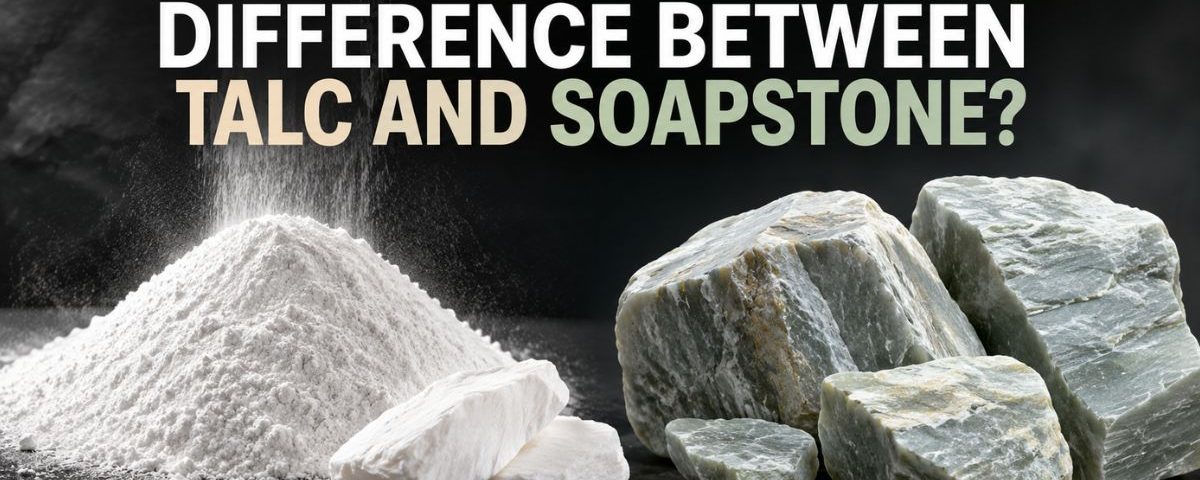
Talc and soapstone are closely related, but they are not the same thing. Talc is a mineral. Soapstone is a soft metamorphic rock composed predominantly of talc, along with varying amounts of other minerals such as magnesite, chlorite, dolomite and carbonates, depending on where and how it formed.
Because talc is a defined mineral and soapstone is a rock built around that mineral, their compositions, grades, processing methods and industrial applications can differ significantly. Understanding the difference between talc and soapstone matters for anyone sourcing industrial minerals, because the two materials are not interchangeable for most technical applications.
Specifications can vary depending on the source, grade and processing method. The explanations below describe general mineralogical and industrial characteristics rather than fixed values for any specific deposit.
What Is Talc?
Talc is a naturally occurring hydrous magnesium silicate mineral. It belongs to the phyllosilicate (sheet silicate) group and has the chemical formula Mg₃Si₄O₁₀(OH)₂. This layered atomic structure is the main reason talc behaves the way it does in industrial use – the sheets slide easily over one another, which gives talc its characteristic softness and slippery feel.
Key mineralogical and physical characteristics of talc include:
- Mohs hardness of about 1, making it one of the softest known minerals
- Natural colour ranging from white to pale green or grey, depending on associated impurities
- Smooth, greasy texture and pearly to dull luster
- Perfect basal cleavage, a result of its sheet-like crystal structure
- Relatively low specific gravity compared to many other industrial minerals
- High thermal stability and good chemical inertness under normal processing conditions
- Naturally hydrophobic surface characteristics, which influence how it behaves in different formulations
- Ability to be ground to very fine particle sizes, supporting a wide range of industrial grades
These characteristics – extreme softness, platy particle shape, chemical stability and fine grindability – are what make talc valuable as an industrial mineral, rather than any single property on its own.
What Is Soapstone?
Soapstone, sometimes called steatite in massive form, is a metamorphic rock. It forms when talc-rich source rock is subjected to heat and pressure within the earth’s crust, a process that concentrates talc alongside other minerals present in the original rock body.
Because soapstone is a rock rather than a single mineral, its composition is not fixed. Depending on its geological origin, soapstone may also contain:
- Magnesite
- Chlorite
- Dolomite
- Other associated carbonate and silicate minerals
Typical physical characteristics associated with soapstone include softness (though usually less extreme than pure talc), good heat resistance, low permeability, ease of workability with hand tools or machinery, and colour that can vary from grey and green to nearly black, again depending on the deposit.
Because soapstone’s exact mineral makeup depends on its geological source, its physical and thermal behaviour can vary noticeably from one deposit to another – which is a key reason it is generally handled and processed as a rock material rather than a standardised mineral product.
Is Talc the Same as Soapstone?
No. Talc is a mineral. Soapstone is a rock that is predominantly composed of talc along with other minerals.
A simple way to think about it: talc is one of the ingredients, and soapstone is the finished dish that also contains other ingredients in varying amounts.
This distinction has practical consequences for industrial buyers. Commercially supplied talc is typically mined, processed and micronized to meet specific technical specifications – particle size, brightness, purity and chemical composition can all be controlled to a defined grade. Soapstone, in contrast, is generally sourced, cut and shaped as a rock material, with its properties tied more directly to the characteristics of the specific quarry or deposit it comes from.
Talc vs Soapstone: Key Differences
The table below summarises the core differences between talc and soapstone across composition, properties, processing and typical applications.
| Property | Talc | Soapstone |
| Classification | Mineral | Metamorphic rock |
| Main composition | Talc | Predominantly talc plus other minerals |
| Chemical composition | Relatively consistent | Variable, depends on deposit |
| Formation | Mineral formation | Metamorphism of talc-rich rock |
| Hardness | Very soft | Generally soft |
| Texture | Smooth, powdery when processed | Smooth, soapy feel |
| Processing | Crushing, grinding, micronization | Cutting, shaping, grinding |
| Industrial use | Powder and mineral applications | Construction, carving, heat-resistant applications |
| Purity | Can be processed to high purity | Depends on geological composition |
| Applications | Plastics, ceramics, paints, paper, rubber, cosmetics | Countertops, carvings, stoves, tiles |
Difference Between Talc and Soapstone: Composition
Talc has a relatively well-defined mineral composition, expressed by its chemical formula. Commercial talc grades can vary in purity and in the type and amount of trace minerals present, but the underlying mineral being processed is consistently talc.
Soapstone does not have one fixed chemical composition. Because it is a metamorphic rock, its final mineral assemblage depends on the composition of the original rock body and the specific conditions of heat and pressure it experienced. Two soapstone deposits from different regions can therefore differ meaningfully in their proportions of talc, magnesite, chlorite, dolomite and other associated minerals.
This is why mineral purity matters so much for industrial buyers. Applications that depend on consistent chemical behaviour – such as plastics, ceramics, paints or cosmetics – generally require processed talc with a known, controlled composition, rather than ground rock with a variable mineral profile.
Physical Properties of Talc vs Soapstone
Talc and soapstone share some overlapping physical traits, since talc is soapstone’s dominant mineral, but the two differ in several practical respects:
- Hardness: talc is extremely soft (roughly Mohs 1); soapstone, while soft, is often slightly harder due to associated minerals
- Density: soapstone’s density can vary more than processed talc, depending on its mineral mix
- Texture: talc feels powdery and slippery when finely ground; soapstone retains a smooth, soapy surface feel in solid form
- Colour: talc ranges from white to pale green or grey; soapstone can range from grey and green to darker tones
- Heat resistance: both materials show good heat tolerance, which is one reason soapstone is used near stoves and fireplaces
- Chemical stability: talc’s consistent composition supports predictable chemical behaviour in formulations
- Moisture behaviour: processed talc grades are typically characterised for moisture content as part of quality control
- Ease of processing: talc is ground and micronized into powder; soapstone is generally cut, carved or shaped as a solid
For industrial buyers, particle characteristics after grinding – fineness, shape and surface behaviour – are usually more important than any single property viewed in isolation, since these directly affect how a mineral performs inside a formulation or process.
What Are the Uses of Talc?
Plastics
In plastics, talc is widely used as a functional filler and reinforcement. Its platy particle shape can improve stiffness and dimensional stability, and it can also influence processing behaviour such as flow and shrinkage in moulded parts.
Ceramics
Talc plays a role in various ceramic bodies and glaze formulations, contributing to specific firing and structural characteristics depending on the formulation it is used in.
Paints and Coatings
As a filler and extender in paints and coatings, talc can influence properties such as opacity, texture and application behaviour, depending on the grade and particle size selected.
Paper
Talc is used in the paper industry both as a mineral filler within the paper sheet and as a component in certain coating formulations.
Rubber
In select rubber formulations, talc can be used as a processing aid and filler, contributing to specific handling and finishing characteristics.
Construction
Talc is used in a range of construction-related filler applications, where its properties support specific formulation requirements.
Cosmetics and Personal Care
Only appropriate, tested and compliant grades of talc are used in cosmetics and personal care applications. Suitability for this category depends on purity, testing and applicable regulatory requirements, and should always be confirmed against relevant standards and documentation rather than assumed from the general material name.
What Are the Uses of Soapstone?
Soapstone’s combination of workability and heat resistance makes it useful across several applications:
- Countertops and sinks, valued for heat resistance and a distinctive appearance
- Tiles and flooring in select architectural applications
- Fireplace surrounds and wood-burning stoves, due to heat retention and resistance
- Carving and sculpture, owing to its softness and workability
- Decorative products and handicrafts
- Selected industrial applications where its rock form is suited to the end use
As with its physical properties, the suitability of a specific soapstone deposit for any of these applications depends heavily on its actual composition and characteristics, which can vary by source.
Talc Powder vs Soapstone Powder
Talc powder and soapstone powder should not automatically be treated as synonyms, even though soapstone is talc-rich. Talc powder is a mineral powder produced from processed talc ore with a known composition. Soapstone powder is ground rock, and its mineral composition – and therefore its performance – reflects whatever mix of minerals that particular soapstone deposit contains.
For industrial buyers, the practical differences to check before purchase include:
- Whether the material is a pure processed mineral powder or ground rock
- Purity and mineral composition
- Particle size distribution
- Intended application and required performance
- Processing method used to produce the powder
- Consistency of quality between batches
Because the material name alone does not guarantee a specific performance profile, industrial buyers should request technical specifications and test data rather than purchasing based on the product name only.
Which Is Better: Talc or Soapstone?
Neither material is universally better – the right choice depends entirely on the application and its technical requirements. Factors that should guide the decision include:
- The specific application and its performance requirements
- Required purity and consistency
- Particle size needs
- Mineral composition requirements
- Thermal requirements of the end use
- Chemical compatibility requirements
- Preferred processing method
- Overall performance specifications
- Cost considerations
- Supply consistency and reliability
For applications needing a defined chemical composition and fine, controlled particle size – such as plastics, ceramics, paints or paper – processed talc is typically the more suitable material. For applications relying on solid, workable, heat-resistant rock – such as countertops, carving or stove surrounds – soapstone in its rock form is the appropriate choice.
How Is Industrial Talc Processed?
Industrial talc generally moves through a defined sequence of processing steps, though the exact parameters depend on the target grade and end-use application:
Mining → Sorting → Crushing → Grinding → Classification → Micronization → Quality Testing → Packaging
Processing requirements are determined by the desired grade and the application it is intended for. Parameters typically monitored and controlled during processing include:
- Particle size and particle size distribution
- Brightness and whiteness
- Moisture content
- Purity
- Mineral composition
- Specific gravity
- Chemical composition
Specifications can vary depending on the source, grade and processing method. Buyers should request current technical data sheets for the specific grade under consideration.
How to Choose the Right Talc for Industrial Applications?
The following checklist can help industrial buyers evaluate talc grades against their application requirements:
- Define the target application clearly
- Confirm the required purity level
- Specify the needed particle size range
- Check whiteness and brightness requirements
- Review chemical composition data
- Confirm acceptable moisture content
- Identify any mineral impurities that must be controlled
- Clarify packaging requirements for handling and transport
- Ask about consistency between production batches
- Request supplier quality documentation
- Confirm testing and certification requirements relevant to the application
- Verify bulk supply capacity against project volume needs
Talc Supplier and Manufacturer in India: What to Evaluate
Pratibha Refractory Minerals operates as an industrial minerals supplier and manufacturer based in India, working with talc and other industrial mineral products for domestic and export markets.
When evaluating any talc supplier in India – including talc manufacturers and talc exporters from India – industrial buyers should generally assess:
- Material quality and how closely it matches stated specifications
- Consistency of supply and quality across batches
- Availability of technical specifications and documentation
- Customisation capability for specific grades or particle sizes
- Bulk supply capacity for project or ongoing procurement needs
- Packaging suited to handling, storage and transport requirements
- Quality testing practices and available certification
- Export capability and experience serving international buyers
As a general practice, industrial minerals suppliers should be evaluated on documented technical performance and demonstrated consistency rather than on marketing claims alone.
Frequently Asked Questions
Is talc the same as soapstone?
No. Talc is a mineral, while soapstone is a metamorphic rock composed predominantly of talc along with other minerals such as magnesite, chlorite or dolomite, depending on the deposit.
Is soapstone made from talc?
Soapstone forms through the metamorphism of talc-rich rock, so talc is typically its dominant mineral component, though soapstone also contains other minerals depending on its geological origin.
What is the main difference between talc and soapstone?
Talc is a single, relatively well-defined mineral, while soapstone is a rock with a variable mineral composition that depends on its specific geological source.
Is soapstone a mineral or a rock?
Soapstone is a rock – specifically a metamorphic rock – not a single mineral.
What is the chemical formula of talc?
Talc’s chemical formula is Mg₃Si₄O₁₀(OH)₂, a hydrous magnesium silicate.
Which is softer, talc or soapstone?
Talc is generally softer, with a Mohs hardness of about 1. Soapstone is also soft but is often slightly harder due to the presence of other minerals alongside talc.
What are the main uses of talc?
Talc is used across plastics, ceramics, paints and coatings, paper, rubber, construction and select cosmetics and personal care applications, depending on the grade and purity.
What are the main uses of soapstone?
Soapstone is commonly used for countertops, sinks, tiles, fireplace surrounds, stoves, carving and decorative products, largely because of its heat resistance and workability.
Can soapstone be converted into powder?
Yes, soapstone can be ground into powder, but its composition reflects the specific mineral mix of that deposit rather than the more standardised composition of processed talc powder.
Is talc powder made from soapstone?
Not necessarily. Talc powder is typically produced from talc ore, which may or may not be sourced from soapstone deposits; the two should not be assumed to be identical without checking the actual source and specification.
How do I choose the right talc grade for an industrial application?
Start with your application’s requirements – purity, particle size, brightness, chemical composition and moisture tolerance – then request technical documentation from suppliers and confirm consistency and testing practices before finalising a grade.