

- Call for Sales Enquiries

- +91-9413034047
- +91-294-2413244
- info@pratibharefractory.com

Quartz Powder Manufacturer in India 2026

Talc Powder Purification: What Industrial Buyers Should Verify in 2026
July 22, 2026
What Is the Difference Between Talc and Soapstone?
August 8, 2026Quartz Powder Manufacturer in India 2026
Quick Answer
India’s best quartz powder manufacturers combine high-purity silica deposits, controlled grinding technology, and export-grade quality documentation. A dependable manufacturer typically offers SiO₂ purity from 98% to 99.7%+, mesh sizes from 100 to 1250, moisture below 0.5%, and third-party lab test reports for every batch. Bulk pricing depends on purity grade, mesh fineness, packaging, order volume, and freight – not on a fixed rate card. Buyers who verify certifications, request pre-shipment samples, and confirm particle size distribution consistently avoid the costliest sourcing mistakes.
| Key Takeaways Quartz powder demand in India is rising fastest in ceramics, engineered stone, solar glass and epoxy flooring.Purity (SiO₂ %) and Fe₂O₃ content are the two specs that most affect price and application fit.Mesh size selection changes performance more than most buyers expect – finer is not always better.Pricing varies by grade, mesh, packaging format, and order quantity; there is no single market rate.Export-ready manufacturers provide COA, MSDS, and third-party lab reports as standard practice.Common buyer mistakes: ignoring particle size distribution, skipping sample testing, and choosing on price alone. |
Table of Contents
- 1. Why Quartz Powder Quality Is Under the Spotlight in 2026
- 2. What Is Quartz Powder? A Working Definition
- 3. How Indian Manufacturers Produce Quartz Powder
- 4. Quartz Powder Grades, Mesh Sizes & Technical Specifications
- 5. Applications: Where Quartz Powder Is Used
- 6. Premium vs Low-Grade Quartz Powder: What Actually Differs
- 7. Quality Testing & Certification Standards
- 8. 2026 Market Forces Shaping Demand, Grades and Pricing
- 9. Buyer’s Guide: Choosing the Right Manufacturer
- 10. Step-by-Step Buying Process
- 11. 2026 Bulk Pricing Guide
- 12. Common Buyer Mistakes to Avoid
- 13. Pros & Cons of Sourcing Quartz Powder from India
- 14. Future Outlook: 2026–2030
- 15. Conclusion
- 16. Frequently Asked Questions
Why Quartz Powder Quality Is Under the Spotlight in 2026
A tile factory in Morbi rejects an entire truckload of quartz powder because the whiteness index falls short by two points. A solar glass plant in Gujarat halts a production line when iron content spikes beyond tolerance. These are not rare events – they are the new normal for an industry where quartz powder has quietly become a make-or-break input rather than a commodity afterthought.
India’s quartz powder sector is expanding on the back of ceramic and sanitaryware growth in Gujarat and Rajasthan, a fast-scaling engineered stone segment, rising solar glass capacity, and a construction chemicals market that increasingly specifies epoxy flooring and self-levelling compounds. At the same time, export buyers from Southeast Asia, the Middle East and parts of Europe are actively diversifying away from single-country sourcing, and Indian quartz powder is one of the beneficiaries of that shift.
This growth has exposed a gap: many buyers still purchase quartz powder the way they would buy a generic bulk mineral, comparing only price per tonne. But quartz powder is a specification-driven material. Purity, mesh distribution, whiteness, moisture, and iron content directly determine whether a batch performs in a kiln, a resin system, or a glass furnace – or causes costly rework. Procurement risk in 2026 is less about finding a supplier and more about verifying that the supplier’s stated specifications match what actually arrives at the dock.
This guide is built for procurement managers, purchase engineers, and business owners who need a genuinely technical, buyer-first resource – not a marketing page dressed up as an article. It covers manufacturing, grades, applications, testing, 2026 market conditions, and a complete buyer’s framework for choosing an Indian quartz powder manufacturer with confidence.
What Is Quartz Powder? A Working Definition
Quartz powder is finely ground silicon dioxide (SiO₂) derived from natural quartz lumps or quartz sand through crushing, grinding, and classification. Unlike silica sand, which retains a coarse, granular structure, quartz powder is processed to controlled micron-level particle sizes, making it suitable for applications where surface finish, chemical inertness, hardness, and whiteness matter.
Chemically, high-quality quartz powder is close to pure SiO₂, with trace levels of Fe₂O₃ (iron oxide), Al₂O₃ (alumina), and other oxides. The lower the impurity load – particularly iron – the whiter and more chemically stable the powder, and the wider its range of high-value applications.
Quartz Powder vs Silica Sand vs Quartz Lumps
| Material | Particle Form | Typical Use |
| Quartz Lumps | Raw, unprocessed rock | Feedstock for grinding, ferro-alloys, glass cullet blending |
| Silica Sand | Coarse granular sand | Foundry moulding, construction, water filtration |
| Quartz Powder | Fine ground powder, 100–1250 mesh | Ceramics, glass, paint, epoxy flooring, engineered stone |
How Indian Manufacturers Produce Quartz Powder
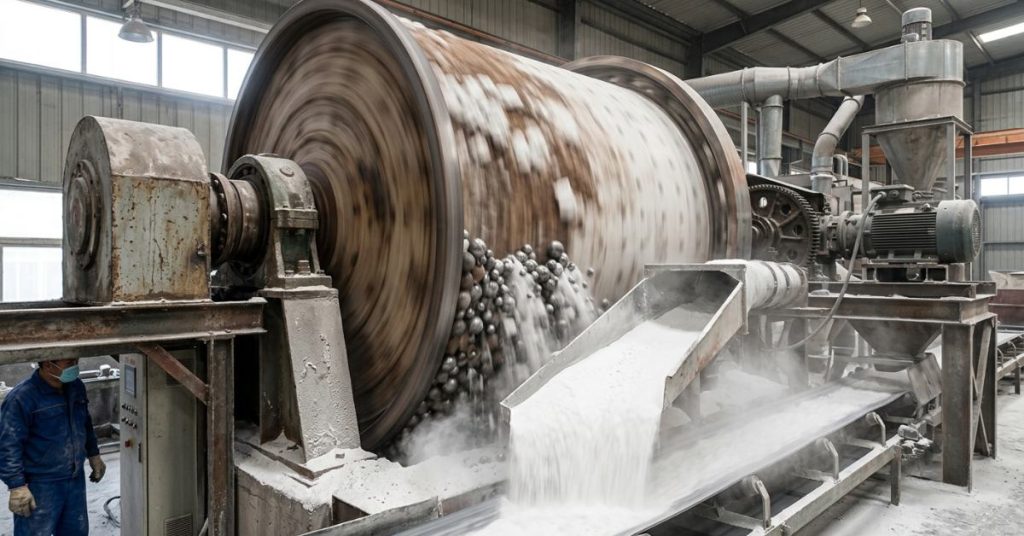
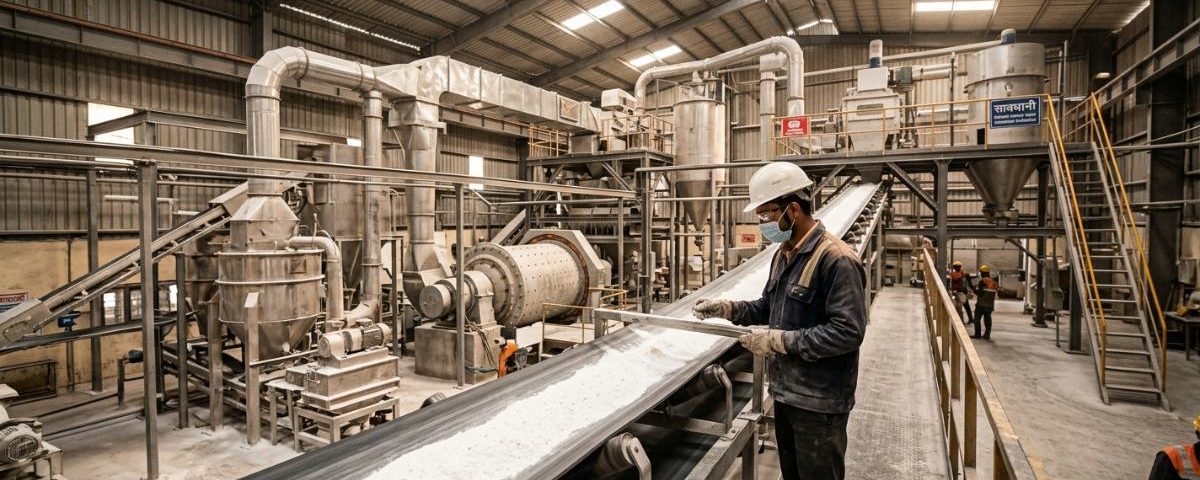
Quality quartz powder is the outcome of a controlled, multi-stage process. Understanding this process helps buyers ask sharper questions and spot shortcuts that compromise consistency.
1. Mining and Sourcing
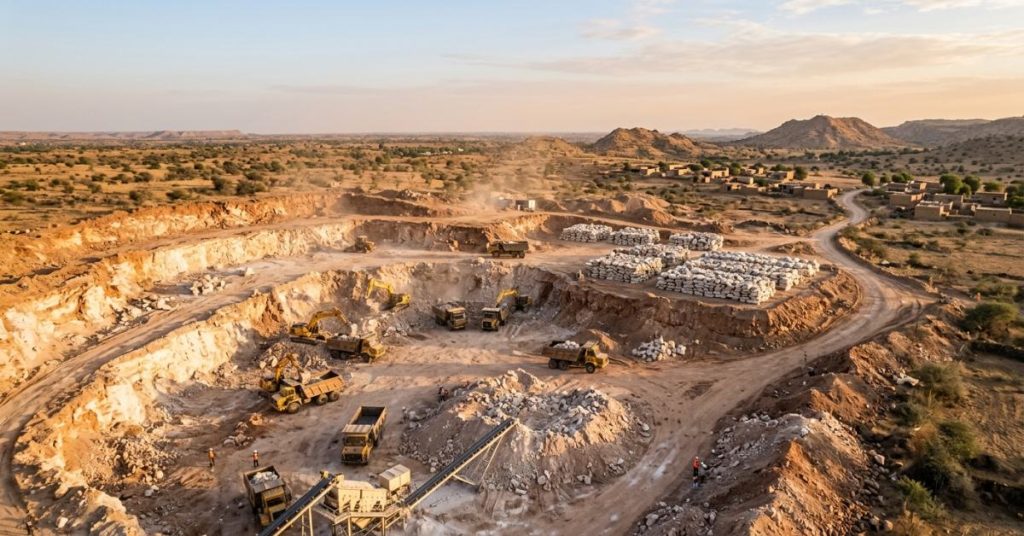
Manufacturers source quartz lumps from mining belts in Rajasthan, Gujarat, and parts of Andhra Pradesh, selecting deposits based on natural SiO₂ purity and low inherent iron content. Deposit selection is the single biggest determinant of final product quality – no amount of processing fully compensates for poor-quality raw material.
2. Crushing and pre-sorting
Raw lumps are crushed and manually or optically sorted to remove visibly discoloured or iron-stained stone before grinding begins. This pre-sorting step materially affects the final whiteness index.
3. Grinding and Classification
Ball mills, roller mills, or air classifying mills reduce the material to the target mesh size. Better manufacturers use closed-circuit grinding with air classifiers, which produces a tighter particle size distribution than open-circuit grinding – a detail that matters more to end-use performance than most buyers realise.
4. Iron Removal (Magnetic Separation)
High-intensity magnetic separators pull ferro-magnetic particles from the ground powder, reducing Fe₂O₃ content. Multiple passes are typically needed to hit premium-grade iron limits below 0.05%.
5. Acid Washing (For Ultra-High-Purity Grades)
For specialised applications such as solar glass or electronics, manufacturers may use acid leaching to further strip surface iron and trace metals, pushing purity above 99.5% SiO₂.
6. Drying, Screening and Packing
The final powder is dried to reduce moisture below industry thresholds, screened to confirm mesh compliance, and packed in moisture-resistant bags – typically HDPE-lined or laminated bags in 25 kg or 50 kg formats, with jumbo bags available for bulk export orders.
Quartz Powder Grades, Mesh Sizes & Technical Specifications
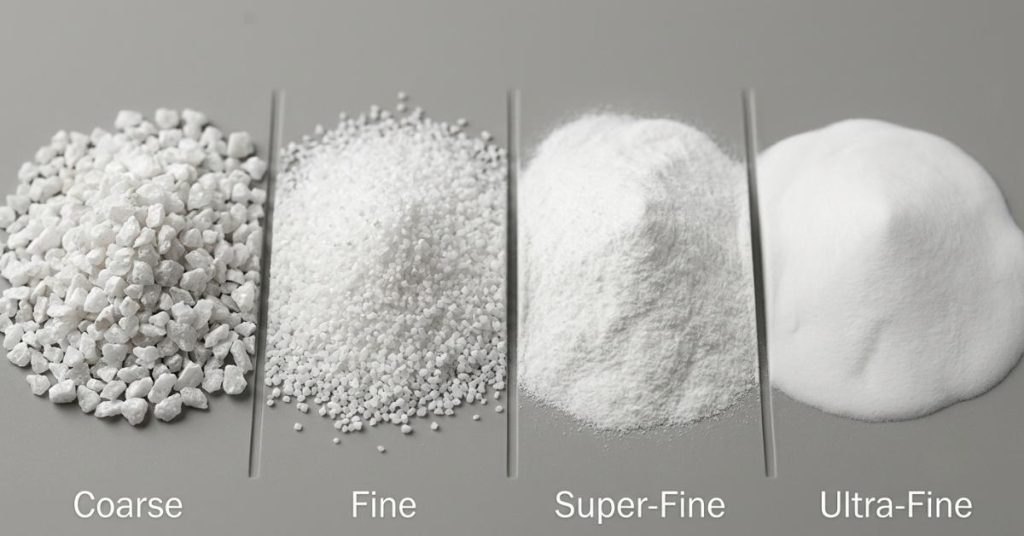
Buyers evaluating manufacturers should request a specification sheet covering the parameters below for the exact grade being quoted – not a generic brochure figure.
| Parameter | Standard Grade | Premium Grade | Ultra-High Purity |
| SiO₂ % | 98.0 – 98.8% | 98.8 – 99.4% | 99.4 – 99.7%+ |
| Fe₂O₃ % | 0.08 – 0.15% | 0.03 – 0.08% | Below 0.03% |
| Al₂O₃ % | 0.3 – 0.6% | 0.15 – 0.3% | Below 0.15% |
| Whiteness | 80 – 88 | 88 – 93 | 93 – 97+ |
| Moisture | Below 1.0% | Below 0.5% | Below 0.2% |
| Specific Gravity | 2.62 – 2.65 | 2.62 – 2.65 | 2.62 – 2.65 |
| Hardness (Mohs) | 7 | 7 | 7 |
1. Understanding Mesh Sizes
Mesh number indicates how fine the powder is – the higher the mesh number, the finer the particle size. Choosing mesh size incorrectly is one of the most common and costly buyer errors, since a mismatch affects flow behaviour, surface finish, and resin or glaze absorption.
| Mesh Size | Approx. Particle Size | Typical Application |
| 100 | 150 microns | Foundry, refractory bedding |
| 200 | 75 microns | Ceramic body, tile manufacturing |
| 240 | 63 microns | Sanitaryware, glaze preparation |
| 300 | 50 microns | Paint fillers, construction chemicals |
| 325 | 45 microns | Epoxy flooring, engineered stone |
| 400 | 37 microns | Coatings, adhesives |
| 500 | 25 microns | Fine ceramics, plastics |
| 600 | 20 microns | Rubber compounding, specialty coatings |
| 800 | 15 microns | High-fill epoxy, electrical insulation |
| 1000 | 10 microns | Precision fillers, cosmetics-adjacent uses |
| 1250 | Below 10 microns | Electronics, high-purity specialty use |
2. Particle Size Distribution – The Overlooked Spec
Two batches can share the same mesh rating yet behave differently in production if their particle size distribution (PSD) differs. A tightly distributed powder packs more predictably in resin systems and glaze suspensions, while a widely scattered distribution can cause settling, uneven glazing, or inconsistent flooring finish. Buyers running high-volume or performance-critical processes should request a PSD curve, not just a mesh number, from their manufacturer.
3. Packaging Standards
- 25 kg HDPE-laminated bags – standard for domestic B2B orders
- 50 kg bags – common for construction chemical and tile plants
- Jumbo bags (500 kg–1,000 kg) – preferred for export and high-volume industrial buyers
- Moisture-barrier liners – essential for coastal or long-transit shipments
- Custom private-label packaging – available from most established exporters on request
Applications: Where Quartz Powder Is Used
Quartz powder’s hardness, chemical inertness, and controllable whiteness make it a functional filler and raw material across a wide range of industries.
| Industry | Role of Quartz Powder | Typical Mesh Range |
| Ceramics & Tiles | Body strength, thermal stability, glaze base | 200 – 325 |
| Sanitaryware | Whiteness, vitrification support | 240 – 400 |
| Glass Manufacturing | Primary raw material for silica content | 100 – 200 |
| Solar Glass | Ultra-high purity feedstock for low-iron glass | 200 – 325 (UHP grade) |
| Paint & Coatings | Extender, opacity and texture control | 300 – 500 |
| Epoxy Flooring | Functional filler for hardness and finish | 325 – 800 |
| Construction Chemicals | Filler in grouts, mortars, self-levelling compounds | 200 – 400 |
| Engineered Stone (Quartz Slabs) | Primary aggregate with resin binder | 100 – 325 (blended) |
| Refractories | Silica source for kiln linings and castables | 100 – 240 |
| Foundries | Mould and core sand additive | 100 – 200 |
| Rubber & Plastics | Reinforcing filler, abrasion resistance | 400 – 600 |
| Adhesives & Sealants | Rheology control, bulking agent | 400 – 800 |
| Electrical Insulation | Dielectric filler in resin compounds | 600 – 1000 |
| Electronics | High-purity filler for encapsulation compounds | 800 – 1250 (UHP grade) |
Premium vs Low-Grade Quartz Powder: What Actually Differs
Price differences between manufacturers often trace back to a small number of process decisions. Understanding these helps buyers judge whether a lower quote reflects genuine efficiency or a quality shortcut.
| Factor | Low-Grade Product | Premium Product |
| Raw Material Selection | Mixed-source lumps, minimal sorting | Selected deposits, manual/optical pre-sorting |
| Iron Removal | Single-pass magnetic separation | Multi-pass separation, sometimes acid washing |
| Grinding Method | Open-circuit milling | Closed-circuit milling with air classification |
| Particle Distribution | Wide, inconsistent | Tight, batch-to-batch consistent |
| Quality Documentation | Informal or none | COA, MSDS, third-party lab reports per batch |
| Moisture Control | Variable, weather-dependent drying | Controlled drying to fixed moisture spec |
The practical takeaway: a quoted price should always be evaluated against a specification sheet, not in isolation. A 5–8% lower price paired with looser Fe₂O₃ tolerance or undocumented PSD can cost far more in rejected batches or production downtime than it saves.
Quality Testing & Certification Standards
Reliable manufacturers test every batch – not just periodic samples – against agreed specifications before dispatch.
1. Standard Testing Methods
- XRF (X-Ray Fluorescence) analysis – confirms SiO₂, Fe₂O₃, Al₂O₃ percentages
- Sieve analysis – verifies mesh size and particle size distribution
- Loss on Ignition (LOI) test – checks for organic or volatile impurities
- Whiteness/brightness meter reading – confirms colour consistency
- Moisture analysis – oven-dry weight comparison
- Specific gravity and bulk density testing
2. Documentation to Request Before Ordering
- Certificate of Analysis (COA) for the specific batch or a recent representative batch
- Material Safety Data Sheet (MSDS)
- Third-party lab test report (SGS, Intertech, or an accredited Indian lab)
- ISO 9001 certification for quality management systems
- Export documentation history if buying internationally
2026 Market Forces Shaping Demand, Grades and Pricing
Several converging trends are shaping how Indian quartz powder manufacturers price, package, and prioritise orders in 2026.
| Trend | Impact on Quartz Powder Buyers |
| Ceramic & tile industry expansion (Morbi cluster) | Rising domestic demand for 200–325 mesh ceramic-grade powder; longer lead times in peak season |
| Engineered stone growth | Increasing demand for consistent PSD and whiteness in coarser blended grades |
| Solar glass capacity additions | Growing requirement for ultra-high-purity, low-iron grades; premium pricing tier expanding |
| Paint & coatings sector growth | Steady demand for mid-mesh extender-grade powder; price sensitivity remains high |
| China-plus-one sourcing shift | International buyers increasingly evaluating Indian suppliers as alternative or supplementary sources |
| Mining and environmental compliance | Stricter state-level mining norms in Rajasthan affecting raw material lead times and cost |
| Freight and logistics costs | Ocean freight volatility directly affects landed cost for export buyers; packaging format influences container utilisation |
| Energy prices | Grinding is energy-intensive; power cost trends influence processing cost, especially for finer mesh grades |
| Government manufacturing initiatives | PLI-linked electronics and solar manufacturing growth is expanding demand for UHP-grade silica inputs |
For buyers, the practical implication is straightforward: request updated lead times and pricing ahead of Q1 and Q3, when domestic ceramic and construction demand typically peaks, and lock in supply agreements with manufacturers who can document consistent raw material sourcing rather than opportunistic spot buying.
Buyer’s Guide: Choosing the Right Manufacturer
1. Questions to Ask Every Supplier
- What is the exact SiO₂, Fe₂O₃, and Al₂O₃ range for this specific grade, backed by a recent COA?
- Can you share a particle size distribution curve, not just a mesh number?
- What is your minimum order quantity (MOQ), and does it change by mesh size?
- Do you offer export packaging (jumbo bags, container-optimised formats)?
- What quality certifications do you hold, and can I see a sample third-party lab report?
- What is your standard lead time, and how does it change in peak season?
- Can you produce custom mesh sizes or blends on request?
- Do you offer private labeling or custom packaging for branded resale?
- What is your sample policy – cost, quantity, and turnaround time?
- What are your payment terms for first-time versus repeat bulk orders?
2. Manufacturer Evaluation Checklist
- Verified factory address and manufacturing capacity
- Documented raw material sourcing (mine location or supplier chain)
- In-house or third-party lab testing capability
- Export track record with reference buyers or shipment history
- Consistent batch-to-batch specification match
- Responsive technical team (not just a sales contact)
- Realistic lead times that match your production schedule
- Transparent, itemised pricing (ex-factory vs FOB vs CIF clarity)
Step-by-Step Buying Process
- Define your technical requirement – mesh size, purity range, whiteness, and application.
- Shortlist 3–5 manufacturers based on certifications, export experience, and specification match.
- Request COA, MSDS, and third-party lab reports for the exact grade you need.
- Order a paid or free sample and independently test it against your process requirements.
- Negotiate pricing based on order volume, packaging format, and delivery terms (ex-factory, FOB, or CIF).
- Confirm lead time in writing, including any seasonal buffer.
- Place a trial bulk order before committing to a long-term supply agreement.
- Set up a recurring quality-check protocol for repeat shipments.
2026 Bulk Pricing Guide
Quartz powder pricing is not a fixed market rate – it is a function of several interacting variables. This section explains how those variables move price, without quoting invented figures that would mislead buyers.
| Pricing Factor | How It Moves Price |
| Purity grade (SiO₂ %) | Higher purity and lower Fe₂O₃ require more processing steps (multi-pass separation, acid washing), raising cost |
| Mesh fineness | Finer mesh requires longer grinding time and tighter quality control, increasing per-tonne cost |
| Order quantity | Larger, consistent orders typically secure better per-tonne rates due to production planning efficiency |
| Packaging format | Custom or laminated packaging, private labeling, and small-bag formats add cost versus standard bulk bags |
| Transportation & freight | Distance from mine/factory, current freight rates, and container availability affect landed cost |
| Customization | Custom mesh blends or tailored PSD specifications typically carry a processing premium |
| Export documentation & compliance | Additional lab testing, certification, and export paperwork add marginal cost for international orders |
| Payment and delivery terms | Ex-factory pricing is lowest; FOB and CIF pricing include logistics and insurance layers |
Buyers should always request quotations broken down by these components rather than a single bundled number. A transparent manufacturer will readily itemise ex-factory price, packaging cost, and freight – an opaque quote is itself a signal worth questioning.
Common Buyer Mistakes to Avoid
- Choosing a supplier on price per tonne alone, without matching specifications
- Skipping independent sample testing before placing a bulk order
- Ignoring particle size distribution and relying only on the mesh number
- Not confirming moisture specification for long-transit or coastal shipments
- Failing to lock in lead times in writing before peak season
- Overlooking packaging suitability for the shipping route and climate
- Assuming all ‘premium’ labeled powder meets the same purity threshold
- Not requesting a batch-specific COA, relying instead on generic brochure specs
Pros & Cons of Sourcing Quartz Powder from India
| Pros | Cons |
| Large, established mining and processing base in Rajasthan and Gujarat | Quality variance is significant between manufacturers – due diligence is essential |
| Competitive pricing relative to several alternative sourcing regions | Peak-season lead times can extend during domestic ceramic industry demand spikes |
| Growing export experience and improving compliance documentation | Not all manufacturers offer ultra-high-purity grades for specialised applications |
| Flexible packaging including export-ready jumbo bags | Freight cost volatility affects landed cost for distant international buyers |
| Wide range of mesh sizes available from established players | Smaller manufacturers may lack consistent third-party testing infrastructure |
Future Outlook: 2026–2030
Demand for high-purity and ultra-high-purity quartz powder is expected to grow faster than standard-grade demand, driven by solar glass expansion, electronics manufacturing incentives, and the continued rise of engineered stone as a mainstream construction material. Manufacturers investing in closed-circuit grinding, acid-washing capability, and consistent third-party testing are positioned to capture this higher-value segment.
At the same time, standard-grade demand from ceramics, construction chemicals, and paint will likely remain the volume backbone of the industry, with price competitiveness and reliable logistics remaining the deciding factors for buyers in these segments. Export buyers are expected to continue diversifying supplier bases, which favours Indian manufacturers who can document quality consistency and compliance rather than compete purely on price.
Conclusion
Quartz powder has moved from a commodity purchase to a specification-driven procurement decision. The manufacturers who consistently deliver value are those who can document purity, control particle size distribution, and back every batch with verifiable testing – not simply those with the lowest quoted price.
Buyers who evaluate manufacturers against the framework in this guide – technical specification match, documented testing, transparent pricing breakdown, and realistic lead times – are far better positioned to build a dependable, long-term supply relationship in 2026 and beyond.
Frequently Asked Questions
Q1. What is the difference between quartz powder and silica powder?
Quartz powder and silica powder are often used interchangeably, but quartz powder specifically refers to ground natural quartz, while silica powder can also include synthetic or precipitated silica. Both are primarily SiO₂, but quartz powder retains the natural mineral’s crystalline hardness and is preferred where mechanical strength and chemical inertness matter, such as ceramics, glass, and epoxy flooring.
Q2. What SiO₂ purity should I look for in industrial-grade quartz powder?
Standard industrial applications like ceramics and construction chemicals typically work well with 98–98.8% SiO₂. Applications requiring higher clarity or chemical stability, such as paint extenders or engineered stone, often need 98.8–99.4%. Solar glass and electronics applications generally require 99.4% or higher with very low iron content.
Q3. How do I know which mesh size is right for my application?
Mesh size should match your process, not general assumptions. Coarser mesh (100–240) suits ceramics, refractories, and foundries, while finer mesh (325–800) suits epoxy flooring, coatings, and adhesives. Ultra-fine mesh (1000+) is typically reserved for electronics and specialty fillers. Always confirm with your manufacturer’s technical team or a small trial batch before committing to bulk orders.
Q4. What is an acceptable moisture level in quartz powder?
Standard-grade powder is generally acceptable below 1.0% moisture, while premium grades target below 0.5%, and ultra-high-purity grades below 0.2%. Higher moisture can cause clumping, inconsistent glaze application, and issues in resin-based applications like epoxy flooring, so always confirm the moisture specification in writing.
Q5. Why does iron content (Fe₂O₃) matter so much in quartz powder?
Iron oxide is the primary driver of discoloration and reduced whiteness in quartz powder. Even small increases in Fe₂O₃ can cause yellowish or grey tints that are unacceptable in white ceramics, glass, and engineered stone. Lower iron content also generally correlates with better chemical purity overall, which matters for high-value or specialty applications.
Q6. What documents should a quartz powder manufacturer provide before shipment?
At minimum, request a Certificate of Analysis (COA) for the specific batch, a Material Safety Data Sheet (MSDS), and ideally a third-party lab test report from an accredited testing agency. ISO 9001 certification and export shipment history are additional indicators of a manufacturer’s reliability and consistency.
Q7. Is Indian quartz powder suitable for export to Southeast Asia and the Middle East?
Yes, Indian quartz powder is widely exported to these regions, particularly for ceramics, construction chemicals, and glass manufacturing. Established exporters offer export-ready packaging, standard compliance documentation, and container-optimised jumbo bag formats suited to long-distance shipping.
Q8. What is the typical minimum order quantity (MOQ) for quartz powder?
MOQ varies by manufacturer and mesh size, with finer or custom grades often carrying higher MOQs due to dedicated grinding runs. Buyers should confirm MOQ directly with shortlisted suppliers, as it can range from a single jumbo bag to full container loads depending on the manufacturer’s production setup.
Q9. Can manufacturers produce custom mesh sizes or blends?
Many established Indian manufacturers offer custom mesh sizing and blended specifications on request, particularly for buyers with specific process requirements. This typically involves a processing premium and may carry a higher MOQ than standard stocked grades.
Q10. How much does packaging affect quartz powder pricing?
Packaging format influences both material cost and logistics efficiency. Standard 25–50 kg bags are the most economical for domestic orders, while jumbo bags reduce per-tonne handling cost for bulk and export orders. Custom or private-label packaging typically adds a moderate premium.
Q11. What is the difference between ex-factory, FOB, and CIF pricing?
Ex-factory pricing covers only the product cost at the manufacturer’s gate, excluding transport. FOB (Free on Board) adds costs up to loading the goods onto the export vessel. CIF (Cost, Insurance, Freight) includes shipping and insurance to the destination port. Always confirm which pricing basis a quotation reflects before comparing suppliers.
Q12. How do I verify a quartz powder sample before placing a bulk order?
Request a representative sample and test it independently for SiO₂ purity, Fe₂O₃ content, whiteness, moisture, and particle size distribution, ideally through an accredited third-party lab. Comparing sample results against the manufacturer’s COA for the same batch helps confirm consistency and trustworthiness.
Q13. What causes inconsistent quality between batches from the same supplier?
Batch inconsistency usually stems from variable raw material sourcing, insufficient magnetic separation, or lack of standardized process controls. Manufacturers using consistent deposit sourcing and closed-circuit grinding with regular quality checks tend to deliver more uniform batches over time.
Q14. Is quartz powder hazardous to handle or ship?
Quartz powder itself is chemically inert, but fine silica dust can pose respiratory risks during handling if proper dust control and PPE are not used. Reputable manufacturers provide an MSDS outlining safe handling, storage, and transport guidelines, which buyers should review and share with their own operations teams.
Q15. What is the shelf life of quartz powder?
Quartz powder does not degrade chemically over time, but prolonged storage in humid conditions can increase moisture content and cause clumping. Proper moisture-barrier packaging and dry warehouse storage allow quartz powder to remain usable indefinitely without quality loss.
Q16. How does quartz powder differ for glass manufacturing versus ceramics?
Glass manufacturing typically requires higher SiO₂ purity and stricter iron limits to avoid discoloration in the final glass, especially for solar and flat glass applications. Ceramic applications are somewhat more tolerant of moderate impurity levels, though whiteness and consistency still matter significantly for tile and sanitaryware quality.
Q17. Can I request private labeling for quartz powder packaging?
Yes, most established exporters offer private-label packaging, allowing buyers to brand bags with their own company name and specifications. This is common among distributors and resellers who want consistent branding across their supply chain.
Q18. What lead time should I expect for a bulk quartz powder order?
Lead times vary by manufacturer capacity, mesh size, and season, but typically range from one to four weeks for standard grades, with longer timelines during peak ceramic and construction demand periods. Always confirm lead time in writing and build in a buffer for custom or export orders.
Q19. Does quartz powder pricing fluctuate seasonally?
Yes, pricing and availability can tighten during peak domestic demand periods, particularly when ceramic and construction sectors ramp up production. Locking in supply agreements or placing orders ahead of these peak windows can help buyers secure more stable pricing and lead times.
Q20. What is the best way to compare multiple quartz powder manufacturers?
Compare manufacturers on a like-for-like specification basis – same mesh size, same purity range, same packaging format – rather than comparing headline price alone. Request COAs, sample test results, and itemised pricing breakdowns from each shortlisted supplier before making a final decision.