

- Call for Sales Enquiries

- +91-9413034047
- +91-294-2413244
- info@pratibharefractory.com

Talc Powder for Rubber Manufacturing: Uses, Benefits and Grade Selection

Talc Powder in PVC: Benefits, Uses & How to Choose the Right Grade
October 8, 2026
Dolomite Powder for Wall Putty: Properties & Grade Selection
October 14, 2026Talc Powder for Rubber Manufacturing: Uses, Benefits and Grade Selection
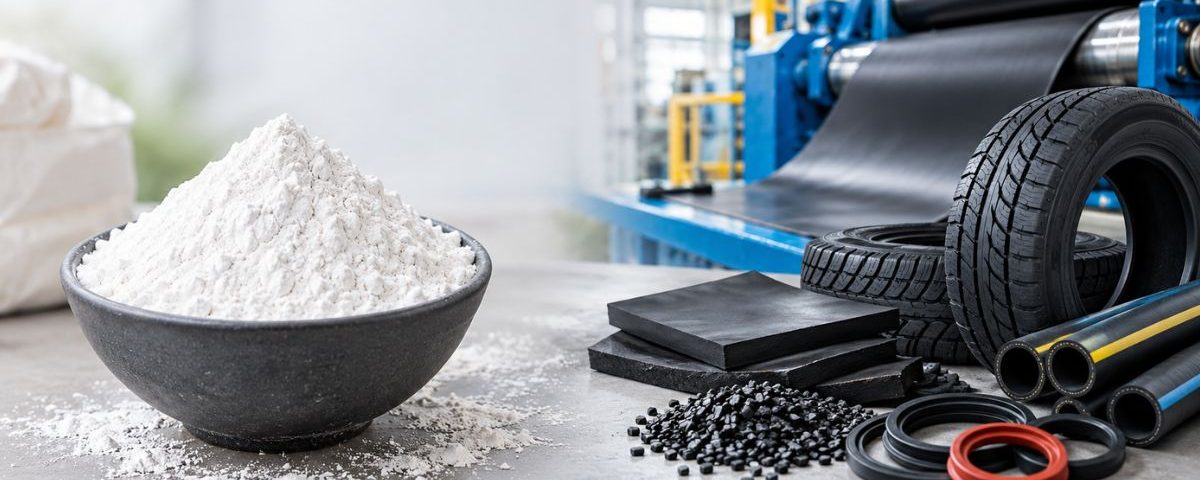
Talc powder for rubber is a finely ground hydrated magnesium silicate. Compounders use it in selected formulations as a mineral filler, and in other forms as a dusting or anti-blocking agent. Whether it suits a compound depends on the rubber type, the grade’s particle size and shape, the dosage and the processing method. No single grade works everywhere. The right choice comes from reviewing technical data and running trials in your own formulation.
Rubber manufacturers evaluate mineral fillers to balance cost, processability and end-product requirements. Talc is one option. This guide explains where it fits, what to check in a technical data sheet, and how to avoid common buying mistakes.
What Is Talc Powder and Why Is It Used in Rubber Manufacturing?
Talc is a naturally occurring hydrated magnesium silicate. Its relevant characteristics for rubber are:
- Platy (lamellar) particle shape, which differs from the blocky particles of many other fillers.
- Softness and low abrasiveness.
- Chemical inertness and insolubility in water.
Technical literature describes talc in rubber as a semi-reinforcing filler or processing aid in suitable compounds. Older rubber-industry literature also describes it as a dusting material and an inert filler in products such as flooring and insulating compounds. Both descriptions are accurate. The role depends on the grade and the use.
Particle size, particle shape, dosage and compatibility with the rubber system all influence the outcome. Two talc grades can behave very differently in the same compound.
Key Applications of Talc Powder in Rubber Products
Talc is evaluated in several rubber product categories, depending on formulation and technical suitability:
- Molded and extruded rubber compounds, where a mineral filler is part of the recipe.
- Automotive rubber components, where the compounder has confirmed suitability for the specific part.
- Rubber sheets, mats and flooring-type products.
- Industrial rubber goods where filler cost, processing and surface characteristics are priorities.
Compound filler vs dusting agent
These are different uses and call for different grades:
- As a filler, talc is mixed into the compound and becomes part of the vulcanised product. Particle size, shape and purity matter most.
- As a dusting or anti-blocking material, talc is applied to rubber surfaces, for example to prevent sticking during storage and handling. Handling characteristics and cleanliness are the main concerns.
Do not assume a grade that works for one use will work for the other.
Benefits of Talc Filler for Rubber
Benefits are conditional. In suitable formulations, talc filler for rubber may offer:
- Filler functionality, with its platy shape contributing differently from rounded fillers.
- Processing effects. Some grades are reported to lower compound viscosity and help flow in extrusion and moulding. This depends on grade and loading.
- Dispersion-dependent behaviour. Finer particles can disperse more evenly but may also behave differently in mixing. Dispersion quality is worth checking by trial.
- Surface finish and dimensional characteristics, depending on formulation.
- Production consistency, when the grade is consistent from batch to batch.
Talc does not automatically improve tensile strength, elongation, abrasion resistance or heat resistance. Any such effect must be confirmed in your own compound.
How to Select the Right Talc Powder Grade for Rubber
Evaluate these factors together:
- Particle size and distribution. A sieve or mesh figure alone says little about the median particle size or the fine tail. Ask for a laser-diffraction particle size distribution where possible.
- Fineness and dispersion. Check how the grade disperses in your mixing process.
- Purity and mineral composition. Accompanying minerals can affect behaviour. Ask what the composition data covers.
- Moisture content. Moisture can affect handling and processing.
- Whiteness or colour, where appearance matters.
- Compatibility with your rubber and cure system.
- Batch consistency.
- Documentation. Ask for a technical data sheet and a certificate of analysis.
No single number decides suitability. Select a shortlist on paper, then confirm with laboratory or production trials.
Talc Powder Specifications for Rubber Manufacturing
Use this table to review any talc powder specification sheet. Values are application-dependent, so confirm them against your own requirement and the supplier’s documentation.
| Specification parameter | Why it matters | What the buyer should verify |
|---|---|---|
| Particle size / distribution | Affects dispersion, viscosity and surface finish | Median size and distribution method, not mesh alone |
| Particle morphology (platy vs blocky) | Influences reinforcement and barrier behaviour | Whether the grade is described as high or low aspect ratio |
| Moisture content | Can affect handling and processing | Test method and typical limit stated on the data sheet |
| Mineral purity / composition | Accompanying minerals may change behaviour | Composition data and how it was measured |
| Whiteness / colour | Matters for light-coloured or visible products | Method and typical range, if relevant to your product |
| Loss on ignition / other chemistry | Indicates composition and consistency | Whether the supplier reports it and how it varies by lot |
| Batch consistency | Prevents processing variation | Certificate of analysis for each lot |
| Asbestos-free statement | Common buyer compliance requirement | Ask the supplier what documentation they can provide |
Talc Powder vs Other Mineral Fillers in Rubber
Talc, calcium carbonate and silica are not interchangeable.
- Talc: platy particles. Used as a filler and processing aid in selected compounds, and as a dusting agent. Behaviour varies sharply by grade.
- Calcium carbonate: widely used as a cost-effective extender with generally blocky particles. It is usually chosen where volume and economy lead the decision.
- Silica: used as a reinforcing filler, particularly where reinforcement is a primary goal. It generally needs more careful dispersion and compounding.
Switching between them changes the compound. Any substitution should be validated against the target properties.
Common Mistakes When Buying Talc Powder for Rubber
- Choosing on price alone. A cheaper grade can cost more through processing problems.
- Ignoring moisture and particle-size consistency. Variation between lots can affect production.
- Assuming all talc grades behave identically. Shape, size and purity differ.
- Overlooking dispersion and compatibility.
- Buying without documentation or testing. Always review the data sheet and run a trial first.
How to Choose an Industrial Talc Powder Supplier
Evaluate suppliers on:
- Product specifications and grade availability.
- Batch-to-batch consistency.
- Technical documentation, including data sheets and certificates of analysis.
- Packaging and bulk supply capability.
- Export and logistics support, where relevant.
- Responsiveness to application-specific questions.
Ask for samples and documentation, and compare suppliers on the same basis.
Frequently Asked Questions
What is talc powder used for in rubber manufacturing?
In suitable formulations, talc is used as a mineral filler or processing aid. In other forms it serves as a surface dusting or anti-blocking agent.
Can talc powder be used as a filler in rubber compounds?
Yes, in selected compounds. Suitability depends on the rubber type, grade, dosage and target properties, so confirm it by trial.
Which talc powder specifications matter for rubber applications?
Particle size and distribution, particle shape, moisture, purity, whiteness where relevant, and batch consistency, along with data sheet and certificate of analysis availability.
Does finer talc powder always perform better in rubber?
No. Finer grades may disperse differently and affect viscosity and processing. The best size depends on the compound and the process.
How do manufacturers select the right talc grade?
They shortlist grades from technical data, then run laboratory or production trials in their own formulation.
What should buyers check before purchasing industrial talc powder?
The technical data sheet, certificate of analysis, batch consistency, moisture and particle-size data, packaging options and the supplier’s support for your application.
Conclusion: Choosing the Right Talc Powder for Rubber Applications
Good results with talc in rubber come from matching the grade to the application. That means reviewing particle size, purity, moisture and consistency, and confirming the choice by testing.
If you manufacture rubber products and are evaluating industrial talc powder, contact Pratibha Refractory Minerals to discuss your application requirements, available grades, technical specifications and bulk supply enquiries.