

- Call for Sales Enquiries

- +91-9413034047
- +91-294-2413244
- info@pratibharefractory.com

Dolomite Powder for Wall Putty: Properties & Grade Selection

Talc Powder for Rubber Manufacturing: Uses, Benefits and Grade Selection
October 14, 2026Dolomite Powder for Wall Putty: Properties & Grade Selection
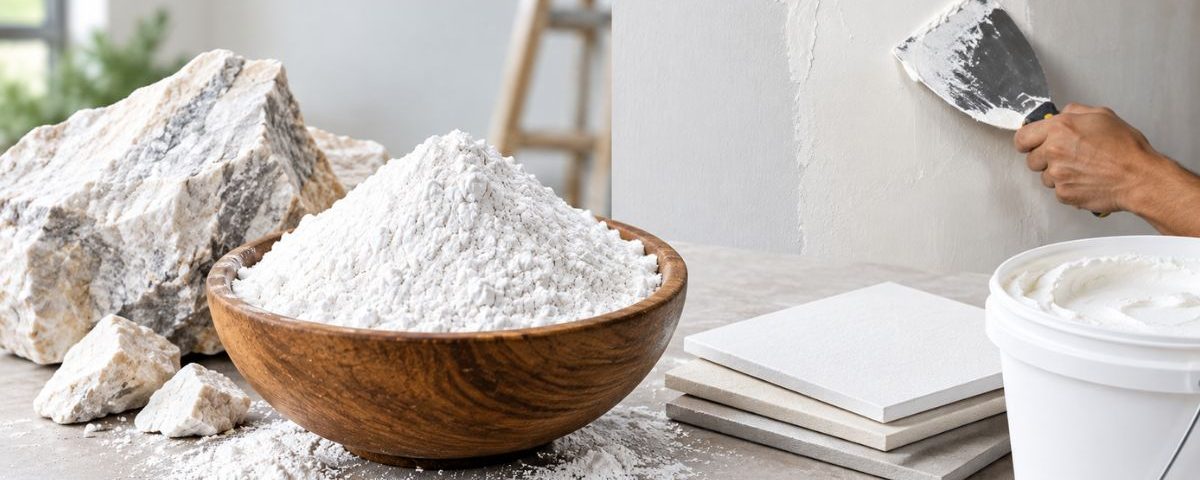
Dolomite powder for wall putty is a calcium magnesium carbonate mineral filler that manufacturers can use in suitable cement-based and polymer-modified formulations. The right grade depends on particle-size distribution, chemical composition, whiteness, moisture and batch consistency. Its suitability must always be confirmed through laboratory and production trials. Mineral fillers form the skeleton of a putty, so small shifts in fineness or moisture can change workability, finish and cost. This guide explains which properties to check, how to select a grade and what to ask a supplier before bulk procurement.
Quick answer: Look for a stated CaO/MgO range, controlled particle-size distribution and sieve residue, consistent whiteness, low moisture, a technical data sheet (TDS), a batch-wise certificate of analysis (COA) and a supplier willing to support sample trials.
What Is Dolomite Powder?
Dolomite is a calcium magnesium carbonate, CaMg(CO₃)₂. Its ideal composition works out to roughly 30.4% CaO, 21.7% MgO and 47.9% CO₂. Natural deposits rarely match this exactly because they carry impurities such as silica and iron. Dolomite has a Mohs hardness of 3.5–4 and a density of about 2.86 g/cm³.
It is closely related to calcite (calcium carbonate), but it contains magnesium and is slightly harder. Calcite has a hardness of 3. Industrial dolomite powder is made by crushing, grinding and classifying the rock.
Two powders sold under the same name can behave differently in a putty. Particle size, composition and consistency decide how a powder mixes, packs and finishes, so grade details matter more than the mineral name.
Why Is Dolomite Powder Used in Wall Putty?
Patent literature on wall fillers and putty compositions lists calcium carbonate or dolomite among the main mineral fillers. Manufacturers evaluate it for these reasons:
- Mineral filler requirement: it supplies fine, white-to-off-white bulk to the dry mix.
- Raw material selection: it can be assessed alongside other fillers on availability and grade.
- Particle packing and finish: the particle-size distribution may influence packing and surface finish, but this must be shown by testing.
- Handling and consistency: a free-flowing, dry powder is easier to blend and bag.
- Cost-performance: the overall cost of the formulation should be compared with a trial-validated baseline.
Some facts are established: composition, hardness and density. Other effects depend on the formulation and must be tested, including whiteness, workability, water demand and crack behaviour. Dolomite does not automatically improve whiteness, adhesion, smoothness, water resistance or crack resistance.
Important Properties of Dolomite Powder for Wall Putty
- Particle size and distribution: this affects packing, water demand, workability and surface texture. A distribution curve says more than a single mesh number.
- Fineness and residue on sieve: coarse residue can show up as surface defects during finishing.
- Chemical composition: CaO and MgO content shows how close the material is to pure dolomite. It also shows how much calcite or other phases are present.
- Whiteness and colour consistency: these affect the appearance of the putty and any paint applied over it.
- Moisture content: moisture can cause lumping, and it can affect storage stability in dry-mix products.
- Impurities and insoluble residue: iron or silica can affect colour and abrasiveness.
- Bulk density and flow: these influence blending, dust behaviour and packaging.
- Batch-to-batch consistency: repeatable properties keep the formulation, colour and finish stable between production runs.
Supplier figures are a starting point. Final suitability needs trials in your own formulation with your binder, polymer and additives.
Dolomite Powder Specifications for Wall Putty
No universal grade suits every putty. The table shows what to request and verify.
| Technical parameter | Why it matters | What wall putty manufacturers should verify |
|---|---|---|
| Particle-size distribution | Affects packing, water demand and finish | Full distribution curve, test method, tolerance between batches |
| Residue on sieve | Coarse particles can cause surface defects | Sieve size, residue limit, measurement method |
| CaO and MgO content | Indicates dolomite purity and consistency | Range per batch, as shown on the COA |
| Whiteness | Affects putty appearance | Measurement method and variation between batches |
| Moisture content | Affects flow, lumping and storage | Limit at dispatch, packaging and storage advice |
| Impurities / insoluble residue | Affects colour and abrasiveness | Limits for silica, iron and insoluble matter |
| Bulk density | Affects blending, dusting and packing | Density basis (loose or tapped) and range |
| Consistency | Keeps production predictable | TDS, batch COAs, retained samples |
Pratibha’s published reference data (from the company’s bulk dolomite page; confirm the current values with the technical desk):
| Parameter | Published reference |
|---|---|
| CaO / MgO | 30–32% / 20–22% |
| Whiteness (Y-value) | 92–96% |
| Moisture | Below 0.3% |
| Mesh sizes | 100, 325, 500 and 1250 (micronised) |
| Documentation | COA with shipments; pre-shipment samples on request |
How to Select the Right Dolomite Powder Grade for Wall Putty
- Define the finished-product targets: application surface, finish, colour and cost.
- Shortlist by fineness: compare particle-size distribution and residue against current practice.
- Check composition and impurities: review CaO/MgO and impurity limits on the TDS.
- Confirm colour requirements: match whiteness and its consistency to the product shade.
- Review moisture and storage: check dispatch moisture, packaging and your storage conditions.
- Check compatibility: test with your binder, polymer, cellulose ether and additives.
- Validate: run laboratory trials, then production-scale validation.
- Compare documents before bulk orders: match the TDS and batch COAs to the sample you trialled.
No grade should be recommended without verified data from your own trials.
Dolomite Powder vs Calcium Carbonate for Wall Putty
Neither is universally superior. Both are carbonate fillers used in dry-mix products.
| Aspect | Dolomite powder | Calcium carbonate |
|---|---|---|
| Composition | Calcium magnesium carbonate | Calcium carbonate |
| Hardness | Mohs 3.5–4 | Mohs about 3 |
| Grades | Depends on source and processing | Depends on source and processing |
| Formulation factors | Test water demand, workability and finish | Test water demand, workability and finish |
| Documentation | Needs TDS, COA and PSD | Needs TDS, COA and PSD |
During trials, compare like-for-like grades on whiteness, particle-size distribution, handling, finish and cost. The right choice depends on your formulation, required performance, available grade and production economics.
Common Mistakes When Buying Dolomite Powder for Wall Putty
- Selecting on price alone and ignoring cost-in-use.
- Ignoring particle-size distribution and checking only a mesh number.
- Overlooking moisture and impurities.
- Assuming every dolomite grade performs identically.
- Not reading the technical data sheet.
- Skipping laboratory trials.
- Not tracking consistency across batches.
How to Choose a Dolomite Powder Supplier
Use this checklist:
- Product specifications are clearly documented.
- The grade suits wall putty and dry-mix use.
- Batches are consistent.
- A TDS and COA are available where applicable.
- Samples can be evaluated before bulk procurement.
- Packaging and quantity options match your needs.
- Delivery and export support are available if you import.
- Quotations and technical queries get prompt responses.
Pratibha Refractory Minerals, based in Udaipur, Rajasthan, supplies dolomite powder to industrial buyers. Its published information covers a COA with shipments and pre-shipment samples for evaluation. See also its guide to bulk dolomite powder supply and export.
Frequently Asked Questions
1. What is dolomite powder used for in wall putty?
It is used as a mineral filler alongside white cement, polymers and additives in suitable formulations. It contributes fine mineral bulk to the dry mix. Its effect on whiteness, workability and finish depends on the grade and the formulation, so confirm performance through trials rather than assuming it.
2. Which properties of dolomite powder matter for wall putty manufacturing?
Particle-size distribution, sieve residue, CaO and MgO content, whiteness, moisture, impurities such as silica and iron, bulk density and batch consistency. Together they influence mixing, water demand, finish and colour. Ask for a technical data sheet covering these before requesting samples.
3. How do manufacturers select the right dolomite powder grade?
Start with the finished-putty requirements, then shortlist grades by fineness, composition, whiteness and moisture. Run laboratory trials in your own formulation and compare them with your current filler. Validate at production scale. Order in bulk only when the data sheet and batch certificates match the trial material.
4. Is finer dolomite powder always better for wall putty?
No. Finer powder has more surface area and may raise water or polymer demand, and it can change handling and cost. The overall distribution often matters more than one fineness figure. The best fineness is the one that meets finish, workability and cost targets in your tested formulation.
5. What specifications should buyers check before purchasing dolomite powder?
Request particle-size distribution and sieve residue, CaO and MgO content, whiteness, moisture, impurity limits, bulk density and packing details. Also ask whether a certificate of analysis accompanies each batch, and which test methods were used, so supplier figures are comparable with your incoming checks.
6. What is the difference between dolomite powder and calcium carbonate in wall putty?
Dolomite is calcium magnesium carbonate, while calcium carbonate has no magnesium in its ideal form, and dolomite is slightly harder. Both are used as mineral fillers. Neither is universally better; the choice depends on available grade, whiteness, trial results and overall economics.
7. Why is batch consistency important when buying dolomite powder?
Putty is made in repeated batches, so variation in fineness, whiteness or moisture can appear as differences in workability, colour or finish between runs. Consistent supply lets manufacturers keep formulations fixed and limit rework. Batch certificates and retained samples help detect drift early.
Conclusion
Choosing dolomite powder for wall putty comes down to grade selection, particle-size distribution, chemical composition, moisture, consistency and formulation testing. Verified data and trial results should drive the decision, not price or mesh number alone.
Wall putty and construction material manufacturers can share their application requirements with Pratibha Refractory Minerals to discuss available grades, verified specifications, samples and bulk supply enquiries.