

- Call for Sales Enquiries

- +91-9413034047
- +91-294-2413244
- info@pratibharefractory.com

Why Vietnam’s Steel Giants and Float Glass Industry Prefer High-Purity Dolomite from India

Soapstone Lumps & Talc Powder for Bangladesh: Land Border vs Sea Routes
May 19, 2026
Bulk Industrial Minerals Supply: A Complete Sourcing Guide for International Buyers (India)
June 10, 2026Why Vietnam’s Steel Giants and Float Glass Industry Prefer High-Purity Dolomite from India
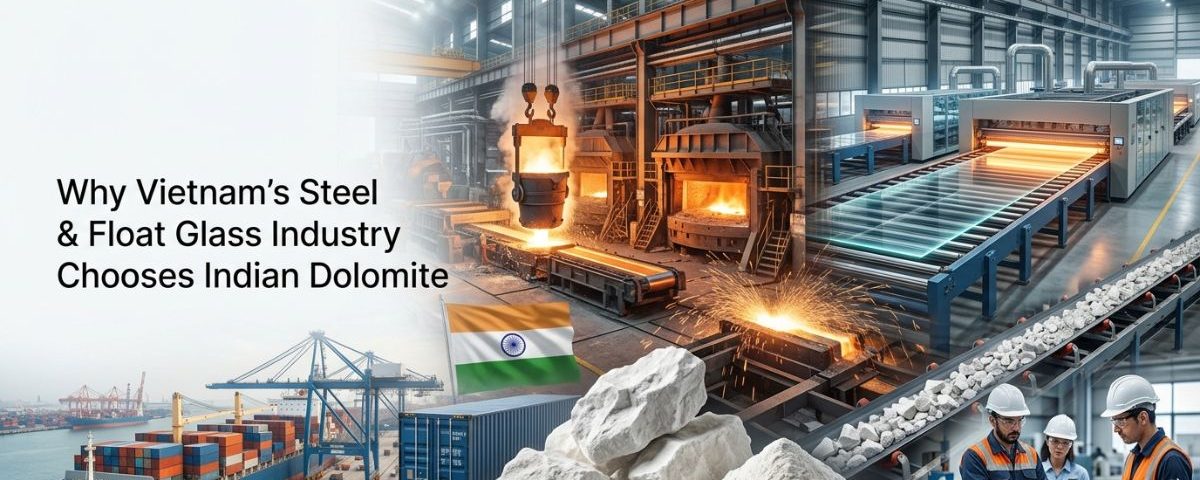
Vietnam’s industrial map looks very different than it did a decade ago. Steel output has climbed past 20 million tonnes annually, and the country now ranks among the top steel producers in Southeast Asia. Float glass capacity has expanded alongside it, feeding a construction boom, a growing automotive sector, and an electronics manufacturing base that keeps pulling in foreign investment.
That kind of growth puts pressure on raw material supply. Steel plants and glass furnaces run continuously, and they cannot afford inconsistent inputs. One off-spec shipment of flux or one batch of dolomite carrying too much iron can throw off a heat or cloud an entire run of glass.
This is exactly where dolomite for the Vietnam steel industry has become a quiet but critical part of the supply chain. And increasingly, procurement teams in Hanoi, Hai Phong, and the southern industrial zones are sourcing that dolomite from India rather than relying solely on regional options.
There are good technical and commercial reasons for that shift. Let’s walk through them.
Why Vietnam’s Steel Industry Needs High-Purity Dolomite
Inside a steel plant, dolomite does two jobs, and both depend on chemistry.
First, it works as a flux material in steel plants. During smelting and refining, impurities like silica and alumina need to be carried out of the molten metal. Dolomite supplies calcium oxide (CaO) and magnesium oxide (MgO), which react with those impurities to form slag that floats off the surface. A clean, predictable flux means a cleaner heat and less rework.
Second, the role of MgO in steelmaking goes beyond fluxing. Magnesium oxide protects the refractory lining of furnaces and ladles. When the slag carries enough MgO, it stops aggressively eating into the magnesia-based refractory bricks. That extends lining life, reduces unplanned shutdowns, and lowers maintenance cost per tonne of steel. For a basic oxygen furnace or electric arc furnace running around the clock, even a small gain in lining life translates into real money.
This is why steel buyers care so much about the CaO and MgO balance. They are not just buying a mineral; they are buying a specific reaction profile. Steel-grade dolomite typically needs MgO in the range of 18–21% and a tight CaO-to-MgO ratio, with low levels of silica and iron that would otherwise interfere with slag chemistry.
Calcined dolomite for Vietnam plants is also in demand. When dolomite is calcined, carbon dioxide is driven off and the material becomes more reactive, which suits certain steelmaking and refractory applications. A supplier who can deliver both raw and calcined grades is far more useful to a procurement team than one who only handles a single form.
Featured snippet paragraph: Dolomite is used in the Vietnam steel industry as a flux material that removes impurities during smelting and as a source of magnesium oxide (MgO) that protects furnace refractory linings. High-purity, low-iron dolomite with an MgO content of around 18–21% improves slag chemistry, extends lining life, and produces cleaner steel.
The Role of Dolomite in Float Glass Manufacturing
Float glass is where purity stops being a preference and becomes non-negotiable.
In a float glass batch, dolomite supplies both calcium and magnesium to the glass network. Those elements improve chemical durability and control the way the molten glass flows and sets on the tin bath. Without the right magnesia balance, glass becomes harder to work and more prone to defects.
But the headline issue in dolomite for the float glass industry is iron.
Why low iron content matters so much in float glass: Iron oxide is the single biggest enemy of glass clarity. Even small amounts give glass a green tint, which you can see in the edge of an ordinary window pane. For high-clarity architectural glass, solar panel cover glass, and automotive glazing, that tint is a defect. To produce water-white or extra-clear glass, manufacturers need low iron dolomite powder with iron oxide held to very low levels, often well below 0.10% Fe₂O₃, and for premium grades much lower still.
This is the practical reason float glass makers are so selective about where their dolomite comes from. Glass clarity minerals like low-iron dolomite and low-iron silica sand directly determine whether a producer can sell into the high-value clear-glass market or is stuck making lower-grade product.
A reliable dolomite supplier for the float glass industry therefore has to control iron at every stage, from the quarry face through crushing, grinding, and packing. One contaminated conveyor or the wrong grinding media can ruin an otherwise good deposit.
Key Chemical Properties Buyers Look For
When industrial procurement teams evaluate dolomite for glass production or steelmaking, they look at a fairly consistent checklist:
- MgO content in dolomite — the magnesia level that drives both fluxing and durability
- CaO and MgO balance — the ratio that defines whether a grade is suited to steel, glass, or refractory use
- Iron oxide (Fe₂O₃) — kept as low as possible, critical for glass, important for steel
- Low silica dolomite — excess silica disrupts slag chemistry in steel and shifts the melt behaviour in glass
- Loss on ignition (LOI) — indicates carbonate content and moisture
- Particle sizing — lumps for some furnace feeds, finely controlled powder for glass batching
Getting these right once is not enough. The number that actually matters to a buyer is the variance between shipments. We’ll come back to that, because consistency is where many suppliers fall short.
Benefits of Indian Dolomite Over Other Sources
India sits on extensive, well-characterised dolomite deposits, and several of them carry naturally favourable chemistry: high magnesia, low silica, and low iron in the right zones. For a buyer, geology that starts clean means less processing is needed to hit spec, and the final material tends to be more stable batch to batch.
A few reasons Vietnamese buyers increasingly favour high purity dolomite from an India exporter:
Favourable base chemistry. Indian dolomite from the right deposits offers strong CaO and MgO balance with low silica, reducing the corrections a steel plant or glass maker has to make on their end.
Processing depth. Indian producers supply dolomite lumps and powder across a wide range of sizes and can calcine on request, so a single source can serve furnace feed, glass batch, and refractory needs.
Cost and logistics. Shipping routes from western Indian ports to Vietnamese ports are well established and competitive. For a buyer comparing landed cost per tonne, Indian dolomite is frequently the stronger commercial case once quality and freight are taken together.
Scale. India’s industrial mineral export sector handles large, recurring volumes, so a buyer ordering thousands of tonnes a month is not stretching the supplier’s capacity.
None of this means every Indian supplier is equal. The deposit, the processing discipline, and the export experience vary enormously. That is the difference between a one-off purchase and a long-term supply relationship.
Why Consistency Matters More Than a Single Good Test Report
Here is something experienced buyers understand that newcomers sometimes miss: a beautiful certificate of analysis on the first shipment means very little if the tenth shipment looks different.
Steel and glass plants tune their processes around the inputs they receive. A furnace operator sets flux additions based on the expected MgO and CaO. A glass batch is calculated assuming a known iron level. When the dolomite drifts, of spec, the whole downstream process has to react, and reacting costs time, energy, and yield.
Consistent mineral quality is the real product. It is what lets a plant run a stable process for months without re-tuning. This is why serious buyers spend so much time auditing a supplier’s quarry control, blending practices, and testing regime before committing to volume. They are buying predictability.
A supplier that controls its own material flow, tests every lot, and blends to hold tight tolerances is worth far more than one offering a slightly lower price with wider variance.
Export and Bulk Supply Capabilities of Pratibha Refractory Minerals
Pratibha Refractory Minerals operates as a 100% export-oriented mineral supplier from India, with dolomite as one of its core products alongside talc, quartz, kaolin, mica, and silica sand. The company is built around serving international industrial buyers rather than the domestic market, which shapes how it handles specification, packaging, and shipping.
For Vietnamese steel and float glass manufacturers, a few capabilities matter most:
Grade flexibility. Pratibha supplies dolomite as lumps and as finely ground powder, in steel-grade and glass-grade specifications, including low-iron material for clear-glass production and calcined grades where reactivity is required.
Bulk volume. As an industrial dolomite exporter, the company is set up for recurring bulk orders, the scale that continuous-process steel mills and glass lines actually consume.
Export-ready packaging. Material can be supplied in jumbo bags, 25/50 kg bags, or loose bulk depending on the buyer’s handling setup, with moisture-protected packing suited to sea freight and humid port conditions.
International shipping experience. The company handles documentation, port logistics, and the practical realities of moving heavy mineral cargo across borders, which removes a lot of friction for importers managing their own supply chains.
This combination, steel-grade and glass-grade dolomite, bulk capacity, and export discipline, is what positions Pratibha as a steel-grade dolomite supplier and dolomite supplier for Vietnam rather than a generic mineral seller.
How Pratibha Ensures Quality Control
Quality in industrial minerals is not a single check at the end; it is a chain of controls from the source onward.
The process starts at selection of raw material, choosing deposit zones with the right base chemistry so the finished product does not depend on heavy correction. From there, crushing, grinding, and sizing are managed to deliver consistent particle sizing, because uniform sizing affects how dolomite behaves in both a furnace and a glass batch.
Every grade is checked against its target chemical composition, with attention to MgO, CaO, silica, and iron, the parameters that decide whether material is fit for steel or for high-clarity glass. Industrial-grade processing standards govern handling to avoid contamination, since iron pickup from equipment is one of the easiest ways to ruin a low-iron grade.
The goal across all of this is repeatability. A buyer should be able to order the same grade six months apart and process it the same way both times. That is the practical meaning of quality assurance in refractory raw materials and industrial minerals.
Comparison: Dolomite Quality Requirements for Steel vs Float Glass
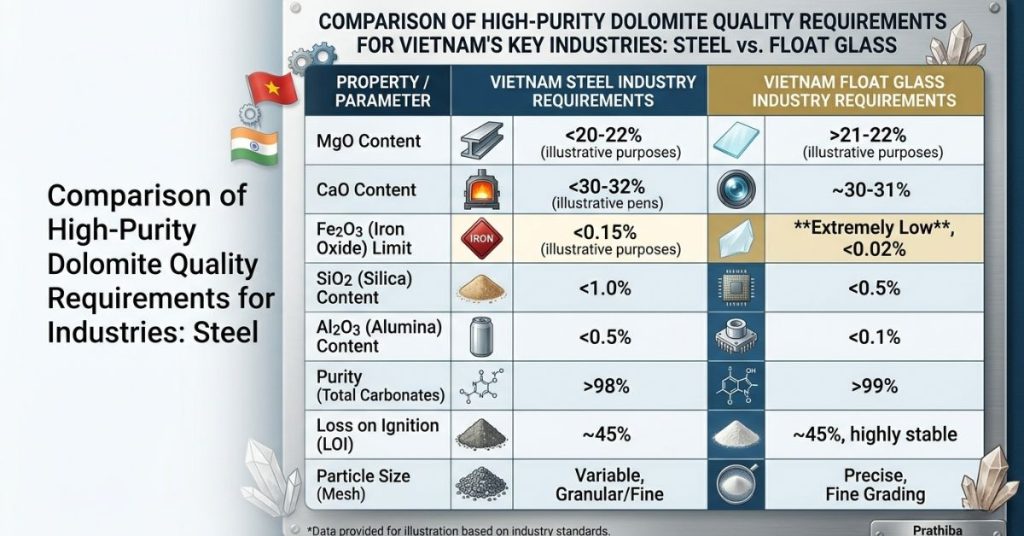
| Parameter | Steel Industry | Float Glass Industry |
|---|---|---|
| Primary function | Flux + refractory protection (MgO source) | Glass former modifier (CaO/MgO source) |
| MgO content | High, typically ~18–21% | Controlled, balanced to batch recipe |
| Iron oxide (Fe₂O₃) | Low preferred | Critically low, often <0.10%, lower for clear glass |
| Silica tolerance | Low silica preferred for slag control | Tightly controlled; affects melt behaviour |
| Physical form | Lumps and powder; calcined grades used | Finely ground powder for batching |
| Most critical property | CaO/MgO balance and consistency | Low iron content for clarity |
| Effect of off-spec material | Poor slag, faster lining wear | Green tint, glass defects, downgraded product |
Vietnam’s Growing Demand for Industrial Minerals
Vietnam’s appetite for industrial mineral exports is tied directly to where its economy is heading. The country has positioned itself as a manufacturing hub, and the Vietnam manufacturing sector keeps expanding across construction materials, automotive, electronics, and solar.
Each of those pulls on glass and steel. New high-rise construction needs architectural glass and structural steel. The push into solar manufacturing needs ultra-clear cover glass, which demands the lowest-iron raw materials available. Automotive growth needs both steel and high-quality glazing.
That demand profile favours suppliers who can deliver high-purity, consistent dolomite at volume, and who can scale with a buyer as their capacity grows. Spot purchasing from inconsistent sources works for a small operation; it does not work for a plant trying to run a stable, high-output process. The trend is clearly toward dependable, repeatable supply, which is why a bulk mineral supplier from India with export depth is an attractive partner.
Why Long-Term Buyers Choose Reliable Indian Suppliers
The buyers who think in years rather than single shipments tend to weigh the same factors:
- Specification reliability — the material matches the COA, shipment after shipment
- Capacity to grow — the supplier can scale volume as the buyer’s plant scales
- Logistics competence — documentation and shipping handled without constant chasing
- Communication — clear responses on grades, lead times, and customisation
- Technical fit — willingness to tailor grade and sizing to the buyer’s exact process
A supplier that delivers on these turns a transactional purchase into a genuine supply partnership. For steel mills and glass lines that cannot afford disruption, that reliability is worth more than a marginal price difference. This is the basis on which Vietnamese manufacturers are choosing export quality dolomite from established Indian sources.
Frequently Asked Questions
What MgO content should dolomite have for steel manufacturing?
Steel-grade dolomite generally requires an MgO content of around 18–21%, with a controlled CaO-to-MgO balance and low silica and iron. The exact target depends on the furnace type and slag practice, so buyers should confirm the specification with their supplier against their own process.
Why is low iron content so important in dolomite for float glass?
Iron oxide gives glass a green tint and reduces clarity. For clear and extra-clear float glass, dolomite must have very low iron, often below 0.10% Fe₂O₃ and lower for premium grades. Low-iron dolomite powder is essential for producing high-clarity architectural, automotive, and solar glass.
What is the difference between raw and calcined dolomite?
Calcined dolomite has been heated to drive off carbon dioxide, making it more reactive. Raw dolomite is used as flux and in glass batching, while calcined grades suit certain steelmaking and refractory applications. A capable exporter can supply both.
Can an Indian dolomite supplier handle bulk export orders to Vietnam?
Yes. Established Indian exporters such as Pratibha Refractory Minerals are set up for recurring bulk shipments, with export-ready packaging and experience handling sea-freight logistics and documentation to Vietnamese ports.
How do I know the dolomite quality will stay consistent between shipments?
Ask the supplier about quarry selection, lot-by-lot testing, and blending practices. Consistent mineral quality comes from controlling the whole chain from source to packing, not just testing the final batch. Request certificates of analysis for each shipment.
Does Pratibha Refractory Minerals supply minerals other than dolomite?
Yes. As a 100% export-oriented supplier from India, Pratibha also exports talc, quartz, kaolin, mica, and silica sand for various industrial applications worldwide.
Talk to Pratibha Refractory Minerals About Your Dolomite Supply
If you run a steel plant or a float glass line in Vietnam, the quality and consistency of your dolomite directly affect your output, your costs, and the grade of product you can sell. You need a source that understands the chemistry, controls it shipment after shipment, and can move bulk volume reliably across borders.
Pratibha Refractory Minerals supplies high-purity, low-iron, steel-grade and glass-grade dolomite as lumps and powder, in bulk, with full export support. Whether you need a stable flux for your furnaces or low-iron material for clear glass, the company can tailor grade, sizing, and packaging to your process.
Reach out to Pratibha Refractory Minerals today for bulk dolomite supply, export pricing, sample analysis, and customised industrial-grade mineral solutions for Vietnam’s steel and float glass industries. Send your specifications and required volumes, and the team will respond with grades, lead times, and a quotation built around your plant’s needs.