


- Call for Sales Enquiries

- +91-9413034047
- +91-294-2413244
- info@pratibharefractory.com

Soapstone Lumps & Talc Powder for Bangladesh: Land Border vs Sea Routes

How Indonesian Importers Buy Talc Powder from India: A Complete 2026 Guide
May 6, 2026
Why Vietnam’s Steel Giants and Float Glass Industry Prefer High-Purity Dolomite from India
May 29, 2026Soapstone Lumps & Talc Powder for Bangladesh: Land Border vs Sea Routes
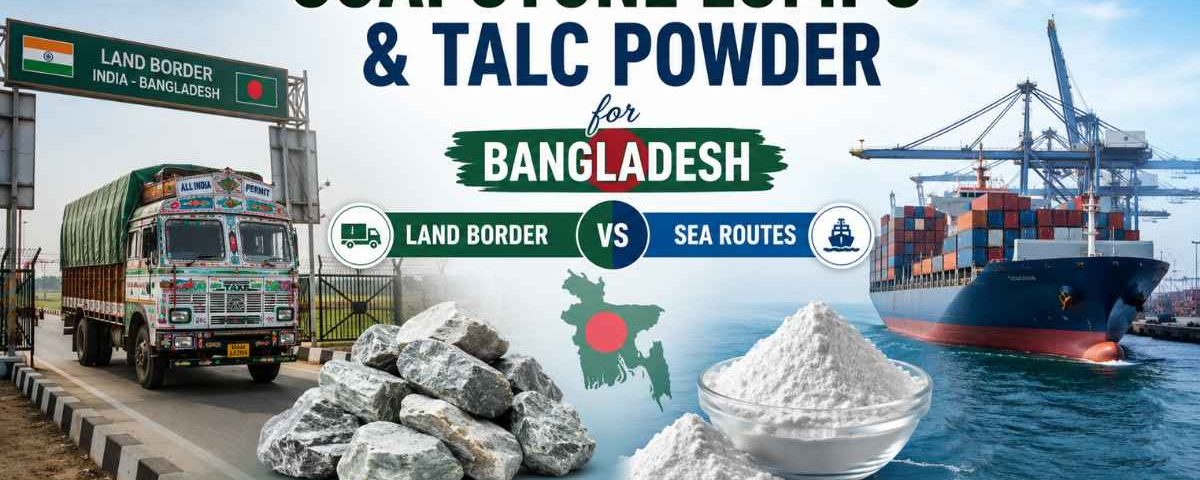
The Bangladesh industrial market is experiencing unprecedented manufacturing growth. From the booming ceramics hub in Gazipur to the expanding paint, plastics, and paper mills across Dhaka and Chittagong divisions, the demand for high-grade raw materials has skyrocketed. Chief among these essential industrial inputs are talc powder and soapstone lumps. For Bangladeshi procurement managers and industrial buyers, sourcing from a reliable talc powder supplier Bangladesh is only half the battle. The true determinant of profit margins and supply chain stability lies in cross-border logistics.
Because India shares both vast land borders and accessible maritime routes with Bangladesh, importers face a critical strategic decision Should you transport bulk minerals via land customs stations or opt for ocean freight?
Choosing the wrong shipping methodology can result in unexpected demurrage, prolonged transit delays, or degraded material quality. This comprehensive guide breaks down the operational realities, costs, and transit dynamics of importing industrial minerals from India to Bangladesh.
Technical Overview: Talc Powder & Soapstone Lumps
Before analyzing the logistics networks, it is essential to align shipping strategies with the physical and chemical requirements of the minerals being transported.
What is Industrial Talc Powder?
Talc is a hydrated magnesium silicate mineral ($Mg_3Si_4O_{10}(OH)_2$). Celebrated as the world’s softest mineral, it possesses distinct properties including chemical inertness, high lubricity, excellent oil absorption, and superior whiteness. As a leading talc powder exporter India, Pratibha Refractory Minerals processes this material into micronized talc powder tailored to specific mesh sizes and brightness levels required by diverse industrial applications.
What are Soapstone Lumps?
Soapstone is a talc-schist rock that contains high concentrations of talc mixed with other minerals like micas, chlorite, and carbonates. Industrial buyers often prefer importing high purity soapstone lumps directly. Sourcing the mineral in its raw lump form allows Bangladeshi factories to crush and grind the material locally, customizing the particle size distribution to their exact in-house manufacturing specifications while reducing initial customs valuation costs.
Key Industrial Applications in Bangladesh
- Ceramics Industry: Acts as a flux, reducing firing temperatures and thermal expansion in ceramic wall and floor tiles.
- Paint & Coatings: Functions as a premium extender pigment, improving mechanical resistance, scrubbability, and anti-cracking properties in architectural and industrial coatings.
- Plastics & Rubber Compounds: Serves as a reinforcing filler to increase tensile strength, stiffness, and heat resistance in automotive and consumer plastic components.
- Paper Manufacturing: Used for pitch control, coating pigmentation, and as a functional filler to improve paper smoothness and opacity.
Why Bangladesh Buyers Prefer Indian Suppliers
When evaluating global sourcing options, Bangladesh importers consistently turn to an Indian mineral supplier over alternatives in East Asia or the Middle East. The advantages span across product quality, economics, and regional proximity:
- Geological Quality & Mineral Purity: India boasts some of the world’s finest talc deposits, particularly in Rajasthan. This region yields exceptionally high-purity soapstone with excellent brightness, low iron content, and no asbestos contamination.
- Unmatched Cost Competitiveness: Proximity drastically minimizes international freight costs. Lower overheads pass directly to the buyer, making Indian talc highly economical.
- Rapid Lead Times: While shipping minerals from alternative global sources can take 30 to 45 days, sourcing from talc powder manufacturers in India cuts transit times down to days or weeks.
- Familiar Regulatory Frameworks: Established trade agreements, such as the South Asian Free Trade Area (SAFTA), combined with deep-rooted banking and Letter of Credit (L/C) channels between Indian and Bangladeshi financial institutions, ensure seamless cross-border trade execution.
The Land Border Export Route (India to Bangladesh)
For many importers across Western and Northern Bangladesh, the land border represents the default logistical pathway.
The Petrapole–Benapole Corridor
The Petrapole (India) – Benapole (Bangladesh) land customs station handles the vast majority of land-based trade between the two nations. Other key land borders utilized by a soapstone lumps exporter include Ghojadanga–Bhomra, Changrabandha–Burimari, and Hili.
![[Processing Plant / Warehouse in India]
[Indian Land Customs Station (Petrapole)]
Border Clearance & Transshipment)
[Bangladesh Land Customs Station (Benapole)]
[Buyer's Factory / Warehouse in Bangladesh]](https://pratibharefractory.com/wp-content/uploads/2026/05/1-1024x536.jpg)
How Land Transport Works
- Sourcing & Packing: The soapstone powder manufacturer India loads the material into 25kg, 50kg, or 1-metric-ton jumbo PP bags.
- Indian Domestic Transit: Cargo is loaded onto multi-axle trucks or trailers from the mineral processing plants (e.g., in Rajasthan or Gujarat) and transported across the Indian highway network to the border.
- Border Clearance: Customs clearing agents file the Bill of Export in India.
- Transshipment: Upon crossing into the Benapole land port, the cargo is frequently transshipped onto Bangladeshi trucks or cleared directly into warehousing zones before final delivery to the buyer’s facility.
Transit Times & Benefits
- Speed: Under optimal conditions, door-to-door transit from a North Indian processing plant to a factory in Dhaka via land border takes 7 to 12 days.
- Agility: Ideal for urgent, just-in-time manufacturing schedules where factory inventory levels are low.
- Smaller Consignments: Accommodates smaller order sizes (e.g., a single truckload of 25 to 30 metric tons), preventing capital from being tied up in massive bulk inventories.
Common Land Border Challenges
- Congestion: The Petrapole-Benapole border is notorious for traffic tailbacks. Trucks can sometimes wait in queue for days during peak trade seasons, causing fluctuating logistics costs.
- Demurrage Risks: Delays in clearing paperwork on either side result in truck detention charges that eat into manufacturing margins.
The Sea Route Export to Bangladesh
When scalability and absolute cost-minimization dominate procurement priorities, ocean freight is the gold standard for bulk talc powder supply.
Port-to-Port Infrastructure
The primary maritime corridor involves shipping from India’s eastern gateway ports—primarily Kolkata Port (Syama Prasad Mookerjee Port) or Haldia Port—directly to Chittagong Port (Chattogram) or Mongla Port in Bangladesh. For mineral processors located deep in Western India, cargo is railed to Mundra or Nhava Sheva ports before embarking on a deep-sea voyage to Bangladesh.
Containerized vs. Break-Bulk Ocean Shipping
- FCL (Full Container Load): Export quality talc powder is palletized, stuffed into standard 20-foot dry van containers (which accommodate roughly 21 to 27 metric tons depending on port weight restrictions), and sealed. This protects micronized powders from moisture and contamination.
- Break-Bulk / Bulk Vessel: For massive industrial orders, high purity soapstone lumps are loaded directly into the hold of a bulk vessel. This method bypasses container costs entirely but requires substantial port infrastructure for unloading.
Marine Transit Times & Process
- The industrial mineral exporter dispatches containerized cargo via rail or road to the designated Indian exit port.
- Customs clearance and stuffing occur at the port’s Container Freight Station (CFS).
- The vessel sails to Chittagong Port. The direct sea voyage from Kolkata to Chittagong takes just 3 to 5 days, though total transit including port handling averages 14 to 20 days.
Cost-Effectiveness for Large Orders
Ocean freight scales beautifully. Freight rates per metric ton drop drastically when moving hundreds or thousands of tons simultaneously. Furthermore, Chittagong Port features well-established industrial transport corridors connecting directly to nearby manufacturing zones.
Comparison Table: Land Border vs. Sea Route
| Logistics Metric | Land Border Route (e.g., Petrapole-Benapole) | Sea Route (Kolkata/Haldia to Chittagong) |
| Primary Cost Structure | Higher per-ton freight rate; vulnerable to spot market trucking price hikes. | Significantly lower per-ton cost for bulk and high-volume containerized shipments. |
| Delivery Speed | Fast (7 to 12 days total transit under normal conditions). | Moderate (14 to 20 days including port loading, sailing, and unloading). |
| Bulk Handling Capacity | Limited to truck capacities (25–35 tons per vehicle); scaling requires massive truck fleets. | High; easily handles thousands of metric tons via FCL or specialized bulk vessels. |
| Documentation Complexity | Moderate; relies heavily on efficient border customs handling and land port authority clearances. | Higher; involves Bill of Lading (B/L), port authorities, shipping lines, and maritime customs. |
| Risk Factors | Traffic congestion at border check-posts; transshipment damage; material exposure during manual reloading. | Port congestion at Chittagong; potential demurrage during peak seasons; moisture exposure if not properly packed. |
| Best Use Cases | Urgent shipments, smaller trial batches, factories located in Western/Northern Bangladesh. | Massive industrial stockpiling, raw soapstone lumps, factories in Chittagong, Comilla, and Dhaka. |
Strategic Decision: Which Route is Best for Your Factory?
Every manufacturing facility operates under unique procurement constraints. Use the following decision matrices to optimize your next mineral import:
Based on Shipment Size
- Choose Land Border: If your monthly consumption is under 50 metric tons, or if you prefer keeping a lean inventory using 1 to 2 truckloads at a time.
- Choose Sea Route: For large-scale procurement exceeding 100 metric tons per month. Shipping multiple 20ft containers dramatically reduces your landed cost per kilogram.
Based on Urgency
- Choose Land Border: If your production line faces an imminent shutdown due to raw material stockouts. Land transport bypasses complex port scheduling.
- Choose Sea Route: If you operate on a structured, predictable 3-month or 6-month forecasting model where transit times can be safely accounted for in advance.
Based on Logistics Budget
- Choose Land Border: If your factory is located in the Khunla, Rajshahi, or Rangpur divisions, where proximity to land borders minimizes domestic secondary transport costs inside Bangladesh.
- Choose Sea Route: If your factory is located in the Chittagong or Greater Dhaka region, where the proximity to maritime ports mitigates the need for long-haul domestic trucking.
Partnering with Pratibha Refractory Minerals
Navigating international trade barriers requires an experienced asset on the ground. Pratibha Refractory Minerals has cemented its reputation as a leading talc powder exporter India, offering end-to-end mineral processing and export solutions engineered specifically for the Bangladeshi industrial landscape.
Uncompromising Quality Assurance
We recognize that the performance of your paints, plastics, or ceramics depends entirely on mineral consistency. Our internal testing laboratories ensure that every batch of micronized talc powder matches your required whiteness, particle size distribution (PSD), and chemical purity parameters.
International Packaging Standards
To prevent moisture ingress and product loss during cross-border transit—especially through humid sea routes or bumpy land transport—we utilize premium, moisture-proof, UV-stabilized PP Jumbo bags and heavy-duty 25kg multi-layer paper bags, completely palletized and shrink-wrapped.
![[25kg / 50kg Heavy-Duty Bags] ➔ [Palletized & Secured] ➔ [Shrink-Wrapped & Moisture Protected]](https://pratibharefractory.com/wp-content/uploads/2026/05/2-1024x536.jpg)
End-to-End Customs & Logistics Management
With decades of experience operating as an established soapstone powder manufacturer India, we maintain strong relationships with premier logistics providers, customs brokers, and shipping lines. We manage the heavy lifting of export documentation, cross-border compliance, and port clearances, ensuring your cargo arrives at your facility devoid of unexpected costs or bureaucratic delays.
Conclusion & Actionable Next Steps
Selecting the ideal logistics pipeline for importing talc powder and soapstone lumps directly impacts your manufacturing efficiency and bottom-line profitability. While land border routes offer unparalleled speed and agility for urgent or smaller shipments, maritime shipping remains the undefeated champion for high-volume, cost-effective bulk raw material supply.
Do not leave your raw material supply chain to chance. Partner with a proven leader who understands the fine balance between mineral chemistry and international transport logistics.
Contact the export team at Pratibha Refractory Minerals today to request a customized quote, secure certified material samples, or speak with an expert about optimizing your shipping routes to Bangladesh.
Frequently Asked Questions (FAQs)
Q1: What is the minimum order quantity (MOQ) for importing talc powder to Bangladesh?
Our standard minimum order quantity for export shipments to Bangladesh is 20 Metric Tons (equivalent to one full truckload or one 20-foot container). This ensuring maximum freight efficiency for the importer.
Q2: Can I get customized mesh sizes for industrial talc powder?
Yes. As an advanced industrial talc powder supplier, we process talc powder to specific particle size distributions ranging from 300 mesh up to ultra-fine micronized grades (2 microns), depending on your industry requirements (paints, plastics, ceramics, etc.).
Q3: Does Pratibha Refractory Minerals provide certificates of analysis (COA) with shipments?
Absolutely. Every single shipment is accompanied by a comprehensive Certificate of Analysis (COA) from our laboratory, detailing chemical composition ($MgO$, $SiO_2$), whiteness/brightness levels, moisture content, and particle size distribution. Third-party inspections (such as SGS) can also be arranged upon request.
Q4: How are payments structured for Bangladesh mineral imports?
We typically operate on standard international trade terms, primarily via Irrevocable Letters of Credit (L/C at sight) opened through reputable global banks, or via mutually agreed advance telegraphic transfers (T/T).
Q5: How do you protect talc powder from moisture contamination during ocean freight to Chittagong?
We apply rigid packaging standards for all marine shipments. This includes packing the powder in internal-liner-fitted PP bags, secure palletization, and wrapping the entire load in heavy-duty stretch film to safeguard against maritime humidity.
Q6: Can you export raw soapstone lumps instead of processed powder?
Yes. We are a prominent soapstone lumps exporter. We supply high-purity raw soapstone lumps directly from our mines for Bangladeshi industrial buyers who prefer grinding the material within their own localized processing plants.