

- Call for Sales Enquiries

- +91-9413034047
- +91-294-2413244
- info@pratibharefractory.com

Cost of Soapstone Vs Quartz: Which Mineral Is More Cost-Effective?

Industrial Minerals Used in Paint Manufacturing: A Complete Guide for Paint Producers
June 12, 2026
China Clay Price from India 2026: What Drives Kaolin Costs for Importers
July 12, 2026Cost of Soapstone Vs Quartz: Which Mineral Is More Cost-Effective?
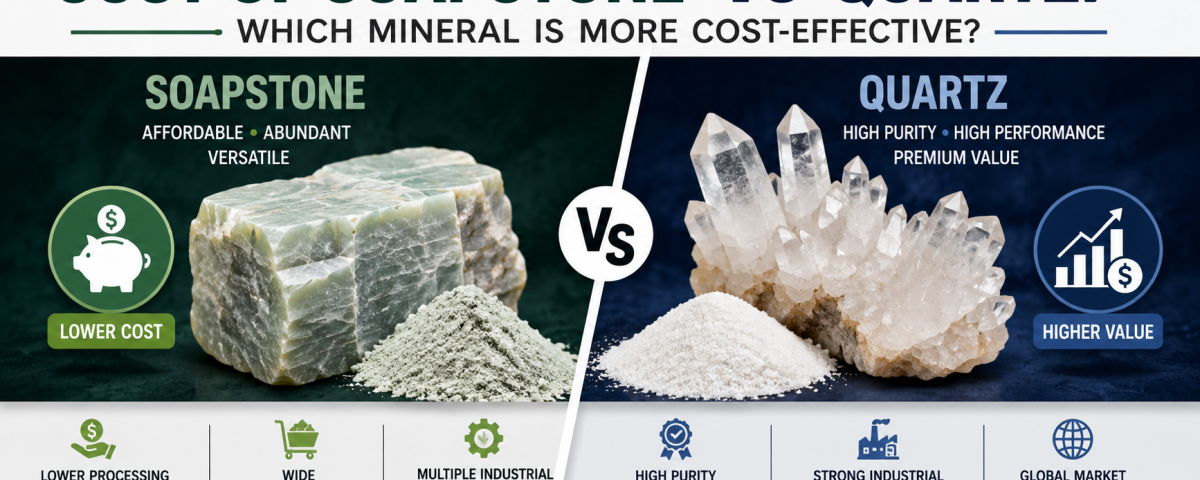
When industrial buyers evaluate minerals for large-scale use, the cost of soapstone vs quartz is often the first comparison they make. However, procurement decisions based solely on purchase price can lead to costly errors down the line. The true value of any industrial mineral is determined by a combination of factors: raw material pricing, processing complexity, transportation logistics, application performance, and long-term supply reliability.
Soapstone and quartz are both widely used across manufacturing sectors from paints and ceramics to glass and electronics but they serve different purposes and come with very different cost structures. Understanding these differences helps buyers optimise both spending and output quality.
Quick Answer: What is the cost difference between soapstone and quartz?
Soapstone is generally less expensive than quartz due to its abundant natural reserves, easier processing, and lower energy requirements during grinding. High-purity quartz commands a premium price because of strict purity standards, intensive washing and grading processes, and strong export demand from the semiconductor, solar, and glass industries.
What Is Soapstone?
Soapstone, also known as steatite, is a metamorphic rock composed primarily of talc, along with varying amounts of chlorite, magnesite, and dolomite. Its high talc content gives it a characteristically soft, soapy texture hence the name. With a Mohs hardness of 1, it is one of the softest commercially mined minerals.
Industrial-grade soapstone powder is widely used as a filler and functional additive across multiple sectors. Its key properties chemical inertness, thermal stability, low oil absorption, and hydrophobicity make it especially valuable in paints, rubber, plastics, ceramics, paper, and animal feed. Soapstone deposits are found across India, Brazil, China, and parts of Africa, ensuring relatively stable availability for bulk buyers.
What Is Quartz?
Quartz is a crystalline mineral composed of silicon dioxide (SiO2) and ranks 7 on the Mohs hardness scale, making it one of the hardest commonly used industrial minerals. Its purity, hardness, and thermal resistance make it indispensable across high-performance applications.
Industrial quartz is used in glass manufacturing, foundry casting, construction aggregates, solar panels, and semiconductor components. High-purity quartz with SiO2 content above 99.5% is especially prized in the electronics and photovoltaics industries, where even trace impurities can compromise product performance. India holds substantial quartz reserves, particularly in Rajasthan, Andhra Pradesh, and Telangana.
Cost of Soapstone vs Quartz – Quick Comparison
| Factor | Soapstone | Quartz |
| Raw Material Cost | Lower – widely available | Moderate to High – purity-dependent |
| Processing Cost | Lower – soft, easy to grind | Higher – hard, needs intensive processing |
| Transportation Cost | Moderate – dense mineral | Moderate to High – strict packaging for purity |
| Availability | Abundant – stable supply | Widely available but high-purity grades limited |
| Purity Requirements | Moderate – talc content varies | Strict – SiO2 purity critical for many uses |
| Industrial Demand | Steady – paints, rubber, ceramics | High and growing – electronics, solar, glass |
| Export Demand | Moderate | High – global demand from tech industries |
Why Soapstone Is Usually Less Expensive
Several structural factors keep soapstone pricing consistently below quartz:
- Abundant Reserves: Major soapstone deposits across India (Rajasthan, Uttarakhand, Madhya Pradesh) ensure consistent raw material availability, preventing supply-side price spikes.
- Lower Processing Requirements: With a Mohs hardness of 1, soapstone is significantly easier to grind into fine powders. This reduces machinery wear, energy consumption, and milling time compared to harder minerals.
- Simpler Beneficiation: Soapstone requires fewer purification steps. Standard grades for paint or rubber filler can be produced without the intensive washing and chemical treatment that quartz demands.
- Lower Energy Consumption: Grinding softer minerals consumes substantially less electricity per tonne – a meaningful saving at an industrial scale where energy costs contribute significantly to the final price.
- Established Domestic Markets: Soapstone has strong domestic demand across Indian manufacturing, which supports stable pricing without heavy dependence on export-driven price volatility.
Why Quartz Can Cost More
Quartz pricing – especially for high-purity and micronised grades – is driven upward by several compounding factors:
- High Silica Purity Requirements: Applications in electronics, semiconductors, and solar cells require SiO2 content of 99.5% or above. Achieving this demands careful ore selection, rigorous lab testing, and rejection of substandard batches.
- Intensive Washing and Grading: Quartz must undergo acid washing, magnetic separation, and fine classification to reach specification. These processes add significantly to per-tonne production costs.
- Export Demand Premium: International buyers from Germany, South Korea, Japan, and the US regularly import Indian quartz, particularly for the solar and semiconductor industries. This export demand competes with domestic supply and pushes prices upward.
- Capital-Intensive Processing: Quartz plants require more robust milling equipment due to its high hardness (Mohs 7). Equipment depreciation, maintenance, and energy draw are all higher than for soapstone.
- Specialised Packaging and Handling: High-purity quartz requires contamination-controlled packaging – another cost layer absent from standard soapstone supply chains.
Soapstone Powder vs Quartz Powder Cost Comparison
| Parameter | Soapstone Powder | Quartz Powder |
| Typical SiO2 / Talc Content | Talc: 60–90% | SiO2: 95–99.9% |
| Production Cost (relative) | Low | Medium to High |
| Processing Complexity | Low – simple milling | High – multi-stage purification |
| Micron Range Available | 10–200 microns | 2–200 microns |
| Typical Applications | Paints, rubber, paper, ceramics | Glass, foundries, solar, electronics |
| Value Generated per Tonne | Moderate | High (especially in tech industries) |
| Price Stability | High | Moderate – export demand influences price |
Which Industries Prefer Soapstone?
Soapstone’s cost advantages make it the default choice for high-volume, cost-sensitive industrial applications:
- Paints and Coatings: Soapstone powder serves as an extender pigment and filler, improving texture and reducing titanium dioxide consumption. Its hydrophobicity improves water resistance. At lower cost per tonne, it delivers excellent ROI for paint manufacturers producing at scale.
- Ceramics: Used as a fluxing agent and filler in ceramic bodies, soapstone improves plasticity and firing consistency without significantly raising input costs.
- Rubber and Plastics: Acts as an anti-tack agent and filler in rubber goods. Its chemical inertness ensures it does not react with polymers, while its low cost keeps compound prices competitive.
- Paper Industry: Used as a filler to improve opacity and smoothness in paper manufacture. Soapstone’s soft texture minimises equipment abrasion compared to harder alternatives.
- Animal Feed: Food-grade soapstone (talc) is used as an anti-caking agent and flow improver in pelleted feeds – a cost-effective functional additive.
Which Industries Prefer Quartz?
In applications where performance requirements are non-negotiable, the higher cost of quartz is not just acceptable – it is necessary:
- Glass Manufacturing: Silica sand and quartz powder are the primary raw materials for flat glass, container glass, and specialty optical glass. There is simply no cost-effective substitute.
- Foundry Casting: Quartz sand is used as a mould material in metal casting. Its thermal stability at high temperatures makes it irreplaceable in ferrous and non-ferrous foundries.
- Solar Industry: Photovoltaic silicon is derived from high-purity quartz. As solar installation grows globally, demand for low-impurity quartz has increased substantially, justifying its premium pricing.
- Electronics and Semiconductors: High-purity fused quartz is used in semiconductor fabrication – wafer carriers, crucibles, and diffusion tubes. Contamination tolerance here is measured in parts per billion.
- Construction: Quartz aggregates and silica sand are used in concrete, mortars, and flooring compounds. Demand is driven by infrastructure growth, supporting consistent volume pricing.
Cost vs Performance Analysis
| Application | Better Choice | Primary Reason |
| Paint Industry | Soapstone | Lower cost filler; improves texture without excess expense |
| Plastic Industry | Soapstone | Inert filler at lower cost per tonne |
| Ceramics | Soapstone / Both | Soapstone for standard ceramics; quartz for high-temp technical ceramics |
| Glass Manufacturing | Quartz | SiO2 is primary glass-forming material; no substitute |
| Construction | Quartz | Structural integrity requires silica aggregates |
| Refractory Products | Quartz | High thermal resistance required; quartz is standard |
| Solar / Electronics | High-Purity Quartz | Purity requirements eliminate lower-grade alternatives |
| Rubber / Paper | Soapstone | Volume-driven; cost efficiency is the primary driver |
Hidden Costs Buyers Often Ignore
Experienced procurement managers know that the invoice price is only part of the total cost equation. Several hidden cost drivers are frequently overlooked:
- Freight and Logistics: Both minerals are heavy bulk commodities. Distance from the mine or processing plant to the buyer’s facility significantly impacts landed cost. Buyers sourcing from distant locations should calculate the cost per tonne including freight before comparing supplier quotes.
- Moisture Content: Excess moisture in mineral powder increases effective weight per usable tonne. Suppliers who do not control moisture rigorously are, in effect, selling water at mineral prices. Always specify maximum moisture limits in purchase orders.
- Purity and Consistency Variability: Inconsistent purity across batches forces manufacturers to adjust formulations mid-production – increasing downtime, rework, and waste. Paying a slightly higher price for a consistent specification is often economically rational.
- Material Wastage During Processing: Lower-grade minerals with higher impurity levels generate more waste at the processing stage. The true cost of a cheaper mineral may exceed that of a higher-grade alternative once wastage is factored in.
- Supplier Reliability: Procurement disruptions – late deliveries, quantity shortfalls, sudden price revisions – carry real costs in production delays. Established suppliers with documented track records in export-quality supply chains offer risk-adjusted value beyond simple price comparison.
Which Mineral Offers Better Value?
The answer depends entirely on the application. Neither mineral is universally superior – the better value is determined by matching mineral properties to production requirements:
| Buyer Situation | Recommended Choice |
| High-volume filler for paints, rubber, or paper | Soapstone – lower cost, adequate performance |
| Glass or refractory manufacturing | Quartz – non-negotiable for process chemistry |
| Technical ceramics or electronic components | High-purity quartz – performance justifies premium |
| Cost-sensitive bulk applications (plastics, fertilisers) | Soapstone – better ROI at scale |
| Export-quality mineral supply for global markets | Quartz – higher demand and premium pricing |
| Mixed manufacturing requirements | Both – source each mineral for its appropriate application |
Buyers who evaluate total cost of ownership – including processing efficiency, waste rates, formulation stability, and supplier reliability – consistently make better procurement decisions than those who focus on per-tonne price alone.
Frequently Asked Questions
Is soapstone cheaper than quartz?
Yes, soapstone is generally less expensive than quartz in equivalent powder grades. Its lower hardness reduces milling costs, and its abundant supply prevents significant price volatility. However, high-volume quartz for standard construction or glass applications can be competitively priced – the gap is most pronounced in high-purity technical grades.
Why is high-purity quartz expensive?
High-purity quartz (SiO2 above 99.5%) requires intensive beneficiation – acid washing, magnetic separation, and precision classification – to meet specifications for the semiconductor, solar, and optical glass industries. These processing steps, combined with strong export demand, drive the premium.
Which mineral offers better industrial value?
Neither can be declared universally better. Soapstone offers better value for cost-sensitive, high-volume applications like paints, rubber, and paper. Quartz offers better value where performance requirements are stringent – glass, electronics, solar, and refractory products.
Can soapstone replace quartz in industrial applications?
In some filler applications – such as plastics and certain ceramic bodies – soapstone can partially replace quartz, particularly where hardness and SiO2 purity are not critical. However, in glass manufacturing, semiconductor production, and construction aggregates, quartz is functionally irreplaceable.
Which mineral is easier to process?
Soapstone is significantly easier to process. With a Mohs hardness of 1, it requires less energy and less robust milling equipment than quartz (Mohs 7). Lower processing complexity translates directly into lower production costs.
Which mineral has higher export demand?
Quartz – particularly high-purity silica grades – commands significantly higher export demand. Indian quartz is exported globally for use in solar panels, semiconductors, specialty glass, and electronics manufacturing. Soapstone also has export markets, but volumes and pricing premiums are generally lower.
What factors affect mineral pricing?
Key pricing factors include: raw ore availability and deposit quality, processing requirements (grinding, purification, classification), purity specifications, moisture and whiteness standards, packaging requirements, freight distance, export demand, and supplier reliability. Buyers should evaluate all these factors rather than comparing headline prices alone.
Conclusion
For industrial buyers, the cost of soapstone vs quartz is not a simple one-number comparison – it is a multi-variable analysis that must account for application requirements, processing costs, supply chain reliability, and long-term value generation.
- Soapstone is generally the more economical choice for high-volume, cost-sensitive manufacturing – particularly in paints, rubber, plastics, and paper.
- Quartz delivers superior performance – and justified higher cost – in glass manufacturing, solar applications, electronics, and high-temperature industrial processes.
- Buyers who evaluate the total cost of ownership rather than the unit price will consistently achieve better procurement outcomes.
Looking for high-quality soapstone powder or quartz products for industrial applications? Contact our team for technical specifications, custom grades and export-quality mineral solutions