

- Call for Sales Enquiries

- +91-9413034047
- +91-294-2413244
- info@pratibharefractory.com

Industrial Minerals Used in Paint Manufacturing: A Complete Guide for Paint Producers

Bulk Industrial Minerals Supply: A Complete Sourcing Guide for International Buyers (India)
June 10, 2026
Cost of Soapstone Vs Quartz: Which Mineral Is More Cost-Effective?
June 17, 2026Industrial Minerals Used in Paint Manufacturing: A Complete Guide for Paint Producers
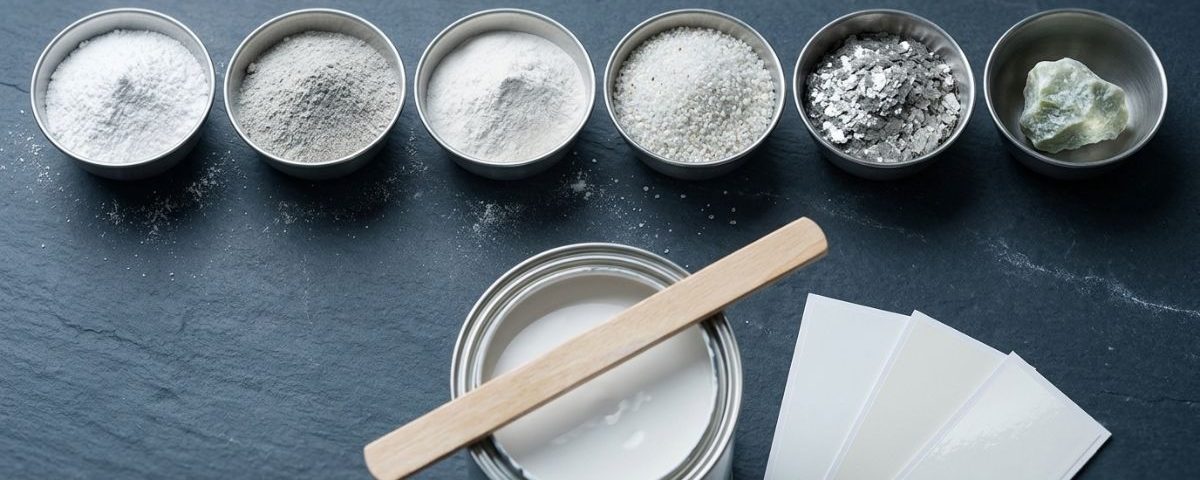
Every can of paint that leaves a factory carries 30 to 60 percent mineral content by weight. The minerals used in paint industry production, such as talc, kaolin, dolomite, quartz, and calcium-based fillers, determine how that paint flows, covers, dries, and survives ten monsoons on an exterior wall. Yet most procurement discussions still treat these minerals as commodity line items rather than performance ingredients.
This guide is written for paint manufacturers, coating formulators, and procurement teams who source paint industry raw materials in bulk. It explains what each mineral actually does inside a formulation, how filler selection affects production cost and finished-film quality, and what to check before signing a long-term supply contract with an industrial minerals supplier in India or anywhere else.
If you manufacture decorative paints, industrial coatings, primers, or powder coatings — and you import minerals into markets like Vietnam, Indonesia, Thailand, Turkey, Egypt, or Nigeria — the next 15 minutes of reading will help you ask sharper questions of your suppliers.
Industrial Minerals Commonly Used in Paint Manufacturing
| Mineral | Function in Paint | Key Benefits | Industries Served |
|---|---|---|---|
| Talc Powder | Extender, anti-settling agent, matting agent | Improves film flexibility, weather resistance, smooth finish | Decorative paints, industrial coatings, primers |
| Kaolin (China Clay) | Extender pigment, TiO₂ partial replacement | Better opacity, gloss control, suspension stability | Emulsion paints, paper coatings, ceramics |
| Dolomite Powder | Extender pigment, filler | Whiteness, low oil absorption, cost reduction | Wall putty, primers, distempers, powder coatings |
| Quartz / Silica Sand | Functional filler, texture agent | Scrub resistance, hardness, abrasion resistance | Textured coatings, floor coatings, industrial paints |
| Calcite / Calcium Carbonate | Primary extender | High brightness, easy dispersion, low cost | Interior emulsions, putty, primers |
| Mica Powder | Barrier filler | Crack resistance, UV protection, anti-corrosive films | Exterior paints, marine coatings |
| Barytes (Barite) | High-density filler | Chemical resistance, smooth high-build films | Automotive primers, industrial coatings |
Each of these minerals plays a different role in the paint manufacturing process. The sections below cover the four that dominate bulk procurement volumes: talc, kaolin, quartz-based minerals, and dolomite.
Why Paint Manufacturers Use Mineral Fillers
Mineral fillers in paint are not just “cheap volume.” A well-chosen filler package does four jobs at once.
1. Cost Optimization
Titanium dioxide (TiO₂) is the most expensive raw material in most paint formulations. Fine kaolin and calcined clay can replace a portion of TiO₂ — typically 10 to 20 percent in interior emulsions — without a visible drop in opacity. At current TiO₂ prices, even a modest substitution rate changes the per-litre economics of a production batch significantly.
2. Performance Enhancement
Fillers control rheology, suspension, and application behaviour. Platy minerals like talc and mica keep pigments suspended in the can and reduce sagging on vertical surfaces. Without the right filler, a paint may look fine in the lab and fail on the applicator’s brush.
3. Durability Improvement
Lamellar (plate-shaped) minerals create a layered barrier inside the dried paint film. This barrier slows down moisture penetration, UV degradation, and crack propagation. Exterior paint that lasts eight years instead of four usually owes that difference to its mineral package, not its binder alone.
4. Surface Finish Improvement
Particle size distribution decides the final finish. Fine particles (below 10 microns) give smooth, high-sheen films. Coarser grades create matt finishes and textured effects. Manufacturers buy multiple grades of the same mineral precisely to control sheen across their product range.
Talc Powder for the Paint Industry
Talc is a hydrated magnesium silicate with a naturally platy (lamellar) particle shape — and that shape is the reason talc powder for paint industry applications remains irreplaceable in many formulations.
What Talc Does in Paint Formulations
When paint dries, talc platelets align parallel to the surface, like overlapping roof tiles. This alignment:
- Blocks moisture pathways through the film
- Reinforces the film against cracking and flaking
- Improves sanding behaviour in primers and undercoats
- Acts as a matting agent in low-sheen finishes
- Prevents pigment settling during storage
Benefits for Coating Manufacturers
- Weather resistance: Talc-rich exterior paints show measurably better chalking and cracking resistance in tropical and coastal climates — directly relevant for buyers in Vietnam, Indonesia, and Nigeria.
- Improved hiding at lower TiO₂ loading: Talc spaces TiO₂ particles apart, improving light scattering efficiency.
- Anti-settling without additives: Reduces dependence on expensive rheology modifiers.
- Chemical inertness: Talc does not react with binders, driers, or tinting systems.
Industrial Applications
Talc grades for paint typically range from 300 mesh to 700 mesh, with whiteness from 85 to 96 percent depending on the deposit and processing. Common applications include exterior emulsions, anti-corrosive primers, road-marking paints, automotive primers, and powder coatings.
For paint-grade talc, buyers should specify: particle size (D50 and top cut), whiteness/brightness, oil absorption, and loss on ignition. A reliable supplier will provide a Certificate of Analysis against these parameters for every shipment.
Kaolin for Paint Manufacturing
Kaolin also called china clay is a hydrated aluminium silicate prized for its fine particle size, white colour, and plate-like structure. Sourcing the right kaolin for paint manufacturing is often the single biggest lever a formulator has for reducing TiO₂ costs.
Role in Paint Production
Kaolin works as an extender pigment. Its refractive index is lower than TiO₂, but when its particles physically separate TiO₂ particles in the dried film, every TiO₂ particle scatters light more efficiently. This “spacing effect” is why calcined kaolin can replace 15–20 percent of TiO₂ in flat and eggshell paints.
Performance Benefits
- Opacity contribution: Especially from calcined grades with controlled void structure.
- Gloss and sheen control: Fine hydrous kaolin maintains gloss; coarser grades flatten it.
- Suspension stability: Kaolin’s plate structure builds mild thixotropy, keeping heavy pigments suspended.
- Improved scrub resistance: In interior emulsions, kaolin improves film integrity under repeated cleaning.
- Better holdout: Reduces binder penetration into porous substrates, improving coverage per litre.
Common Industrial Applications
Interior and exterior emulsion paints, undercoats and primers, traffic paints, paper coatings, and ceramic glazes. Paint-grade kaolin is typically specified by brightness (85–92%), particle size (45-micron residue), and oil absorption.
Internal link: anchor “china clay” or “paint-grade kaolin” → Kaolin Powder
Quartz and Silica-Based Minerals in Paint Manufacturing
Quartz powder and silica sand bring something talc and kaolin cannot: hardness. With a Mohs hardness of 7, silica-based minerals are the workhorses of coatings that must survive abrasion.
Applications
- Floor coatings and epoxy systems: Graded silica sand provides anti-skid texture and load-bearing strength.
- Textured exterior finishes: Coarse quartz grades create durable decorative textures.
- Industrial and protective coatings: Fine quartz powder improves film hardness and scratch resistance.
- Road-marking paints: Silica improves wear life under traffic.
Advantages
- Exceptional abrasion and scrub resistance
- Chemical inertness silica resists acids (except HF), alkalis, and solvents
- Low oil absorption, allowing high filler loading without rheology problems
- Excellent dimensional stability in thick-film systems
Industrial Use Cases
A typical epoxy floor coating may carry 200 to 400 percent silica filler on resin weight, blended across multiple particle sizes to maximize packing density. Buyers should specify silica purity (SiO₂ %), particle size distribution, and moisture content — moisture above 0.5 percent can cause defects in moisture-sensitive systems like polyurethanes.
Internal link: anchor “quartz powder” / “silica sand” → Quartz / Silica Sand (and “quartz granules” → Quartz Granules where relevant)
Dolomite in Paint Industry
Dolomite is a calcium magnesium carbonate that has quietly become one of the most cost-effective extender pigments in the paint industry, particularly across Asian and African markets.
Role as Extender Pigment
Dolomite powder serves as a white, low-cost bulking filler in primers, putties, distempers, and economy emulsions. Its double-carbonate structure makes it slightly harder and less reactive than pure calcite, giving formulators a filler that holds up better in mildly demanding applications.
Benefits
- High natural whiteness: Good dolomite deposits deliver 90 percent and higher whiteness without beneficiation.
- Low oil absorption: Allows higher filler loading with less binder demand — a direct cost saving.
- Weather and alkali resistance: Performs better than calcite in exterior cement-based putties and alkaline environments.
- Easy dispersion: Reduces grinding time and energy cost during paint production.
Industrial Applications
Wall putty (a major consumption segment), cement primers, distempers, powder coatings, and joint compounds. Standard paint-grade dolomite ranges from 200 mesh to 500 mesh, specified by whiteness, CaO/MgO content, and acid-insoluble residue.
Internal link: anchor “dolomite powder” → Dolomite Powder
How to Select the Right Industrial Mineral Supplier
For a paint manufacturer, the wrong supplier does not just cost money — it costs production batches. Here is a practical checklist procurement teams can use when evaluating an industrial minerals supplier in India or any other origin country.
Product Consistency
Ask for Certificates of Analysis from the last six months of shipments, not just a typical-values datasheet. Look at the variation in whiteness, particle size, and moisture across lots. A supplier whose D50 swings by several microns between shipments will force you to re-adjust your grind every batch.
Particle Size Control
Confirm the supplier operates modern classification equipment (air classifiers, not just sieving for fine grades) and can verify particle size with laser diffraction reports. For paint applications, the top cut (D97/D98) matters as much as the average — a few oversize particles ruin a smooth finish.
Export Capability
Check actual export experience: documentation handling (Certificate of Origin, fumigation, SGS/third-party inspection), packing options (25 kg bags, 50 kg bags, jumbo bags, palletized containers), and familiarity with import requirements in your country. A technically good miner who has never containerized for sea freight will create costly delays.
Quality Certifications
ISO 9001 is a baseline. Depending on your end market, ask about REACH compliance (for European-linked supply chains), heavy-metal test reports, and whether the supplier runs an in-house lab or depends entirely on outside testing.
Supply Reliability
Ask three direct questions: What is your captive or contracted mine capacity? What is your monthly processing capacity by grade? What is your average lead time from confirmed order to bill of lading? Suppliers who own or control their mineral source can hold pricing and supply commitments through market swings far better than traders can.
Common Challenges Faced by Paint Manufacturers
Raw Material Inconsistency
The most common complaint in mineral procurement: shipment three behaves differently from shipments one and two. Whiteness drops, oil absorption rises, and suddenly tinted shades don’t match the standard. Root cause is usually mixed-source ore or weak lot-wise quality control at the processor.
Cost Fluctuations
Freight volatility, energy costs in grinding, and currency movement all hit landed cost. Manufacturers buying spot every quarter face the full force of this volatility; those with annual contracts and indexed pricing absorb it more smoothly.
Supply Chain Issues
Port congestion, container shortages, and seasonal mining restrictions (monsoon shutdowns affect some Indian mining regions between June and September) can stretch lead times. Buyers who maintain only two weeks of mineral inventory are one delayed vessel away from a production stoppage.
How Reliable Mineral Suppliers Solve These Challenges
A serious export-oriented supplier addresses all three problems structurally: single-source ore with lot-wise lab testing for consistency, long-term contract pricing for stability, and production planning plus buffer stocks for delivery reliability. When evaluating suppliers, ask specifically how they handled supply during recent disruption periods — the answer reveals more than any brochure.
Why India Is a Leading Source of Industrial Minerals for Paint Manufacturing
Manufacturing Capabilities
India holds large, commercially viable reserves of talc (soapstone), dolomite, quartz, china clay, and calcite, with major processing clusters in Rajasthan, Gujarat, and southern India. Rajasthan in particular, is one of the world’s significant soapstone/talc-producing regions, with established grinding and classification infrastructure built around the deposits.
Export Advantages
- Competitive processing costs compared to European and East Asian origins
- Established mineral export documentation ecosystem and experienced freight forwarders
- Direct container connectivity from Mundra, Kandla, and Nhava Sheva ports to Southeast Asia, the Middle East, Africa, and East Asia
- English-speaking technical and commercial teams, which simplifies specification discussions
Global Supply Chain Benefits
For buyers in Vietnam, Indonesia, Thailand, Turkey, Egypt, Nigeria, South Korea, Japan, and China, Indian-origin minerals typically offer a strong landed-cost position with transit times of roughly one to four weeks depending on destination. India’s scale also means buyers can consolidate multiple minerals — talc, dolomite, quartz, and kaolin from one origin, reducing supplier management overhead.
Why Global Buyers Choose Pratibha Refractory Minerals
Pratibha Refractory Minerals (PRM) was founded in 1987 in Udaipur, in the mineral-rich state of Rajasthan, India the heart of the country’s talc, dolomite, and quartz mining belt. What began as a refractory minerals manufacturer is today a multi-product company supplying fillers, extenders, refractory minerals, and chemicals to industries across the globe.
- Experience: Nearly four decades in mineral manufacturing since 1987, making PRM one of India’s established producers of refractory and white minerals.
- Export capabilities: Exports form 80% of PRM’s business, with a strong presence across Europe, Africa, and the Gulf, and the documentation and logistics experience that comes with decades of international trade.
- Product range under one roof: Manufacturer and supplier of Talc / Soapstone Powder, Dolomite Powder, Kaolin Powder, Silica Sand, Mica Powder, and Talc/Soapstone Lumps — letting paint manufacturers consolidate their entire filler package from a single source.
- Customized specifications: Customization is PRM’s core strength. Grades are tailored to each buyer’s specific requirements for particle size, whiteness, and packing — built on a deep working understanding of how each mineral behaves in the customer’s application.
- Proven across industries: PRM minerals are used worldwide in paints, plastics, rubber, ceramics, paper, textiles, cosmetics, soaps and detergents, adhesives, animal feed, and agro-chemicals — breadth that reflects consistent quality across demanding applications.
Get Specifications, Samples & Bulk Quotations
If you manufacture paints, coatings, putty, or primers and want consistent, export-grade industrial minerals from India, Pratibha Refractory Minerals can support your sourcing program.
Here is how to start:
- Request technical specifications for talc powder, dolomite powder, quartz powder, kaolin, or silica sand grades matched to your application.
- Order free samples for lab evaluation in your own formulations before committing to volume.
- Get a bulk quotation with CIF/FOB pricing to your port, packing options, and confirmed lead times.
📩 Email: info@pratibharefractory.com | 📞 Phone / WhatsApp: +91-9413034047 | ☎️ Landline: +91-294-2413244 📍 Address: 147, Road # 9, Ashok Nagar, Udaipur 313001, Rajasthan, India | 🌐 Website: pratibharefractory.com
Send us your current specification sheet, and our team will respond with a grade recommendation and quotation.
Frequently Asked Questions
1. What minerals are used in paint manufacturing?
The main minerals used in paint manufacturing are talc, kaolin (china clay), calcium carbonate (calcite), dolomite, quartz/silica, mica, and barite. They function as extender pigments and functional fillers, typically making up 30–60% of a paint formulation by weight.
2. Why is talc powder used in paint?
Talc powder is used in paint because its plate-shaped particles improve weather resistance, prevent cracking, reduce pigment settling, and act as a matting agent. Talc also improves hiding power by spacing out titanium dioxide particles, lowering formulation cost.
3. How does kaolin improve paint quality?
Kaolin improves paint quality by boosting opacity, controlling gloss, stabilizing pigment suspension, and improving scrub resistance. Calcined kaolin can replace 15–20% of titanium dioxide in flat paints, reducing raw material cost without visible loss of whiteness.
4. What are mineral fillers in paint?
Mineral fillers in paint are finely ground natural minerals such as talc, dolomite, calcite, kaolin, and quartz added to extend expensive pigments, control sheen and texture, improve film durability, and reduce overall production cost.
5. Which mineral improves paint durability?
Talc and mica improve paint durability the most because their lamellar (plate-like) particles form a barrier inside the dried film that blocks moisture and UV penetration. For abrasion durability, quartz and silica fillers provide the highest film hardness.
6. What is the role of dolomite in paint production?
Dolomite acts as a white, low-cost extender pigment in paint production. It offers high whiteness, low oil absorption, good alkali resistance, and easy dispersion, making it widely used in wall putty, primers, distempers, and economy emulsion paints.
7. How do paint manufacturers choose mineral suppliers?
Paint manufacturers choose mineral suppliers based on lot-to-lot consistency, particle size control, whiteness, in-house quality testing, export documentation capability, certifications such as ISO 9001, supply capacity, and proven delivery reliability across past shipments.
8. What particle size is ideal for paint minerals?
Most paint-grade minerals fall between 5 and 45 microns. Fine grades (D50 of 5–10 microns) suit smooth, high-sheen finishes, while coarser grades (20–45 microns and above) suit matt paints, putties, and textured coatings. Top cut (D97) control is critical for surface finish.
9. Why import industrial minerals from India?
India offers large reserves of talc, dolomite, quartz, and china clay, competitive processing costs, established export infrastructure, and direct shipping routes to Asia, Africa, and the Middle East. Buyers can also consolidate multiple minerals from a single Indian supplier.
10. Which industrial mineral is best for coatings?
There is no single best mineral it depends on the coating’s job. Talc is best for weather resistance and flexibility, kaolin for opacity and TiO₂ reduction, quartz/silica for abrasion resistance, and dolomite for cost-effective whiteness in primers and putties. Most industrial coatings use a blend.
Conclusion
The minerals used in the paint industry production decide far more than cost they determine opacity, durability, finish, and how a paint behaves from the factory to the final coat on a wall. Talc brings weather resistance, kaolin reduces TiO₂ dependence, quartz adds hardness, and dolomite delivers economical whiteness. For paint manufacturers and importers, the real competitive advantage comes from pairing the right mineral grades with a supplier who can hold specifications consistent, shipment after shipment.
Pratibha Refractory Minerals supplies export-grade talc powder, dolomite, quartz, kaolin, and silica sand to paint and coatings manufacturers worldwide. Share your specification sheet today and receive a tailored grade recommendation, free samples, and a bulk quotation for your next sourcing cycle.