

- Call for Sales Enquiries

- +91-9413034047
- +91-294-2413244
- info@pratibharefractory.com

Top Silica Sand Producing States in India

Bulk Dolomite Powder Supplier & Exporter India
August 22, 2026
Minerals Used in Steel Industry: Types, Applications and Importance
September 7, 2026Top Silica Sand Producing States in India
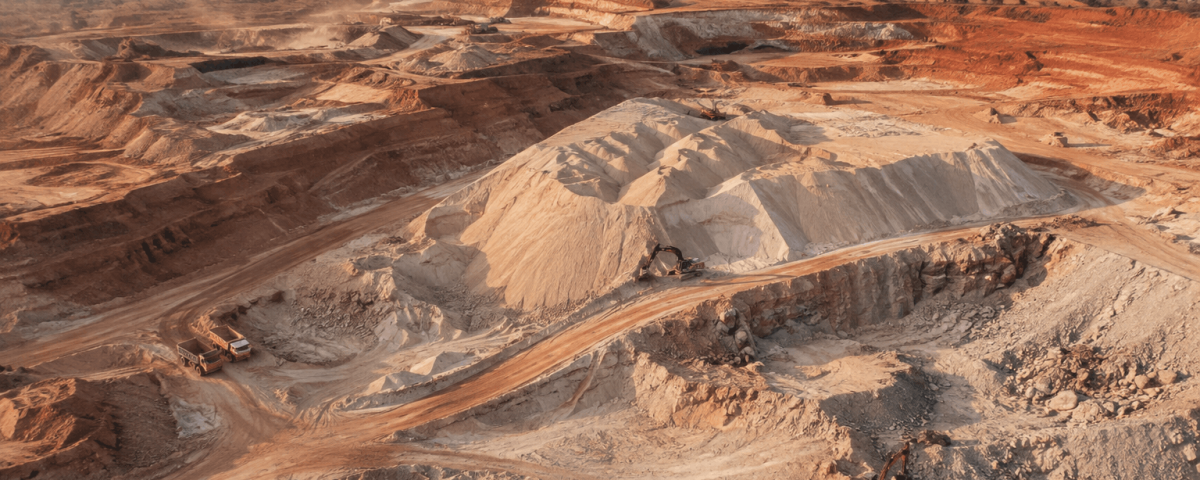
Silica sand largely composed of silicon dioxide (SiO₂) is one of India’s most industrially important non-metallic minerals, feeding the glass, foundry, ceramics, construction, and refractory sectors. India’s silica sand and quartz resources are estimated by the Indian Bureau of Mines (IBM) at nearly 3,908 million tonnes, concentrated in a handful of states : Rajasthan, Gujarat, Andhra Pradesh, Telangana, Uttar Pradesh, Karnataka, and Tamil Nadu among them. For industrial buyers, where the sand comes from matters almost as much as the mineral itself, because deposit geology directly shapes purity, grain size, and the applications a given batch is fit for.
What Is Silica Sand?
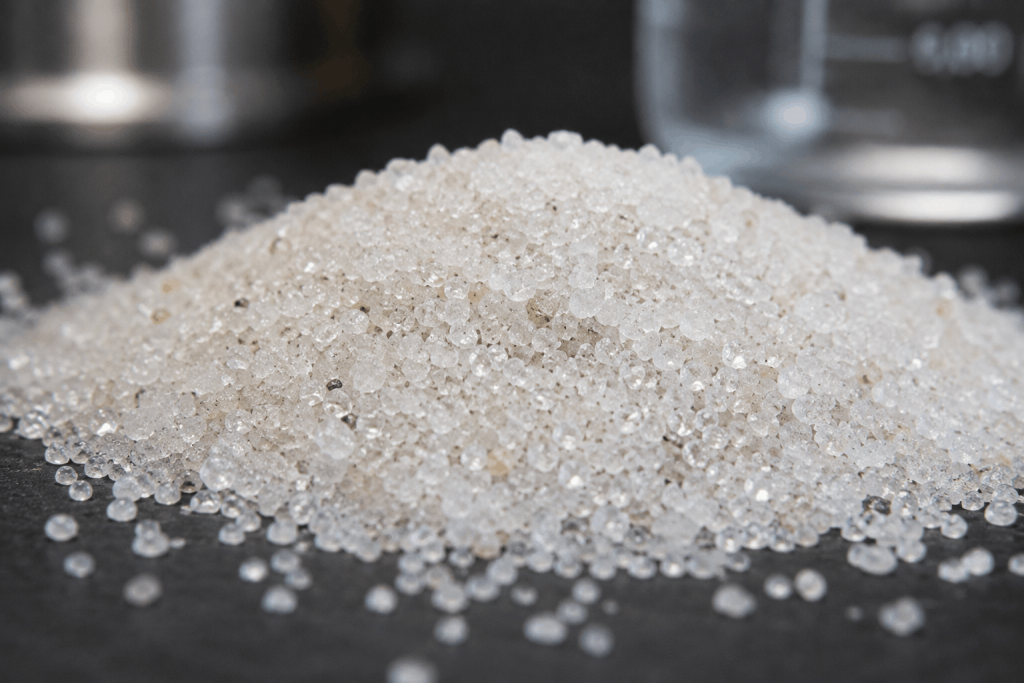
Silica sand is a granular material composed predominantly of quartz grains — crystalline silicon dioxide (SiO₂) formed through the weathering of quartz-rich rocks and their subsequent transport and deposition by rivers, wind, or ancient seas. Ordinary construction or river sand often contains a mix of quartz, feldspar, mica, clay, and other minerals, which limits its use to low-specification applications like masonry and filling.
Industrial-grade silica sand is different. It is defined by a narrower set of quality parameters:
- SiO₂ purity — typically 95–99.9% for industrial use, with glass-grade material often exceeding 99%
- Iron oxide (Fe₂O₃) content — kept as low as possible, since iron causes discoloration in glass and reduces refractory performance
- Grain size and grading (mesh size) — determines suitability for casting, filtration, or abrasive use
- Moisture content and mineral impurities — affect handling, processing cost, and end-product consistency
This distinction between ordinary sand and beneficiated, application-graded silica sand is why sourcing from established mineral-bearing regions — and from suppliers who process and test their material — matters for industrial buyers.
Top Silica Sand Producing States in India
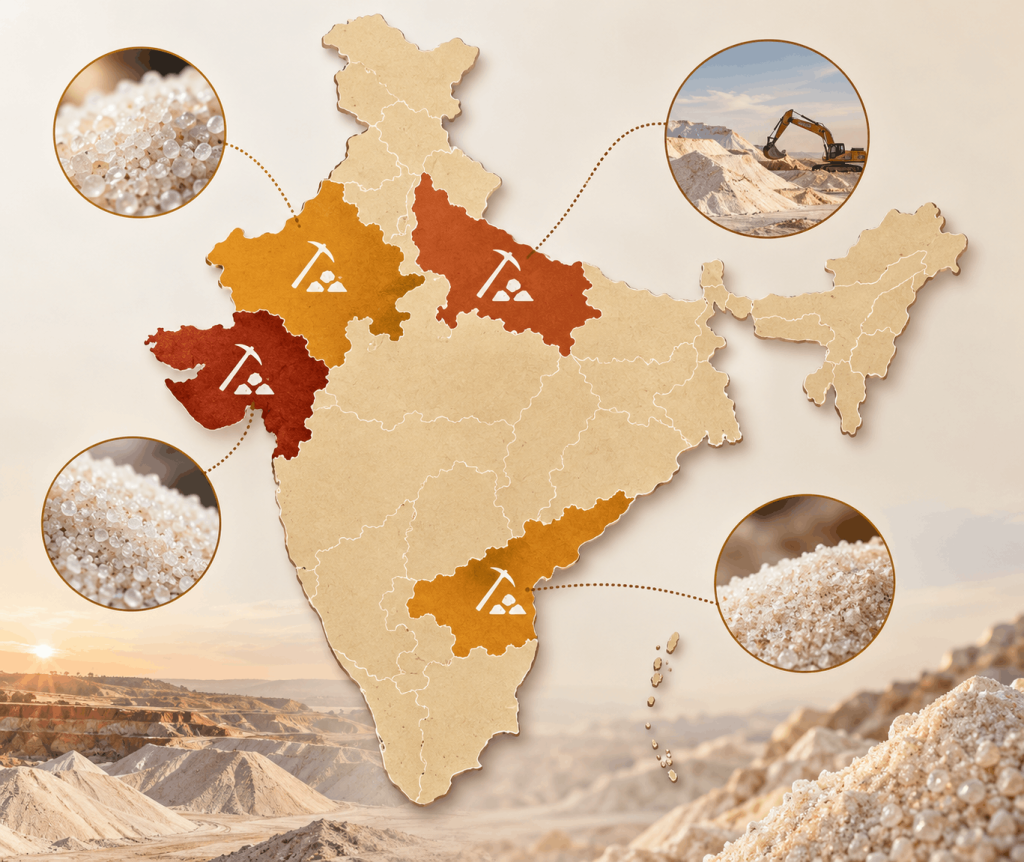
According to IBM’s National Mineral Inventory, silica sand and quartz reserves/resources are distributed across several states, though the largest bulk resource base (accounting for over 40% of the national total under the combined “quartz and silica sand” category) lies in Haryana, followed by Rajasthan. However, active mining, glass-grade beneficiation, and export-oriented supply are concentrated in a different, more industrially active set of states. It’s worth noting that because silica sand is classified as a “minor mineral,” state-wise production is reported directly to state Directorates of Mining and Geology rather than centrally, so consistent year-on-year figures for every state are not always available — a limitation IBM itself flags in its yearbooks.
Rajasthan
Rajasthan is among the most industrially active silica sand and quartz-producing states, with mining concentrated in the Thar Desert belt around Jodhpur, Bikaner, and Jaisalmer, alongside quartz workings in other districts. IBM production data for 2021–22 recorded roughly 1.9 million tonnes of silica sand output from the state, alongside significant quartz production. Rajasthan’s silica sand serves foundry, ceramics, and construction-material buyers across northern and western India, and the state also holds the second-largest share of the country’s reserve base after Haryana.
Gujarat
Gujarat is a long-established silica sand hub, with the state’s Commissioner of Geology and Mining placing the state’s inferred silica sand reserves at nearly 984 million tonnes and Gujarat’s share of national production at around 12%. Key mining centers are spread across Bharuch district (Amod, Bhimpur, Rajpardi) and Kachchh district (Anjar), along with Himatnagar. Gujarat’s proximity to ceramic clusters like Morbi and its port infrastructure make it a significant supply base for both domestic ceramic manufacturers and export-oriented buyers.
Andhra Pradesh
Andhra Pradesh’s Nellore district, particularly the Gudur belt, hosts some of India’s best-documented glass-grade silica sand deposits — marine dune sands spread over roughly 110 sq. km, with geological studies estimating well over 100 million tonnes already extracted historically and substantial reserves remaining. IBM production data shows Andhra Pradesh among the leading silica-sand-producing states in recent reporting years, supplying glass manufacturing and foundry industries in South India.
Telangana
Telangana, carved from undivided Andhra Pradesh, continues to report meaningful quartz and silica mineral production, with mining activity around Hyderabad and Mahbubnagar. The region supplies foundry and ferro-alloy industries and benefits from established mineral-processing infrastructure inherited from the undivided state.
Karnataka
Karnataka holds quartz and silica sand reserves distributed across several districts and reports periodic production, primarily feeding foundry, ceramics, and construction-materials demand within the state and neighboring Tamil Nadu.
Tamil Nadu
Tamil Nadu holds a notable share of national silica mineral resources — around 201 million tonnes per IBM’s reserve estimates — supporting the state’s large ceramics, glass, and foundry manufacturing base, particularly around industrial clusters in the northern and western parts of the state.
Uttar Pradesh
Uttar Pradesh is home to one of India’s most quality-recognized silica sand deposits: the Naini area in the Prayagraj (formerly Allahabad) district, which IBM records as producing very high-quality silica sand. The state’s strategic importance was underscored when NMDC took over a silica sand mining and beneficiation project from the Uttar Pradesh State Mineral Development Corporation, designed to produce beneficiated high-purity silica sand at a capacity of 300,000 tonnes per year for float and sheet glass manufacturing.
Other Notable Resource-Bearing States
IBM reserve data also identifies substantial silica mineral resources in Haryana, Maharashtra, Jharkhand, and Kerala. Haryana’s resource base is the largest in the country by tonnage, though it is concentrated in quartzite and lower-grade categories rather than beneficiated glass-grade sand. Maharashtra and Kerala contribute meaningfully to foundry and ceramic-grade supply, while occurrences are also documented in Bihar, Madhya Pradesh, Punjab, and Delhi.
Comparison of Major Silica Sand Producing States
| State | Major Production Areas | Key Characteristics | Major Industrial Applications |
| Rajasthan | Jodhpur, Bikaner, Jaisalmer | Large, consistent volumes; second-largest national reserve base | Foundry, construction, ceramics |
| Gujarat | Bharuch (Amod, Rajpardi), Kachchh (Anjar) | ~12% of national production; strong processing/export infrastructure | Ceramics, glass, construction |
| Andhra Pradesh | Nellore (Gudur belt) | High-purity marine dune deposits; well-documented glass-grade reserves | Glass manufacturing, foundry |
| Telangana | Hyderabad, Mahbubnagar | Established mineral-processing base from undivided AP | Foundry, ferro-alloys |
| Uttar Pradesh | Naini (Prayagraj) | Recognized for very high quality; NMDC beneficiation project (300,000 TPA) | Float/sheet glass |
| Karnataka | Multiple districts | Moderate reserve base; regional supply | Foundry, ceramics, construction |
| Tamil Nadu | Northern & western districts | ~201 million tonnes in reserves | Ceramics, glass, foundry |
Industrial Applications of Silica Sand
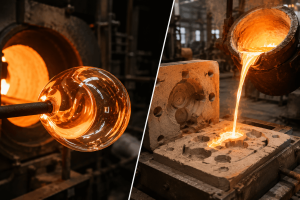
Silica sand’s uses vary sharply with purity and grain characteristics:
- Glass manufacturing — the largest end use; requires low-iron, high-SiO₂ sand for clarity in float glass, container glass, and specialty glass
- Foundry and metal casting — used as moulding and core sand due to its high melting point and dimensional stability
- Ceramics and tiles — a key raw material for glazes, sanitaryware, and tile bodies, especially around clusters like Morbi
- Construction materials — used in concrete, plaster, and specialty construction products
- Water filtration — graded silica sand is a standard filter medium in municipal and industrial water treatment
- Refractories — high-purity silica is used in furnace linings and refractory bricks that must withstand extreme heat
- Chemicals and other industrial uses — including as a raw material for sodium silicate, and as proppant in oil and gas well-completion applications
Each of these industries has distinct purity, grain-size, and iron-content thresholds, which is why sourcing decisions are rarely just about finding “silica sand” — they’re about finding sand matched to a specific process.
How to Choose the Right Silica Sand Supplier
For procurement and technical teams, selecting a silica sand supplier involves more than price comparison. Key considerations include:
- SiO₂ purity — verified against application-specific thresholds (e.g., 99%+ for premium glass sand)
- Iron content (Fe₂O₃) — critical for glass clarity and refractory performance
- Grain size and mesh distribution — must match the process, whether foundry moulding, filtration, or glass batching
- Moisture content — affects handling, transport cost, and downstream processing
- Consistency of supply — batch-to-batch uniformity matters more to industrial buyers than a single good sample
- Processing capabilities — washing, drying, grading, and beneficiation infrastructure at the supplier’s end
- Bulk supply capacity — the ability to meet recurring, large-volume orders reliably
- Testing and quality control — access to lab reports (SiO₂%, Fe₂O₃%, moisture, sieve analysis) for every batch
- Application-specific specifications — a supplier’s ability to customize grading for glass, foundry, ceramic, or construction use cases
For industries where mineral consistency, particle size, and chemical composition directly affect production quality, working with an experienced supplier such as Pratibha Refractory Minerals can help buyers source material tested and graded to their specific industrial requirements, rather than relying on generic, unverified stock.
Future Outlook
Demand for silica-based industrial minerals in India is expected to keep growing, driven by expansion in the glass, construction, and ceramics manufacturing sectors, along with rising domestic and export demand for high-purity, application-specific silica sand. Sectors like solar glass, specialty glass, and water treatment are adding new, tighter-spec demand on top of traditional foundry and construction use. At the same time, environmental and regulatory scrutiny of mining — including sustainable extraction practices and rehabilitation of mined areas — is becoming a bigger factor in how buyers evaluate long-term suppliers, not just producers with the lowest price per tonne.
Conclusion
India’s silica sand resource base — spread across Rajasthan, Gujarat, Andhra Pradesh, Telangana, Uttar Pradesh, Karnataka, Tamil Nadu, and several other states — gives industrial buyers a genuinely diverse sourcing landscape, but geography alone doesn’t guarantee fitness for purpose. The right choice depends on matching a deposit’s purity, grain characteristics, and processing quality to the specific demands of glass, foundry, ceramic, or construction applications. For buyers evaluating options, established, quality-focused suppliers such as Pratibha Refractory Minerals offer a way to navigate that variability with tested, application-graded material rather than guesswork.
FAQ
Which state produces the most silica sand in India?
Production is reported unevenly since silica sand is classified as a minor mineral, but Rajasthan, Andhra Pradesh, and Gujarat are consistently among the states with the highest recorded production and processing activity, based on available IBM and state mining department data.
Where is high-quality silica sand found in India?
Notable high-purity deposits include the Naini area in Uttar Pradesh’s Prayagraj district and the Nellore (Gudur) belt in Andhra Pradesh, both recognized for glass-grade quality.
What industries use silica sand?
Glass manufacturing, foundry and metal casting, ceramics and tiles, construction materials, water filtration, refractories, and chemical manufacturing are the primary industrial users.
How is industrial silica sand different from regular sand?
Industrial-grade silica sand has significantly higher SiO₂ purity, lower iron and impurity content, and controlled, consistent grain sizing — attributes ordinary construction or river sand does not reliably offer.
What should buyers check before purchasing silica sand?
Buyers should verify SiO₂ purity, iron oxide content, grain size/mesh distribution, moisture content, and request batch-level lab test reports, while also assessing a supplier’s processing capability and ability to deliver consistent bulk volumes.